
Tagalog Plays Return to San Francisco
/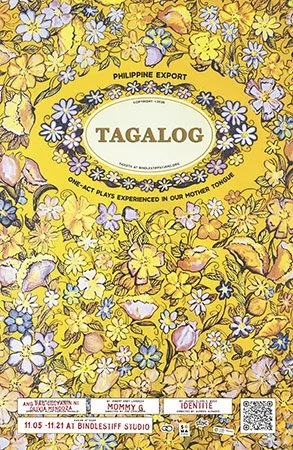
A culturally evocative poster of Tagalog 2026 designed by mumu.
Co-produced by Lorna Velasco and Allan “Samson” Manalo, the fifth iteration of Tagalog features three plays: Ang Pag-Uulyanin Ni Olivia Mendoza (The Forgetting of Olivia Mendoza), written by Rolin Cadallo Obina and directed by Allan “Samson” Manalo; Mommy G, written by Jobert Grey Landeza and directed by Joe Cascasan; and Identité, written by Jhudiel Clara D. Sosa and directed by Aureen Almario.
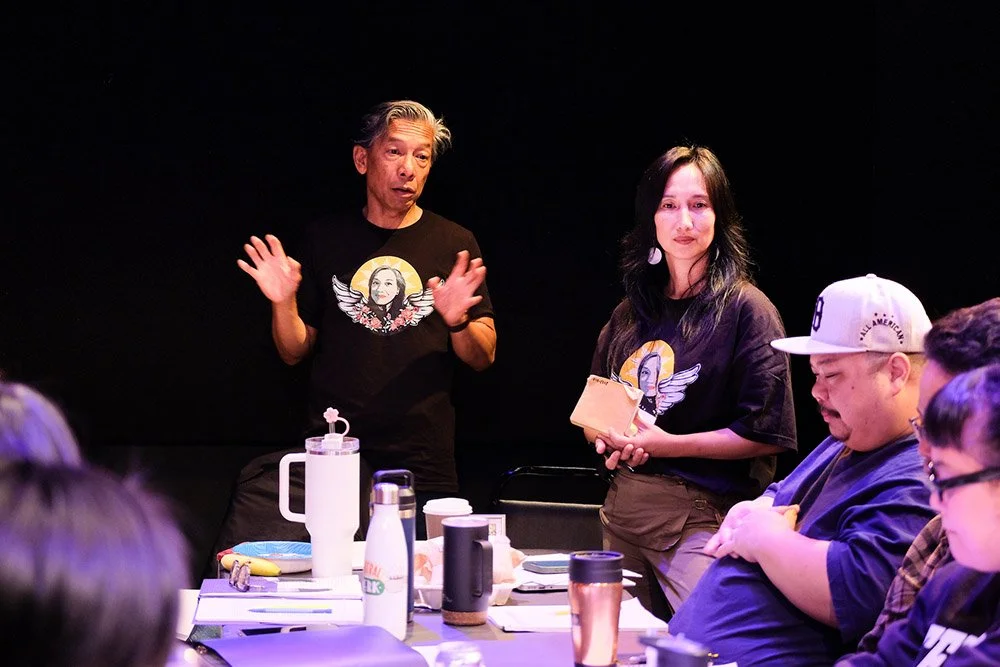
Tagalog 2026 co-producer and director Allan “Samson” Manalo and producer Lorna Velasco at a pre-production table read at Bindlestiff Studio (Photo by Paciano Triunfo)
Tagalog 2026 honors its co-creator Joyce Juan-Manalo, a beloved member of the SOMA Pilipinas community, theater artist, producer, and designer. Along with her husband, Allan Manalo, Joyce took over and ran Bindlestiff Studio, transforming it into an epicenter of Filipino American performing arts.
The fifth production was already in the works following the 2019 staging when Joyce came across Ang Pag-Uulyanin Ni Olivia Mendoza. “When she read it, she even saw a video of the original production of it, she really loved it, she cried, she said, ‘This is such a beautiful story,’” recalls Manalo. “I just remember her sitting on the couch telling me how she was excited about it for the next Tagalog.”
Joyce passed away in 2023. Tagalog 2026 now represents the culmination of that work and a continuation of her legacy.
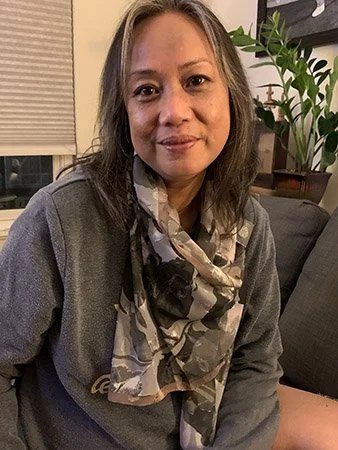
Joyce Juan-Manalo (Photo by Allan “Samson” Manalo)
Honoring Joyce
“In the creation of this series, we really wanted to honor Joyce, honor her legacy, and make sure that we're able to mount her dream play [Ang Pag-Uulyanin Ni Olivia Mendoza],” says Velasco.
In keeping with that tribute, the plays selected for Tagalog 2026 intentionally focus on women's stories.
“Knowing Joyce, this is exactly what she would have wanted. I think all three plays hit on the theme that she would just love,” says Manalo.
“It's very deep, it's very nuanced. People, hopefully, will come out of it with a better understanding of their moms, their sisters, their daughters,” says Velasco.
Ang Pag-Uulyanin Ni Olivia Mendoza centers on a woman in her 70s living with dementia who is gradually forgetting who she was. “Because of that, the friction in terms of her identity, her sexual identity, her gender identity comes into play,” Velasco explains. “And then what does family mean? What does that mean now for this woman who is at the very end of her life? Who is her family now? What does love mean? And is it enough for people to stay?”
Mommy G explores love through the life of a 65-year-old woman. “Where does she find independence and choice and pleasure and joy? Having supported and taken care of a family, when is it her turn to find love for herself?”
Identité examines the relationship between a Gen X mother and her Gen Z daughter, exploring their differing expectations of womanhood, personal choice, joy, and pleasure. “That plays into expectations around womanhood, expectations around choice, expectations around joy and pleasure, what it means for a Gen X mom and what it means for a Gen Z daughter at this point in time, and coming from the province to Manila,” says Velasco.
The mother and daughter must also confront competing values and expectations. “So there's that system as well that they're playing against each other: whose values, whose needs, needs to be met? And is this something where people can meet in the middle or needs to be accepted, regardless, because of the absolute love between a mother and a daughter?”
The Cast
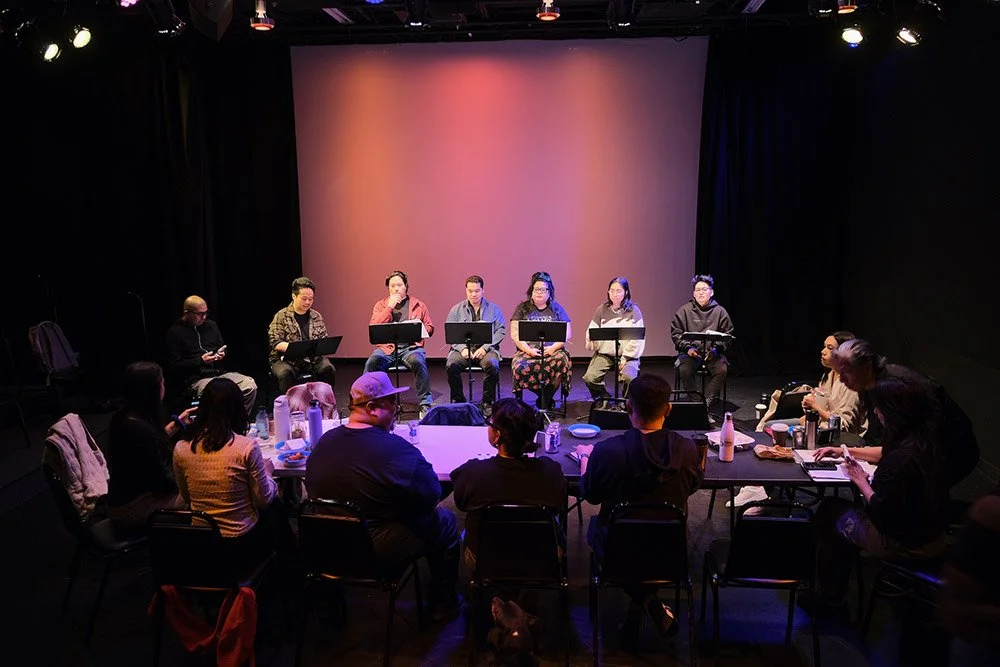
The cast and crew of Tagalog 2026 at a pre-production table read at Bindlestiff Studio (Photo by Paciano Triunfo)
The cast of Tagalog 2026 features Trixia Apiado, Paolo Asuncion, Raphael Louis Buenaventura, Jay Bordon, Nic Feliciano, Eve Ganderosa, Nix Guirre, Boni Juan, Archie Lacanilao, Faye Lacanilao, Samantha de la Serna, Nikki Santiago, and Patrick Silvestre.
Two cast members are children of Filipino film actors: Jay Bordon, whose mother is Filipina film actress Janet Bordon, and Paolo Asuncion, son of Filipino film actor Vic Vargas. Asuncion makes his theater acting debut in this production. Boni Juan, Joyce Juan-Manalo's brother and the production's set designer, also makes his Filipino American theater acting debut.
Tagalog was the brainchild of the late Joyce Juan-Manalo and Lorna Velasco. The idea took root when the two worked together on A Pinoy Midsummer (2012), an adaptation of A Midsummer Night's Dream directed by Velasco, with Juan-Manalo serving as art director and creating props and costumes.
“She was my creative partner in a lot of the work that I did at Bindlestiff at that time,” recalls Velasco, who was then the studio's artistic director.
For the production, Velasco translated the script of the six characters comprising Shakespeare's Rude Mechanicals into Tagalog and had them perform without English supertitles. “The actors were speaking in Tagalog in contrast to Shakespearean English, but then the audience loved hearing Tagalog and were really eating it up, and it didn't matter whether they knew the language or not.”
Velasco and Juan-Manalo recognized this “hunger for Tagalog” and conceived the idea of bringing plays written in Tagalog in the Philippines to San Francisco.
Joyce subsequently introduced Velasco to Rody Vera, a Filipino playwright, theater actor, director, and co-founder of Virgin Labfest, the annual Philippine theater festival dedicated to staging “untried, untested, and unstaged one-act plays” at the Cultural Center of the Philippines (CCP).
Vera and Boni Juan, Joyce's brother, are prominent Philippine theater artists affiliated with the Philippine Educational Theater Association (PETA). Allan Manalo also knew Vera and had acted in two Virgin Labfest productions during its early years, when he and Joyce lived in the Philippines from 2003 to 2008.
“Rody curated the plays for us and said, here are a really strong plays that you should consider,” says Velasco. “We looked through it, we said yes to some, said no to some.”
Previous Productions
The first Tagalog production premiered in 2016, followed by a second iteration in 2017 and a third in 2019. The fourth, in 2021, became a virtual production during the COVID-19 pandemic and included an online playwriting workshop with Rody Vera.
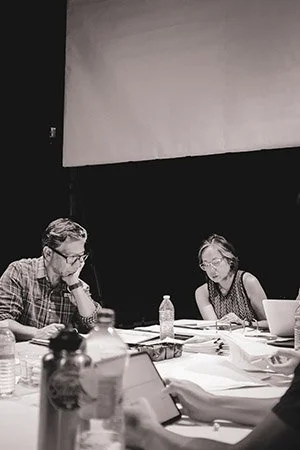
Allan “Samson” Manalo and Joyce Juan-Manalo working on Tagalog 2019 at Bindlestiff Studio (Photo Contributed)
Production went on hiatus following Joyce's death in 2023. In 2025, Velasco, Manalo, and several members of the Bindlestiff Studio crew, including artistic director Aureen Almario, traveled to the Philippines to attend Virgin Labfest at the CCP.
“It's a one-month festival, we were there for a week, and we tried as much as we can to watch all the plays,” says Velasco. “A few of us saw Mommy G, a few of us saw Identité, and so, I was like, ‘What would be a great way to compliment Olivia?’ These two other plays emerged in conversations with Allan and Aureen.”
Mounting Tagalog 2026 presented its share of challenges. One cast member of Identité could not participate in rehearsals until late in the production because of personal circumstances. Then, just two weeks before opening night, Manalo was scrambling to replace an actor in an essential role in Ang Pag-Uulyanin Ni Olivia Mendoza who abruptly left the production.
“We were about to rehearse and it was very upsetting because it was the first time, one of the rare times, that I had the whole cast together and we didn’t have a cast anymore,” Manalo recalls.
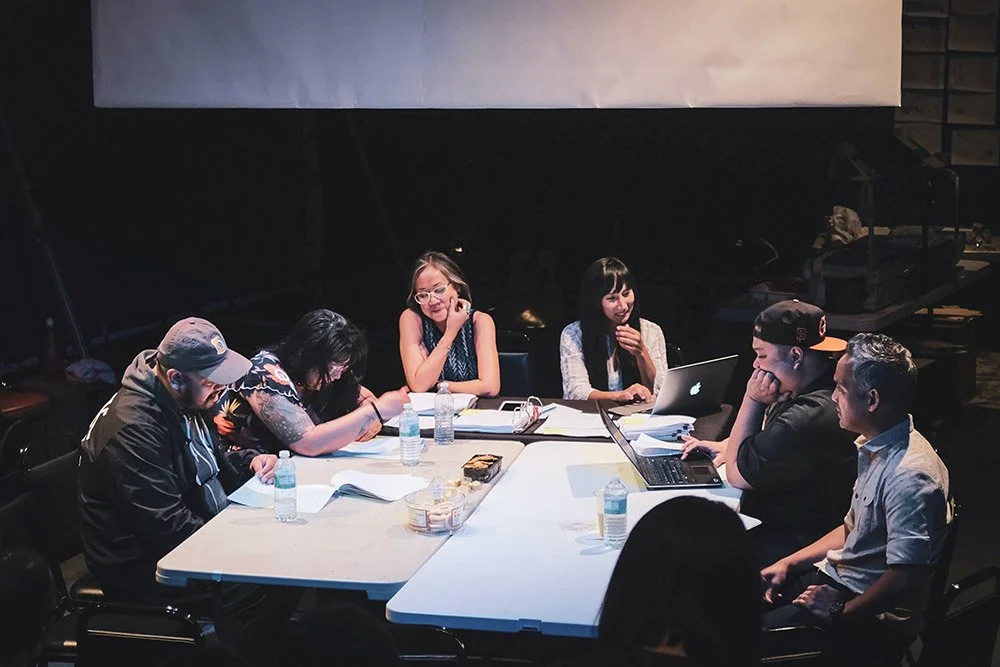
Joyce Juan-Manalo and Lorna Velasco with the cast of Tagalog 2019 at Bindelstiff Studio (Photo Contributed)
Last-Minute Replacement
To keep rehearsals going while searching for a last-minute replacement, Boni Juan stepped in temporarily to read for the role of Cesar, despite his primary responsibility as the production's set designer.
“He read well, and so the cast started saying, ‘Well, you know, why don’t you play Cesar?’” says Manalo.
Boni initially refused. But Manalo persisted, even invoking Joyce.
“We’re driving to the theater, and I said, ‘You know, Kuya Boni, Joyce would have loved it if you played Cesar.’ And he’s like, ‘Stop already, I don’t want to hear it.’”
Boni worried about memorizing the lines, although Manalo and the cast encouraged him. He continued rehearsing the role without committing to it, reasoning that he still had to finish building the set.
Meanwhile, Manalo and Velasco approached five other actors from their usual Tagalog pool and its extended circle. None was available.
Manalo made one final appeal. “I said, ‘You know, Kuya Boni, I’m channeling Joyce as the producer and the priority right now is we need you to play Cesar.’”
Boni finally agreed.
“I swear that the whole cast was just so giddy to have him on board,” says Manalo. “I told my family and now they’re super excited. There’s this new energy on top of Boni playing Cesar. His acting debut here in the United States.”
Lingua Franca
The Philippines has more than 180 languages. Tagalog, a regional language spoken as a second language by a majority of Filipinos, evolved into a postcolonial lingua franca across the archipelago and the diaspora. Its standardized form, known as Filipino and based primarily on Tagalog, is recognized as the Philippines' official national language.
As in previous productions, the Tagalog plays are presented with English supertitles.
Growing up Filipino American, Manalo heard his grandmother speak both Tagalog and Kapampangan. He eventually picked up some Tagalog from Joyce and from songs by the Filipino rock band the Eraserheads. His exposure to the language deepened when he lived in the Philippines and watched plays in Tagalog, experiencing their storytelling styles, subject matter, and treatment of everything from religion and sexuality to love.
“This particular Tagalog is to be able to experience all that. Not only experience it but really engage in it, because you’re able to see the translation live as it’s coming and, at the same time, hearing the way those words are expressed.”
For Manalo, realizing the production Joyce had envisioned is deeply personal. “It encompasses everything; her pride as a woman, her pride as a Filipina, and her pride in speaking the language.”
Velasco sees Tagalog 2026 as “a way to pay tribute to who we are being Filipinos in America. It’s a way to remember where we come from, how connected we are to each other, and to just enjoy being in a black box theater, enjoy really good storytelling.”
“Para kay Joyce (for Joyce),” they say in unison.
Tagalog 2026 runs November 5–21, 2026, Thursdays through Saturdays at 7:30 p.m., at Bindlestiff Studio, 185 6th St., San Francisco.
www.bindlestiffstudio.com / Box Office: (415) 796-3848. Tickets: $35 general admission, $25 students/seniors, and $50 to support the artists.
Tagalog 2026 is made possible with support from Bindlestiff Studio, the San Francisco Arts Commission, the Theatre Bay Area CA$H grant program, and SOMA Pilipinas Cultural District.
Wilfred Galila is a San Francisco Bay Area-based multimedia artist and writer.
More articles from Wilfred Galila
