

Nanay Seryang’s Folk Tales: Voices of Love
/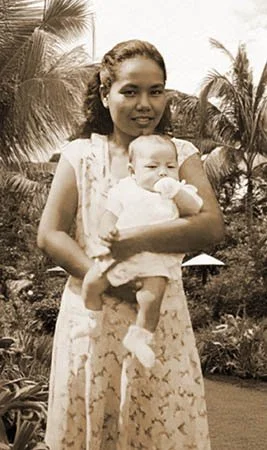
Nanette at three months with Nanay Seryang (Photo courtesy of Nanette Carreon-RUhter)
I remember that when I was five, she lay on the floor beside my bed each night, her voice rising through the shadows as she told me of the kapre who lived behind the great acacia tree outside our window. She would point to the drifting clouds and whisper, “See that? Smoke from his giant pipe.” And I, wide-eyed and willing, believed what I saw. “He’s waiting to catch little children who are not asleep yet,” she would warn in a half-playful, half-serious tone. I would pull the blanket over my head, safe beneath her stories.
Outside my grandmother’s house was a cement heart embossed on the ground. Nanay said a nuno sa punso lived there. To this day, I do not really know what a nuno is. The phrase literally means “ancestor of the mound,” but to us children, he was simply a friendly dwarf. Nanay warned us never to step on his home. If we did, we had to say, “Tabi-tabi po” (“Excuse me, may I pass?”), a small apology whispered to the unseen.
She told us of the manananggal, a self-severing, witch-like monster who hated the smell of garlic, and of the aswang, a witch who prowled after dusk. Her voice would drop to a hush when she said, “Don’t stay outside too late. She might find you.” And we, obedient and trembling, would huddle closer to the glow of her stories.
Sometimes, in an even softer tone, half prayer and half story, she spoke of the Diwata sang Bukid, the mountain spirit in flowing white robes. If we tended our garden well, Nanay said, the diwata would bless us. Her tales lulled me to sleep and opened the first pages of my imagination.
Her stories wove more than fear or wonder. They taught me to listen to voices beyond my own, to respect what I could not see, and to believe that kindness carried its own quiet power. Long before I could name what love was, I had already felt it in the way Nanay lived, in her hands that worked without complaint and in her eyes that watched over me as fiercely as any guardian spirit. She was, in her own way, the diwata who blessed my childhood.
Sometimes I watched Nanay wash clothes in the backyard, her arms strong and sure, the rhythm of rinsing and wringing like a song of endurance. She chewed betel nut, which stained her teeth a deep red, and she was proud of it, a small badge of habit and heritage. Her iron glided over our clothes with quiet mastery. She taught me to press collars first and to press hard enough to smooth the day’s wrinkles away.
From Nanay, I learned that love could live quietly in daily work, in the steady rhythm of hands that never rested, in the care folded into freshly pressed clothes, and in the patience that stitched order into every day. At night, her voice would soften into song. Her lullaby, “Ay, ay, kalisud, kalisud sang binayaan…”, an old Ilonggo love song, carried both sorrow and sweetness. I had memorized every word long before I understood its meaning. Perhaps that is how love begins, not in grand gestures, but in the music that lingers long after the singing stops.
Whenever Mama got mad at me for something I had done wrong, or sometimes had not done right, Nanay would take me aside, wrap me in her arms, and gently explain why Mama had reason to be angry. When my parents quarreled, their voices rising like thunder through the house, Nanay would whisk me away to the servants’ quarters and distract me with a game of sungka, a traditional shell game.
Those moments came too often. One night, my grandmother arrived and spoke to my parents behind closed doors. I hovered nearby, my heart pounding, sensing something I could not name. Through the thin wooden walls, I heard her say that it was best for them to part ways.
Before my tears could blur my sight, Nanay pulled me close, wiped them dry, and whispered, “Akon’g palangga…”, my darling girl. Then she took my hand and led me to the corner store to buy hopia, my favorite treat. In her embrace, I felt protected and loved, sheltered from the storm.
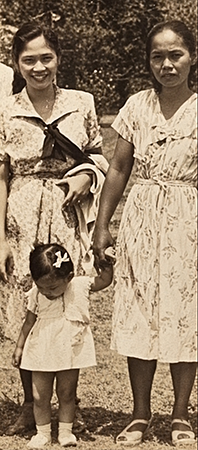
With Nanette’s mother and Nanay Seryang holding her, at two years (Photo courtesy of Nanette Carreon-RUhter)
Looking back now, I realize that Nanay gave me more than comfort. She taught me what love looks like when it has no words, how it can steady a frightened child and hold space for peace when the world turns loud. In her arms, I first understood what safety felt like, a stillness that needed no promises, only presence.
Even now, when life grows uncertain, I return in memory to that small, heart-shaped mound outside my grandmother’s house, to the scent of hopia still warm in my hands, and to Nanay’s tight hold, my tiny hand disappearing in hers as she assured me that life was good and that God would always be beside me.
Nanay’s presence stretched across generations and seasons of my life. She stayed with our family long after I had children of my own. When I had outgrown the need for a nanny, she cared for my youngest brother, Butch. She became our mama when our real mother went to Spain to complete her doctorate in Spanish philology.
In Mama’s absence, it was Nanay who stood beside me through my quiet milestones. She was there the day I first had my period, teaching me a folk ritual I still remember. “Jump several times so you’ll grow tall.” Then, with gentle seriousness, she told me what it meant to be a lady.
Nanay was still part of our family when I began dating in college. In the 1960s, reserved families did not allow unmarried girls to attend dances without chaperones. She became my official chaperone and my unofficial commentator. She had strong opinions about the boys I dated and clear preferences about who deserved my time. When I broke up with Eddie, who would later become my first husband, and began seeing someone new, she refused to chaperone me.
During those years, she formed her own circle of friends among my classmates’ yayas, a lively community of women who waited in the “chaperones’ room,” trading stories and laughter about their alaga, whose virtues and mischief they compared with equal pride.
In later years, my grandmother employed Nanay as her mayordoma, the one who oversaw the household and supervised the other household help. She became my grandmother’s sous-chef and, without meaning to, my second cooking instructor. Nanay would secretly save a few Spanish olives for me, my favorite treat, much to my grandmother’s mild annoyance, since they were imported and pricey.
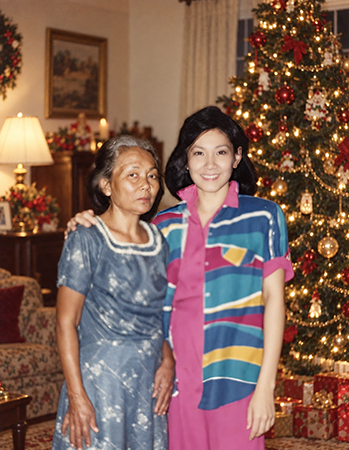
Nanay and Nanette In the early 80’s when Nanette visited home from Hong Kong
When my husband was assigned to Hong Kong in 1979, I had to say goodbye to my Nanay. When I took my boys to bid farewell at my grandmother’s house, I slipped into the kitchen while my cousins captured the moment in the living room. Nanay Seryang was diligently preparing lunch for us.
As I rushed to embrace her, she gently pushed me away and said, “No, I smell like garlic, and it will be all over you,” as if I had any qualms about it! I refused to let her go and tightened my embrace.
“Nay, you know that if you were younger and stronger, I would have taken you with us,” I said, our eyes misty with emotion.
“Ay sus, akon’g palangga, nagalakat ka na gali. Ma-miss gid taka.” “Oh, my darling, you are leaving already. I will miss you so much.”
She must have taken a quick shower while we ate because, when it was time to leave, she stood in line to give us her final embrace. I could feel her heartbeat as hot tears dotted my shoulder.
Knowing that we would return home every Christmas helped ease the pain a little. For several years, I made sure to bring her pasalubong, a small gift from our travels, each time we came back.
Then one day, Mama told me that Nanay had returned to Iloilo for good. Her eyesight was failing, and she wanted to rest. I was deeply saddened. I never had the chance to speak to her again or to write to her daughter in Iloilo, in the Visayas. Nanay could neither read nor write, and mail rarely reached her remote barrio. The distance between Hong Kong and the Visayas felt wider than oceans.
I never learned how Nanay passed away. Sometimes my soul still cries because I did not fly to wherever she was and give her one last embrace. I wonder if she was cared for in her old age, if she ever thought I had forgotten her, and if she, too, had longed for me. The unanswered questions remain, like stories interrupted before their final lines.
Long before I could name what love was, I had already felt it in the way Nanay lived.
Yet Nanay’s voice has never truly left me. I hear it in the hush before a story begins, in the rhythm of a sentence, and in the silence that follows a word spoken with love. She taught me that stories can shelter us from fear, preserve what distance threatens to erase, and carry the presence of someone we have lost. Though she could neither read nor write, she gave me the first language of my heart, a language made of memory, tenderness and imagination.
For forty-four years, I have taught English and literature, often telling my students that my first teacher was Nanay Seryang. She taught me beneath the shadows of childhood, with folk tales, lullabies, warnings and whispered endearments. Every story I read, teach, or write is, in some way, an answer to the stories she gave me. Through literature, I keep her voice alive, and through that voice, the woman who could not write her own stories continues to shape mine.
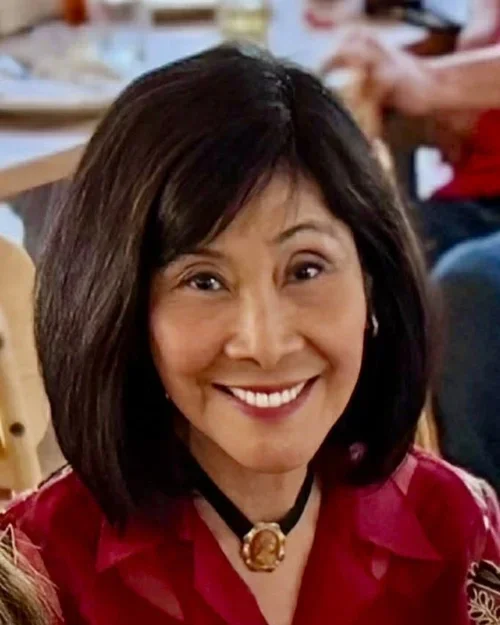
Nanette Carreon‑Ruhter stands as a Honolulu‑based writer shaped by years in international classrooms and a deep devotion to Filipino stories. She previously taught at Hong Kong International School, Taipei American School, and Singapore American School, and has guided creative writing workshops for Filipino immigrants throughout Hawaii. Her essays explore family, identity, and the ways memory becomes a home that travels across generations. She is finishing her memoir, Before Time Slips Away, written for her seven grandchildren. When she’s not writing, she’s on the pickleball court, in the kitchen, traveling with family, keeping close ties with friends and former students around the world, and enjoying life with her husband, Jim.
More articles from Nanette Carreon-Ruhter
