
Capsule Living in Dubai: OFWs and the Price of Proximity
/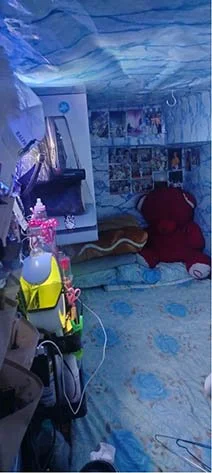
Inside Joyah’s blue-toned capsule room in Dubai, a neat, well-lit space holds only what she needs to rest. Family photos on the wall bring home closer, turning a small private space into something personal and grounding. (Photo by Joyah)
Rented monthly, furnished minimally, and designed for efficiency, capsule rooms are not about comfort. They are about survival. As rents rise and commutes grow longer, living small has become a deliberate choice for OFWs who want to stay close to work, control expenses, and continue supporting families back home. In one of the world’s most expensive cities, the meaning of home is quietly being reshaped.
Why Capsule Living
Dubai’s major job hubs—Deira, Bur Dubai, Business Bay, Dubai Marina, and Al Quoz—are where work is concentrated and rent is highest. For OFWs earning modest salaries, even a shared room near the city center can take up a significant portion of monthly income.
Cheaper housing farther away in places like Sharjah or Ajman comes with long daily commutes that drain time, energy and money. For many workers, the savings from lower rent are outweighed by exhaustion and the loss of rest after extended shifts.
For this reason, proximity matters more than space. A small private room close to work means more sleep, fewer daily expenses and a predictable routine. Capsule rooms emerged as a practical compromise—minimal personal space in exchange for affordability and location. Choosing a capsule is not about comfort, but strategy. As Faisa shared, “If you work in the city and do not earn much, you choose to save, because every dirham counts.”
Who Chooses Capsule Living

Faisa sits inside her butterfly-accented, pink-toned capsule in Dubai, posing for a quick selfie in a neatly kept softly lit space. Within the compact room, personal touches and color bring warmth and personality to an otherwise minimal living space. (Photo by Faisa)
Capsule living is most common among OFWs who are living alone in Dubai. Many residents do not have immediate family members working in the city. For solo workers, renting a capsule makes financial sense.
Those with family members in Dubai often choose larger rooms, shared flats, or villas where rent is divided among relatives. Cooking becomes a daily routine in these households, significantly lowering food expenses. In contrast, capsule residents are usually single occupants who prioritize location over space and accept higher food costs in exchange for lower rent and shorter commutes.
Capsule residents represent OFWs who make conscious trade-offs to keep their overseas employment sustainable—choosing proximity, affordability, and time over comfort and space.
Life Inside a Capsule Room

Faisa lies comfortably inside her capsule in Dubai, resting in a quiet moment of privacy. In the soft, enclosed space, she relaxes and unwinds, finding comfort in her own small corner away from the demands of the day. (Photo by Faisa)
Inside a capsule, a bed fills most of the space. There is just enough room to sit up and store a small suitcase or folded clothes. Proper lighting, air-conditioning and ventilation make the room liveable in Dubai’s climate. A solid door, often with a lock, separates one tenant from another. That door matters. It offers security and a sense of ownership, even within a very small space.
Privacy, however, comes with discipline. Noise travels easily through thin walls, and many residents work different shifts. Calls to family in the Philippines are usually made in the kitchen or on the terrace. Movies are watched with headphones, and even small movements require care to avoid disturbing neighbours.
Bathrooms, kitchens and laundry areas are shared. Schedules are followed closely. Missing a shower or laundry slot may mean waiting until later in the day or another week. The kitchen is largely functional. Many residents eat out on workdays, relying on nearby Filipino restaurants. Cooking is usually done on weekends, with viands prepared in batches and stored in shared refrigerators.
There are clear physical limits to capsule living. You cannot stand up inside. Belongings must be reduced to essentials, and storage is minimal. Before sending a balikbayan box, the folded cardboard is often kept inside the capsule while items are collected over time. On packing day, the box is unfolded in the kitchen or hallway and sent out the same day so it does not block shared spaces.
Beyond physical constraints lies a quieter challenge: confinement. Capsules offer privacy, but within a space that allows only sitting or lying down. Adjusting to stillness, learning to live within limits, and respecting the rhythms of others become part of daily life.
Coping and Adaptation
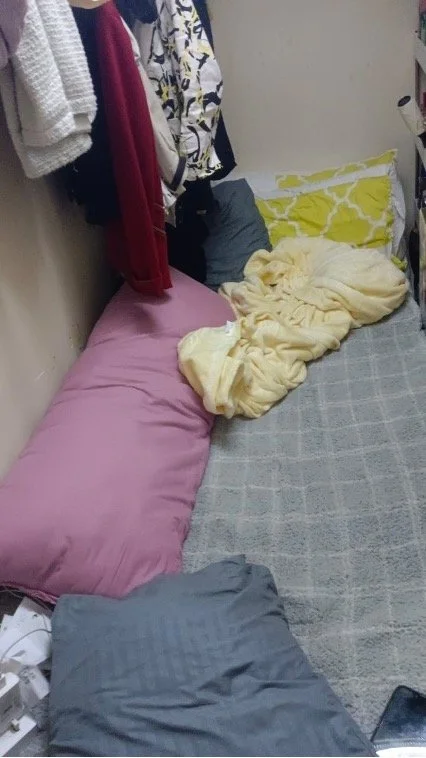
Flor’s capsule in Dubai reflects her choice of privacy over space, a small but personal room closer to work instead of a larger place far away. In this compact setting, she finds rest and routine, valuing time and convenience over size. (Photo by Flor)
Inside the capsule, personalization is subtle. A family photo taped to the wall. A small shelf for essentials. Preferred lighting that softens the narrow space. Cleanliness becomes a form of care. As Joyah shared, “I clean it every day and try to make it look nice, even though it’s just a small room.”
Much of life happens outside the capsule. Long work hours and side jobs mean the room is mainly a place to sleep. Meals and breaks extend into the neighbourhood. Cafes, Filipino restaurants, parks, and public beaches become extensions of daily living.
Sundays are often devoted to church services or Bible study, sometimes hosted in Filipino family homes. Weekends may include karaoke with friends, or camping trips. Movement, shared company, and open spaces balance the confinement of the weekdays.
Community also exists within capsule residences. Shared living requires respect, quiet hours and cooperation. Flor, who chose capsule living to rest properly, noted, “The hardest part is getting along with the people you live with.”
Becoming Normal in Dubai
What was once seen as unconventional has become part of Dubai’s housing reality. Capsule living is no longer limited to tourists. It is now used by service workers, office staff, and professionals who prioritize location and cost over space.
As demand has grown, these accommodations have become more regulated and standardized. While quality varies, capsule living is now a recognized response to the needs of a diverse migrant workforce.
Inside a capsule, a bed fills most of the space. There is just enough room to sit up and store a small suitcase or folded clothes.
Capsule living is often described by size, but its meaning runs deeper.
In these small rooms, priorities become clear. Comfort is measured by rest, not luxury. Privacy is valued as recovery. A capsule may not allow one to stand, but it offers safety, quiet, and sleep.
Here, home is redefined. It is not measured in square meters, but in purpose. Temporary, imperfect, and deeply intentional.
At the end of the day, an OFW closes a small door in the heart of Dubai. Inside, there is little room to move, but enough space to rest, plan, and dream. In that narrow room, sacrifices live alongside hope. And for now, that is home.

Michael Lucero is a Filipino civil engineer from Palawan who has been working as an OFW in the Middle East since 2006 and is currently based in Dubai, UAE. He writes narrative stories and blogs on Filipino life abroad, craftsmanship, and the quiet intersections of engineering, music, and everyday survival far from home, including guitar-related writing at jmjguitars.com.
More articles from Michael G. Lucero
