
Keka Enriquez’s Return to the Paintbrush
/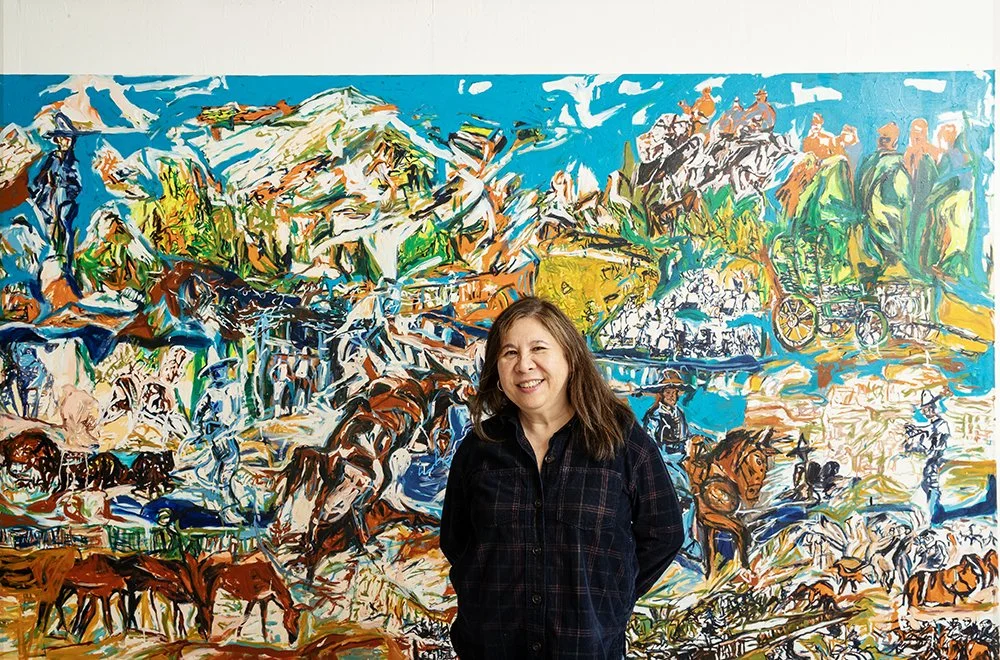
Keka Enriquez (Photo by Luke Abiol, courtesy of BAMPFA)
“I remember thinking ‘I’ve painted enough. I’m tired. I’m going to take a rest,’” Enriquez recalls. “I didn’t think it was going to be a twenty-year rest, to the point that I really didn’t imagine myself going back to it.”
The rest is over. Over the past two years, Enriquez has finally returned to painting, and now she’s preparing for her first solo exhibition at a U.S. museum. On December 2, the Berkeley Art Museum and Pacific Film Archive will open MATRIX 290 / Keka Enriquez: History Painting showcasing eight new Enriquez paintings as part of its signature contemporary art series MATRIX. Curated by Victoria Sung, the exhibition marks Enriquez’s long-awaited return, while also revealing how profoundly her practice has changed over time.
Enriquez launched her early career as a painter while she was an undergraduate at the University of the Philippines, where she studied under Roberto Chabet, a foundational figure in Filipino conceptual art. Chabet introduced his students to contemporary Western artists through U.S. magazines such as Artforum and ARTnews. Enriquez particularly gravitated toward the expressive brushwork of artists like Jean-Michel Basquiat and Julian Schnabel, while she and her friends embraced the rebellious spirit of punk rock and New Wave music.
“We were like a gang,” she says. “We would sit on the library steps with beer in our hands, pretending we were punk rockers.”
By her third year in college, Enriquez was exhibiting at Manila’s Finale Art File gallery where her first solo exhibition sold out to great acclaim. She went on to exhibit internationally and to win the Thirteen Artists Award from the Cultural Center of the Philippines, one of the most prestigious national awards given to Filipino artists.
Restless
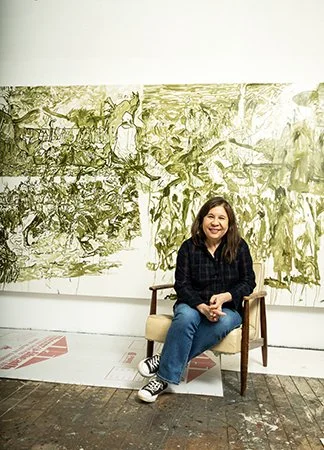
Keka Enriquez (Photo by Luke Abiol, courtesy of BAMPFA)
But amid her early professional success, Enriquez felt a growing restlessness, a desire to see the world that eventually led her to move to the United States in 1998. She settled in San Francisco, where she hoped to continue her life as a working artist. But financial realities led her to take odd jobs in retail and coffee shops, until she eventually pivoted to a new career as a recreational therapist for San Francisco General Hospital. As she adjusted to marriage, professional transition and life in a new country, painting eventually receded from her daily life.
The invitation that brought Enriquez back to painting arrived in 2023, when a close friend encouraged her to contribute two paintings to a group exhibition back home in Manila. Her initial response was emphatic.
“‘I’m done with art. I’m really, really done with art. I don’t miss it,’” she recalls saying. “I really didn’t think I needed this in my life anymore.”
Return to the Studio
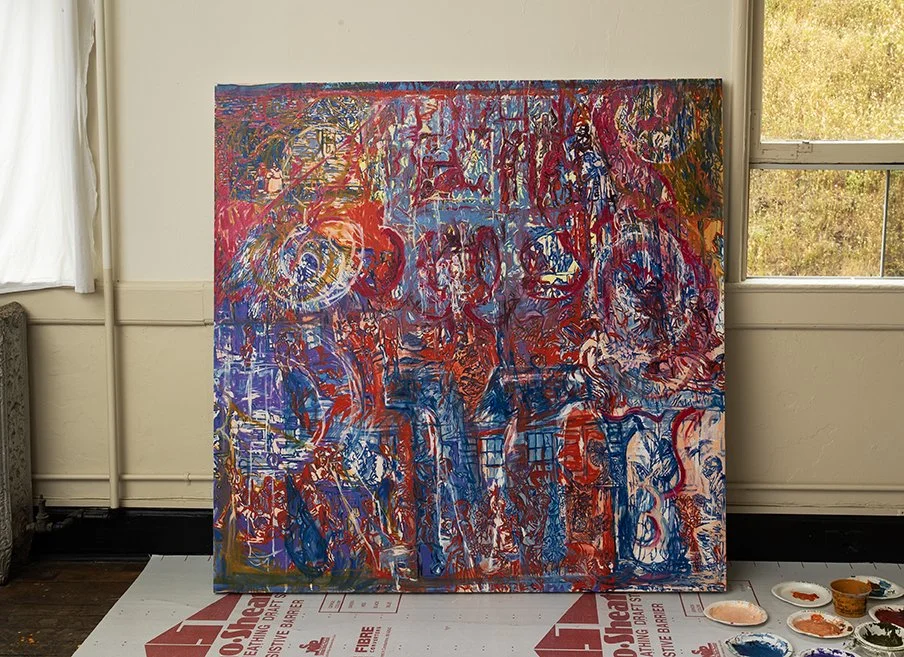
Keka Enriquez’s studio at Headlands Center for the Arts, Sausalito, California (Photo by Luke Abiol, courtesy of BAMPFA)
Enriquez eventually softened to the notion of contributing work to the Manila exhibition, and once she returned to the studio she found her artistic passion suddenly renewed. She soon secured representation with the prestigious gallery Silverlens, whose representatives had continued to express interest in her work during the hiatus. New exhibitions and art fair presentations followed, although she was careful about the pace. (“I didn’t want to burn out again,” she explains.)
Enriquez’s exhibition at BAMPFA offered an opportunity to develop this renewed practice on a larger scale. In partnership with the museum, Headlands Center for the Arts hosted Enriquez for a two-month residency on their Marin County campus earlier this year, giving her time and space to work beyond the one-bedroom apartment in San Francisco’s Tenderloin District that had doubled as her painting studio.
“I always thought I was a city girl until I stayed [at the Headlands],” says Enriquez, who found herself captivated by the coyotes, owls and other wildlife in the foggy coastal outpost of West Marin. “I was able to really focus on the works for BAMPFA because of the silence, no distraction. I would just go to my studio at three in the morning and paint.”
The open landscape also helped shape a body of work markedly different from the interior paintings that had established her reputation. Those earlier paintings were often inspired by photographs of beautiful homes, combining an interest in color and composition with themes of aspiration, gender and domestic space—what Enriquez described as metaphors for her own “interior life.”
Expressive Approach
The more recent paintings retain that expressive approach to paint, while also expanding their subjects to encompass collective experience. For the BAMPFA exhibition, Enriquez immersed herself in the history of the American West, exploring stories of cowboys and vaqueros, Shakers and the Ghost Dance movement. Archival research became integral to her painting process, as did visits to historical sites—including the decommissioned immigration station on Angel Island, in the center of the San Francisco Bay.
“It was no longer so much about just me and my interiority,” says Enriquez. “It was more about what’s going on around me that I cannot close my eyes to.”
For the BAMPFA exhibition, Enriquez immersed herself in the history of the American West.
She hopes viewers will find connections to their own experiences in these paintings, whose historical subjects invite reflection on the present. She also wants them to enjoy the colors and brushstrokes, and to share in her enthusiasm for painting itself.
“I love paint,” she says. “I never got out of that medium for some reason, because I just really feel like there’s a lot there for me to say using that medium. I love to experiment with paint, and see it for how it looks.”
Audiences in the Bay Area can see how it looks from December 2 through April 25, when MATRIX 290 / Keka Enriquez: History Painting will be on view at BAMPFA. For more information, visit bampfa.org.
AJ Fox is a writer, publicist, and art lover who is based in Berkeley, California. He works at the Berkeley Art Museum and Pacific Film Archive.
More from AJ Fox
