
An Afternoon on Margaha Beach
/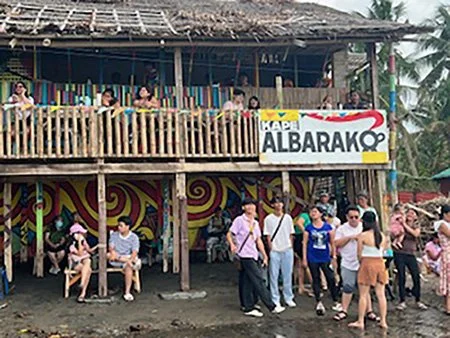
Festival viewing café (Photo by Lilia Villanueva)
That promise was fulfilled yesterday, February 21, when we drove to Old Sagay—our second trip to this northernmost city of our island in ten years(!)—with a slim hope to see Nune—but to partake in the opening of the city’s 7th annual festival of short films by local filmmakers. This beachfront arts event, one of many that Margaha Beach plays host to, was not anything I expected and, at my age, a privilege not to have missed.
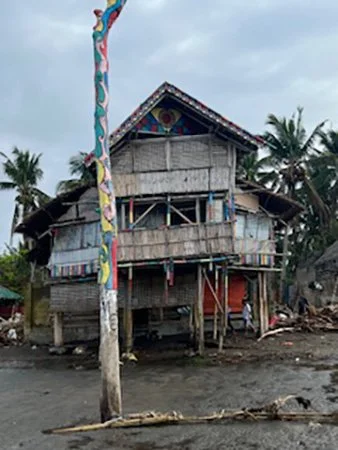
Visual artist Nune Alvarado’s residence marked by painted totem pole (Photo by Lilia Villanueva)
We were invited by our son Ben, who was executive producer of one of the film entries. Ben has been an active mentor to local filmmakers for several years; by association, we show support to his mentees and especially to organizers of grassroots art events. It was a fabulous opportunity to visit Nune’s stomping grounds, with the hope of saying hello to the legendary Tatay of Margaha Beach.
The first adventure was navigating the half-lane footpath-turned-paved footpath into Purok Bougainvilla, the only entry into Margaha Beach, now totally concealed from the path by back-to-back homes, structures, and makeshift resorts. Without the skills of driver, Michael, I would’ve forbidden our car from entering the “Welcome to the Community of Color (of Maestro Nunelucio Alvarado)” entrance to the footpath. After a harrowing inch-apart crawl from car to trisikad (pedaled tricycle) to fence to canal to babies to dogs, we entered a packed parking space of a karaoke-blasting resort, whose very pregnant parking attendant said we could park there and walk to Kape Albarako, the site of the event, which was “next door.” As we walked toward the water, she stopped suddenly and said, “Ooops, indi pa pwede gali kay taas pa ang tubi.” (“Can’t walk there because the water is still too high to walk on the beach.”) Apparently, there is no access from the footpath directly to Kape Albarako! She suggested we go to the next resort where there is also parking and which may be closer to Kape Albarako. Another inch-by-inch crawl to the next resort in the car, and again, I walked out first toward the sea and found the water still lapping up the resort’s walls, at least knee-high from the beach.
Since we were still early for the 3 p.m. start time, we decided to go back to town and get some lunch. Enting’s did not disappoint. The sustenance prepared me for the scene at Margaha Beach.
The beach is a kilometer length of black sand. The locals believe: Itom nga balas; bulong sa lawas (black sand is healing for the body)—an ode to the volcanic black sand’s healing power. It is not unusual to see adults buried in the black sand early in the morning, we were told. Upon returning from lunch, the low tide had begun in earnest, and a sliver of beach sand allowed one to walk toward Kape Albarako, a colorfully painted bamboo building that sprawled across 20 meters of beachfront, with a second floor. A few meters away, also on the beachfront, was a taller bamboo house whose stilts clearly demonstrated how high the high tide is on this beach. This was the Alvarado residence. On the lower level, we were told, was Maestro Nune’s work studio, where he also taught young artists, according to his wife, Sally, who greeted us as we tiptoed into the Kape building.
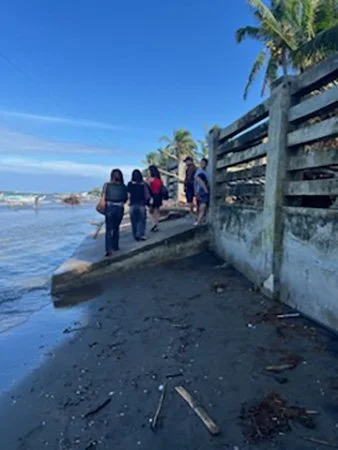
Low-tide beach path to Kape Alvarado (Photo by Lilia Villanueva)
It was difficult to get my bearings at first: where was the film festival actually going to be held? There was no “hall” or enclosed area for showing film. It was an open, balcony-style café building that looked out to the Visayan Sea, with a beach that was still half-filled with water and local kids out with their body boards, skidding up and down the shallowing water in front of us. People started to wade in or skirt the wet paths into the Kape and find benches and plastic chairs, or walk on the beach barefoot.
We settled at a front-view table with Ben’s friends, Catherine and her husband Ronelle, who beautifully did the soundtrack to Ben’s Rye movie. Catherine teaches production design. No one talked about where or when or how the “festival” was going to happen. A group of young, cheerleader-type boys and girls marched out in front of us on still very wet sand and began warm-up exercises—stretching, twirling, and jumping around in pairs and in groups. Obviously, they were going to perform—but how? And where? In the wet sand? I was confused but also intrigued. They all had a serious air about them, like a real dance troupe. The waterboarding kids still skidded here and there, doing tricks on their boards and impressing their audience, while the dancers continued their warm-up as the water continued to recede into the sea.
More people were on the beach now, but it was still wet and muddy in most parts. Adults began to break out serious food from styro boxes, sharing among themselves and their kids, who darted in and out between servings and ran back to play in the water, farther and farther away from their seated folks. Still, there was no visible sign of any “festival” being prepared to start.
At about past 4 p.m., elaborate homemade kites began to appear on the beach, making tentative attempts to stay up in the air. First, there was the jeepney kite—colorful and beautifully upright once it was in the air. Some people applauded. Then the giant fish kite went up, followed by the crab kite. They were all beautiful and sailed right past the appreciative audience, who whooped and applauded, and the kids jumped up and down as they pointed up at them.
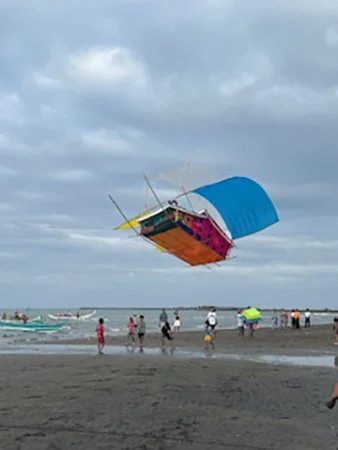
Kites started the festival (Photo by Lilia Villanueva)
Then, quietly and without fuss, a stage was carried by four men and planted in front of us on the beach. A group of techies followed with 30 or more LED “boxes” and tons of wires. Ahhhh—the films would be screened on that stage on the beach. The sea breeze was gentle and perfect for the evening fest. The emcee got on the mic and welcomed everybody. She explained that the ten featured filmmakers would each board an assigned banca and make a fluvial entrance when the ceremony began. How cool is that!
Of course, there were technical delays, and the fluvial entrance of the filmmakers was not as dramatic as MacArthur’s “I shall return” march on the beach. The delay forced the bancas to retreat from the shoreline until the special passengers had to disembark, lest they walk farther away from the stage.
The festival began with the dance troupe from the State University of Northern Negros (SUNN), opening with a very well-executed modern number on the sandy beach! Festival judges and local officials were introduced, walking to the stage—some barefoot, others comfortably in their ready-for-wet Crocs—with filmmakers and their crew joining them for photo, video, and drone ops. Lupang Hinirang blared on screen and throughout the now-dusky beach, with the beautiful silhouette of the horizon etched by eyebrow-stroke clouds.
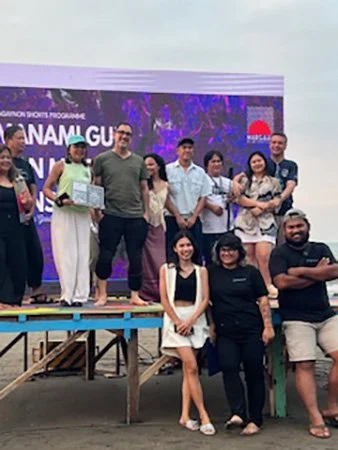
Filmmakers introduced on stage (Photo by Lilia Villanueva)
Through all this, I noticed three tiny girls in their swimsuits who did not stop or pause to look up from their serious sand-digging and building work—an activity I watched for at least an hour. They ran to their moms only for quick spoonfuls of rice. They were each beautifully covered by the itom nga balas, bulong sa lawas.
I felt so happy for them.
I told Catherine when I found my way back to the front-row table to watch the first short film entry: “I feel like I’m back in the ’60s. This scene is as natural and organic as it can get. I feel happy, even though I wish I had seen Nune to say hello.” I had a chat with Sally, and she described how Nune has gotten much weaker these days and how his dementia has progressed. They weren’t sure if he would make it from his house to the Kape-han. I had taken photos of Nune’s bamboo castle and imagined his body now leaning sideways as much as his house. Always one with nature, Nune is.
The locals believe: Itom nga balas; bulong sa lawas (black sand is healing for the body)—an ode to the volcanic black sand’s healing power.
The short films were a minute detail among the hundreds of details I observed and experienced at Margaha Beach that day. I am grateful that the film festival got us back to Old Sagay, and most grateful that I was witness to a rare, authentic moment of living on this island of my birth: where Sagaynons moved freely and supported their community without muss or fuss; where everybody was accepted, welcomed, and thanked for who they were and what they had done for their community; where pretense was completely absent—even for just the moments we were there.
All truly refreshing and inspiring—to be a Filipino. Seriously.

Lilia V. Villanueva and her husband Craig Scharlin have been living in the Philippines for over ten years, dividing their time between Bacolod and Baguio.
More articles from Lilia V. Villanueva
