

The Historic Delano Grape Strike’s Sacrifices and Rewards
/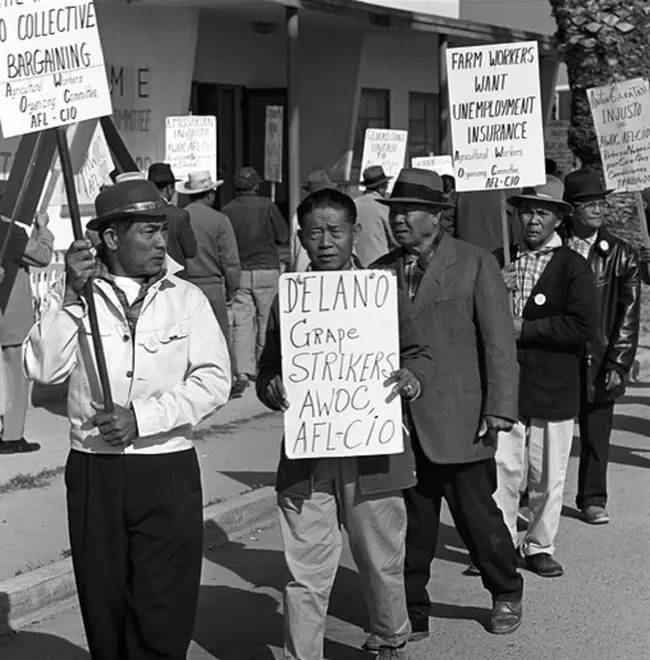
Agricultural Workers Organizing Committee members picketing in front of the Filipino Community Hall as part of the Delano Grape Strike on September 24, 1965. (Source: © Harvey Richards Media Archive)
The most immediate cost was economic. When workers walked off the fields in Delano on September 8, 1965, they gave up their primary source of income. Agricultural laborers were already among the lowest-paid workers in California, often earning near-subsistence wages tied directly to seasonal harvests. By striking, they forfeited even that limited income.
A Five-Year Fight
The strike lasted not for days or weeks, but for five years. During this period, many workers had no steady employment. Some found occasional work outside the strike zones, but many remained committed to the movement and relied on strike funds, donations and mutual aid to survive. The financial hardship was constant. Families struggled to pay for food, rent and basic necessities. Savings, where they existed, were quickly exhausted.
Housing insecurity became a central part of the cost. Many farmworkers lived in labor camps or employer-controlled housing tied to their jobs. Once they went on strike, they risked eviction. Workers and their families were forced to move, double up with relatives, or rely on community support networks. In some cases, entire households were displaced. For the Filipino workers, many of whom were single men living in communal housing, the loss of employer-provided shelter was immediate. For Mexican families, the burden extended to spouses and children, who shared in the instability.
It was in response to this housing crisis—especially among elderly Filipino workers—that one of the most important institutional developments of the strike emerged: Agbayani Village in Delano. Completed in 1974 and named after Filipino labor leader Paulo Agbayani, the village provided permanent housing for retired and aging Filipino farmworkers who had sacrificed their livelihoods during the strike. Many of these men had no families in the United States, having lived as migrant laborers for decades under exclusionary immigration laws that prevented them from forming stable households. During the strike, they were among the most vulnerable, with no income, no employer housing, and limited means of support.
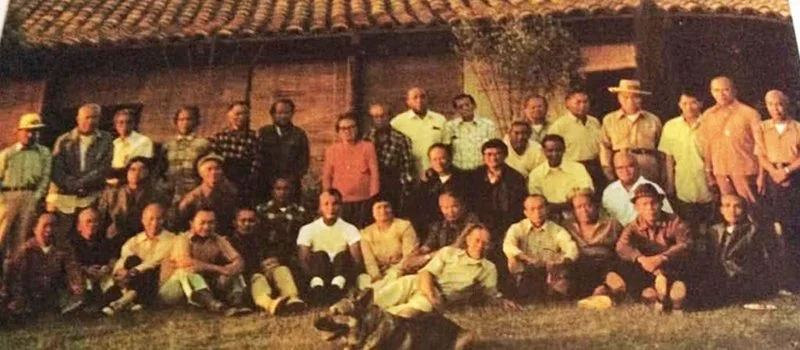
This photo of Manongs in front of Agbayani Village was published by Harvard Review. (Photo courtesy of Lorraine Agtang)
Long-Delayed Recognition
Agbayani Village represented both a response to immediate hardship and a long-delayed recognition of these workers’ contributions. Built by the United Farm Workers with support from unions, churches and volunteers, it offered dignified housing, communal facilities and a sense of permanence that had been absent from the lives of the manongs. The creation of the village underscored the depth of sacrifice made by Filipino workers during the strike. It was not simply that they had lost wages for five years; many had reached the end of their working lives without security, making the provision of housing a moral and political necessity.
Nutrition and health also deteriorated under the strain of the strike. With limited income, food consumption declined in both quantity and quality. Community kitchens and donated goods helped sustain strikers, but these resources were inconsistent. Malnutrition, especially among children, became a concern. Health care was largely inaccessible, as farmworkers typically lacked insurance and relied on minimal services even before the strike. The prolonged stress of uncertainty, combined with physical hardship, contributed to declining health among many participants.
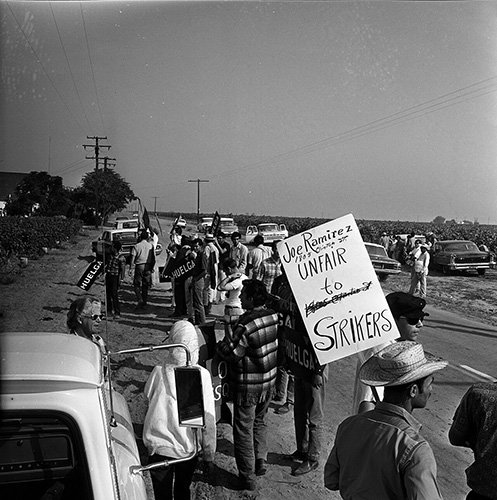
United Farm Workers on strike in Delano, California (Photo by Frank Q. Brown, Los Angeles Times, Creative Commons License)
Significant Social Cost
The social cost was equally significant. The strike divided communities, sometimes sharply. Not all workers joined the strike, and growers actively recruited strikebreakers. This created tensions within labor camps and across ethnic lines. In some cases, workers who crossed picket lines were ostracized or confronted. Violence, while not constant, was present. Picket lines were sites of confrontation between strikers, replacement workers, and law enforcement. Arrests occurred, and some workers faced legal penalties for their participation.
Family life was deeply affected. For Mexican American workers, whose participation expanded after the involvement of Cesar Chavez and Dolores Huerta, the strike required entire households to adapt. Children were drawn into the movement, sometimes participating in marches and boycotts, while also experiencing the instability of reduced income and uncertain living conditions. Education was disrupted for some, as families moved or struggled to maintain stability. The strike became a defining experience for a generation, shaping identities as well as material conditions.
For the Filipino workers led by Larry Itliong, the cost carried an additional dimension. Many of these workers were older, with fewer opportunities to recover economically after years of lost income. They had spent decades in the fields, often without accumulating significant savings or securing long-term security. By committing to the strike, they risked what little stability they had left. The decision to strike was therefore particularly consequential. It was not only a gamble for better wages, but a sacrifice of their remaining working years. The later construction of Agbayani Village stands as a testament to this reality, acknowledging that many of these men had given everything to a movement that would only partially repay them in material terms.
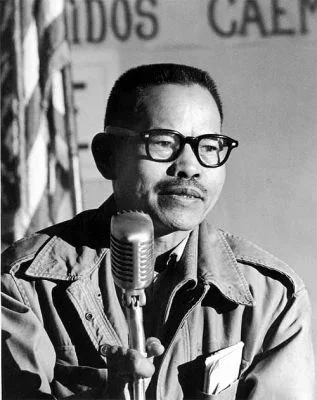
Larry Itliong (Source: Wikipedia)
Psychological Toll
The psychological toll of the strike was profound. Uncertainty became a constant condition. Workers did not know when, or if, the strike would succeed. The long duration tested morale. Periods of hope, such as the 1966 march from Delano to Sacramento, alternated with periods of discouragement as negotiations stalled and growers resisted. Maintaining commitment over five years required sustained discipline and belief in the movement’s goals. This endurance was itself a cost, measured in stress, anxiety, and emotional strain.
The expansion of the strike into a national boycott added another layer of sacrifice. Many workers left the fields entirely to become organizers, traveling to cities across the United States to promote the boycott of table grapes. This meant further separation from families and communities. It also required adapting to new roles, often without financial compensation. These organizers lived on minimal stipends, relying on the support of unions, churches, and sympathetic groups. Their work was essential to the eventual success of the strike, but it came at the cost of personal stability.
Legal and institutional pressures compounded these hardships. Growers sought injunctions to limit picketing, and law enforcement often sided with agricultural interests. Workers faced arrests for trespassing or disturbing the peace. The legal environment was not neutral; it imposed additional risks on those who chose to strike. For undocumented workers, or those with uncertain status, participation carried even greater danger.
Significant Gains
Despite these costs, the strike ultimately achieved significant gains when contracts were signed in 1970. Wages increased, health benefits were introduced, and the United Farm Workers gained recognition as a bargaining agent. Yet these outcomes do not erase the sacrifices made during the preceding years. The benefits were collective and long-term, while the costs were immediate and personal.
The strike lasted not for days or weeks, but for five years. During this period, many workers had no steady employment.
The Delano Grape Strike stands as a reminder that labor victories are not achieved without profound sacrifice. The workers who participated endured years of economic hardship, social disruption, and personal strain. Their willingness to sustain the strike under these conditions was a critical factor in its success. The creation of Agbayani Village, rising out of that hardship, remains one of the clearest material acknowledgments of what those workers gave—and what they were owed.

Alex S. Fabros, Jr. is a retired Philippine American Military History professor.
More articles from Alex Fabros, Jr.
