
A Ballot’s Long Way Home
/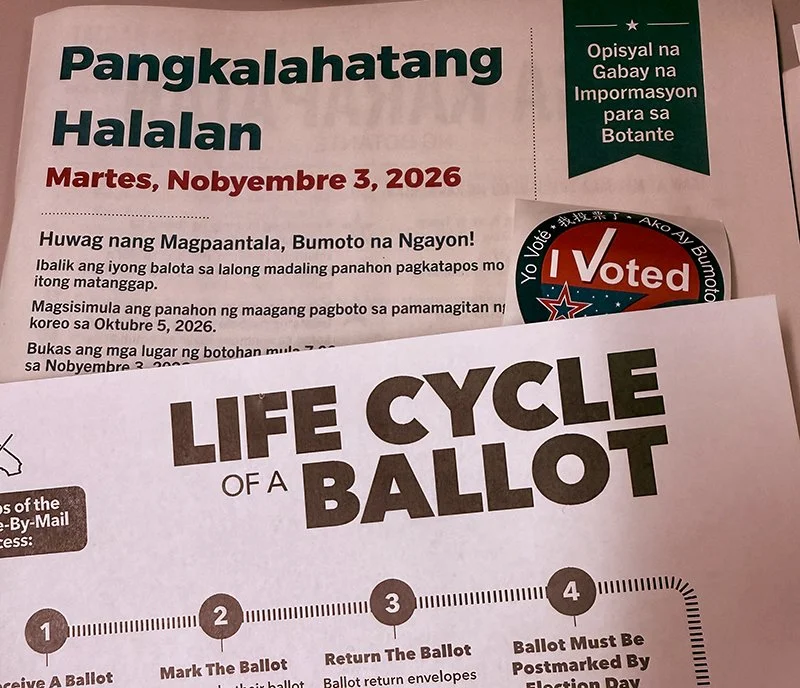
The author translated election materials to Filipino.
After 26 years in America, I finally had the chance to participate in an election beyond casting my vote. I had wanted to do this for some time, and this year, from the primaries to the midterms, I found myself reviewing, translating, and proofreading election materials from English into Filipino; I initially thought my experience with literary translation would serve me well, but election translation, I discovered, is a different beast altogether.
In poetry, a word may carry several meanings; in translating vital documents and other language-access materials, however, ambiguity is considerably less welcome. A candidate statement, for instance, must say exactly what the candidate intended. A ballot measure must mean the same thing in Filipino as it does in English.
Instructions must be clear enough that voters know exactly what to do, yet precision is not the same as word-for-word equivalence. Words carry the weight of their particular histories and local uses, and not all of them cross easily from one language into another. Some English terms are better left in English, especially when their Filipino equivalents would be less familiar to the very people they are meant to inform.
Preserving the Meaning
The task is to preserve meaning while allowing language to remain recognizable to its readers. Which is to say, there is little room for poetic license, however tempting it might be to improve upon the prose.
There were voter information guides, official ballots, candidate statements, instructions, and other materials to review. The work required patience, a good eye, an ear for the nuances of both languages, a familiarity with the contexts in which words are used, and the judgment to know when a translation was technically correct but not quite right for the intended readership.
It also meant paying close attention to easily overlooked details such as a misplaced punctuation mark, an inconsistent term, a word omitted or repeated, questions of register and tone (i.e., always use the more respectful forms of address, such as kayo vs. ikaw, ninyo vs. mo, inyo vs. iyo). And the willingness to spend a surprising amount of time debating a perfectly ordinary word (ng and nang deserve special mention). A 46-page ballot measure on rent control and eviction protections, in particular, tested my patience, taking more than 20 hours to complete and keeping me at my desk until one in the morning during the final round!
For someone who came from the Philippines, there was a certain satisfaction and a measure of historical irony in translating election materials from English into Filipino. Filipino presence in America predates the United States itself, beginning with the documented landing of Filipino sailors near Morro Bay in 1587. Following the American annexation of the Philippines in 1898, successive waves of Filipinos arrived as students, agricultural laborers, military personnel, professionals, and family members.
Generational Full Circle
I am a first-generation immigrant from a long line of first-generation immigrants. My great-grandfather arrived in 1905 when Filipinos were U.S. nationals under American colonial rule; my grandparents came in the 1970s with their unmarried children, and later petitioned for my parents who, in turn, petitioned for my sister and me; and with a new generation born in the years since, our family’s American story now spans across five generations. And here I am, 80 years after Filipino immigrants gained the right to become naturalized U.S. citizens and, with it, the opportunity to vote, trying to make sure a voting guide made sense in Filipino. Which is to say, history has its peculiar ways of coming full circle.
When the proofreading period ended, I had the opportunity to see what happened beyond the printed page. I answered phones, observed a Vote Center in operation, and spent time learning the lifecycle of a ballot after voters return them.
The phone bank was a learning experience in its own right, with questions ranging from the routine to the urgent. There were anxious callers, irate callers and callers so grateful for the guidance that they urged me to give them a holler if I ever found myself in their part of the world. Calls came from as far away as the UK, France, Italy, Canada, and Hong Kong with overseas voters seeking guidance on how to cast and return their ballots.
Closer to home, voters wanted to know what to do after marking the wrong choice, how to obtain a replacement envelope, why a signature alone would not suffice without a name and address to identify its owner, or why they couldn’t simply text in their vote.
Election Night Watch
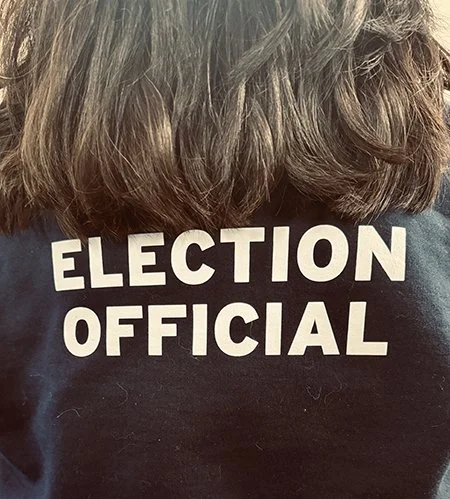
The author's official election day designation
At a Vote Center, I watched election officials assist voters by checking records, issuing ballots, explaining procedures, guiding first-time voters and conditional voters, all with frequent coordination with election HQ. It was a rather large logistical undertaking marked by a mixture of anticipation, exhaustion, nervous energy, and good humor as some of the last voters arrived at the eleventh hour (7:54 p.m. to be exact on Election Night!). After 8 p.m., ballots started coming in from the Vote Centers, and the evening stretched past midnight before the last workers finally headed home.
But Election Night was only one part of a much longer process. Behind the scenes, the steady work of collecting, sorting, and processing early ballots was already well underway. The ballot envelopes pass through specialized equipment that reads identifying information and captures signatures. Those signatures must then be checked against voter registration records. There are checks, and checks on those checks, and then a few more for good measure.
Some envelopes require further review, and voters with missing or mismatched signatures were contacted to correct the problem. Once the signatures were verified, the envelopes were opened and the ballots extracted then separated from their identifying envelopes to preserve the secrecy of the vote. The work continues until the official canvass is complete and the results are certified.
Impressive Operation
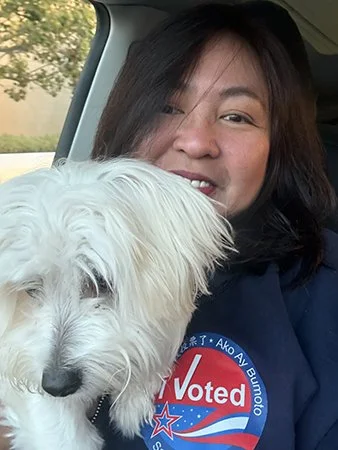
The author after doing her duty
What impressed me was not only the technology or the procedures but the people attending to them. Much of the work was repetitive and painstaking. Envelopes had to be handled, records examined, ballots inspected, and numbers reconciled. In the ballot-processing area, I observed workers operating in pairs, following security protocols that restricted personal phones and unnecessary conversation.
Across the entire operation, from proofreading and answering calls to assisting voters and sorting ballots, the work demanded patience, concentration, rigor, and an uncommon attention to detail. The people doing it came from remarkably varied backgrounds such as retirees, lawyers, marketing professionals, professors, artists, new immigrants, former electeds, grandparents, and students.
They brought with them different political affiliations, perspectives, generations, and life experiences, but shared a commitment to the integrity of the electoral process. There was little glamour in any of it, and considerable dedication. Much of their work would remain invisible to the voters whose ballots they helped shepherd through the process.
A New High
Somewhere in the middle of all this, our county reached a new high in voter registration! That is a great many individual voices and a great many choices to account for. Each voter belongs to a particular set of districts, with its own combination of candidates and ballot measures. What appears to be a single countywide election is, behind the scenes, an intricate arrangement of ballot types, voter records, equipment, people, and procedures, all working together to ensure that voters receive the correct ballots and that their choices are faithfully recorded and counted. At that scale, accuracy is both an administrative virtue and a cornerstone of the election’s legitimacy.
Somewhere in the middle of all this, our county reached a new high in voter registration! That is a great many individual voices and a great many choices to account for.
Having grown up in the Philippines during martial law, I have never taken the workings of democracy for granted. The electoral histories of both countries offer ample reason to value transparency and scrutiny. Seeing the process from the inside gave me a deeper appreciation of its complexities and why so many safeguards are necessary. So the next time I place my ballot in a drop box, I will know that its journey is only beginning, and how much care it takes to safely see it home.
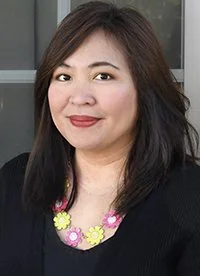
Aileen Cassinetto is an Academy of American Poets Laureate Fellow, a YBCA 100 awardee, and recipient of the Foley Poetry Prize. She is the co-founder of Paloma Press and co-editor of Dear Human at the Edge of Time: Poems on Climate Change in the United States and The Nature of Our Times: Poems on America’s Lands, Waters, Wildlife, and Other Natural Wonders, two poetry anthologies that serve as companions to national climate and nature assessments. An active member of the FilBookFest community since 2011, she serves on the advisory boards of Philippine American Writers and Artists, Inc. (PAWA) and the Filipino American International Book Festival.
More articles from Aileen Cassinetto
