
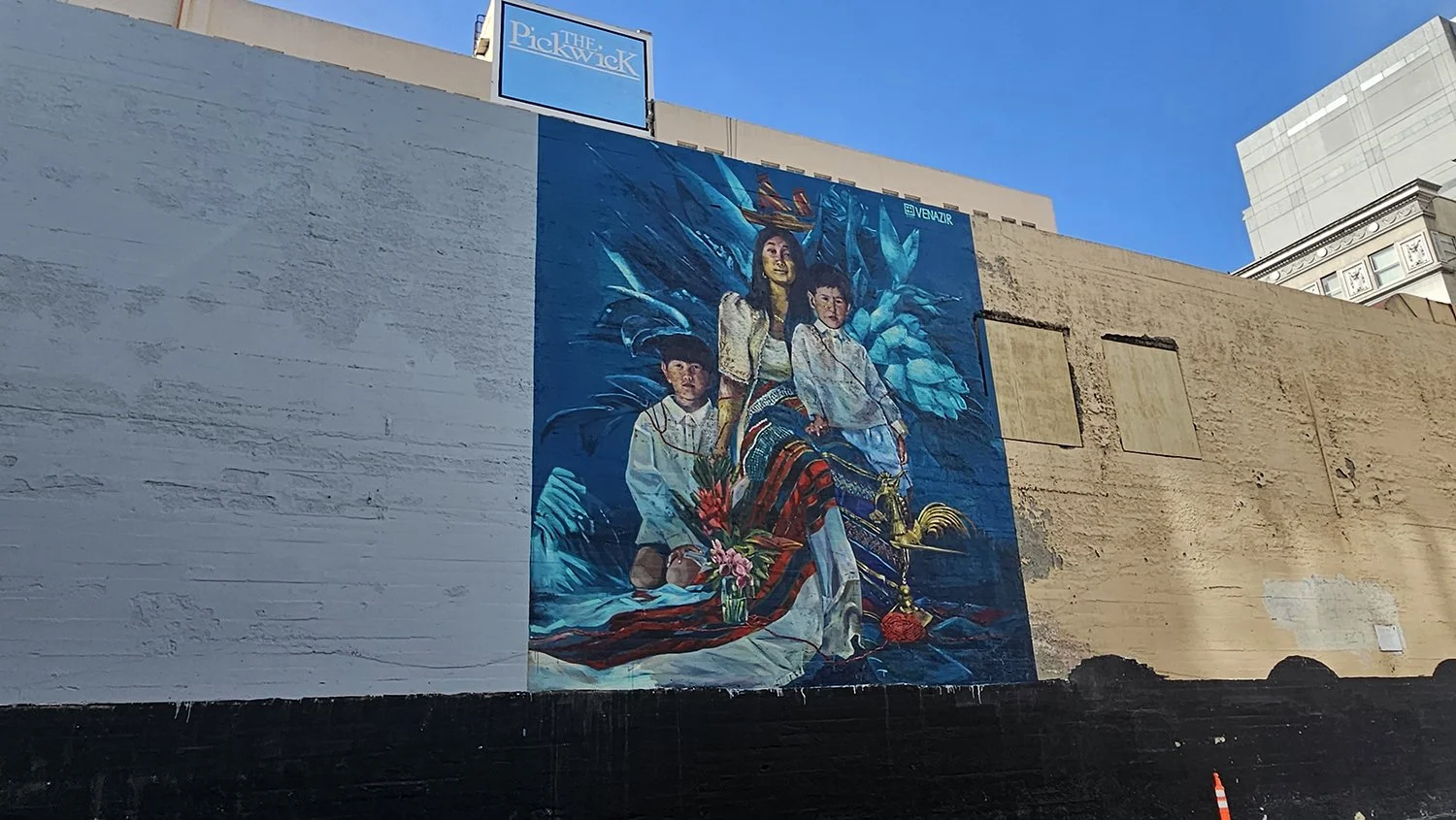
Rain Batingana’s Journey from Durian City to the Big Apple
/
Rain Batingana graces the pages of British Vogue in its October 2025 issue, commanding the frame in an ensemble called Fierce by AP.
Amid the festivities, I noticed Rain’s striking figure, dressed in a piece from Jay-R Gamboa Flores’s DAMGO (DREAM) Collection. Her delicate, lithe arms moved deftly as she arranged a performer’s hair before helping her slip into a traditionally inspired red-and-blue beaded t’nalak gown.
Then I locked eyes with Rain.
She had the unmistakable gaze of a supermodel: deep, alluring and inviting, the kind of look that makes you feel as though you have encountered ...fame? I knew I recognized her from somewhere. Have I seen her on a television show? Perhaps in an Instagram reel, with Law Roach offering his signature commentary? I racked my brain for an answer.
Fashioned from a necklace, my headdress refused to cooperate; the small gong at its center simply would not sit right. “It looks better when the beads are centered,” Rain advised, sharing a smile.
In meeting her in the restroom that evening, I had unknowingly encountered a piece of fashion history. Meet Rain Batingana, the first Filipino trans woman model to grace the runway of Project Runway.

Rain Batingana is a New York City-based runway model who made history as the first Filipina transgender model to appear on Project Runway.
From the Land of Dreamweavers
Growing up in Davao City, Philippines, Rain Batingana was drawn to beauty queens, supermodels and the spectacle of the runway. Encountering Rain is like being embraced by a warm sunset melting across your face. For a moment, you are blinded and humbled by her beauty.
Her signature look is her slender frame, piercing brown eyes, and striking kayumanggi–the beautiful, sun-kissed tan inherent to Filipinos. The kind of tan that is the envy of the Western world. Yet in the Philippines, where skin-whitening products proselytize fairer complexions as ideal, her natural beauty represents something worth celebrating: the beauty that always belonged to us before the world conditioned us to question it.
I remember growing up and wondering why grocery stores had entire aisles devoted to whitening products. Silka, Belo Kojic Acid and SkinWhite sat beside Magic Sarap and Datu Puti soy sauce and vinegar, as though the magic of whiteness were as essential a staple as the condiments that shape signature Filipino dishes like adobo and sinigang.
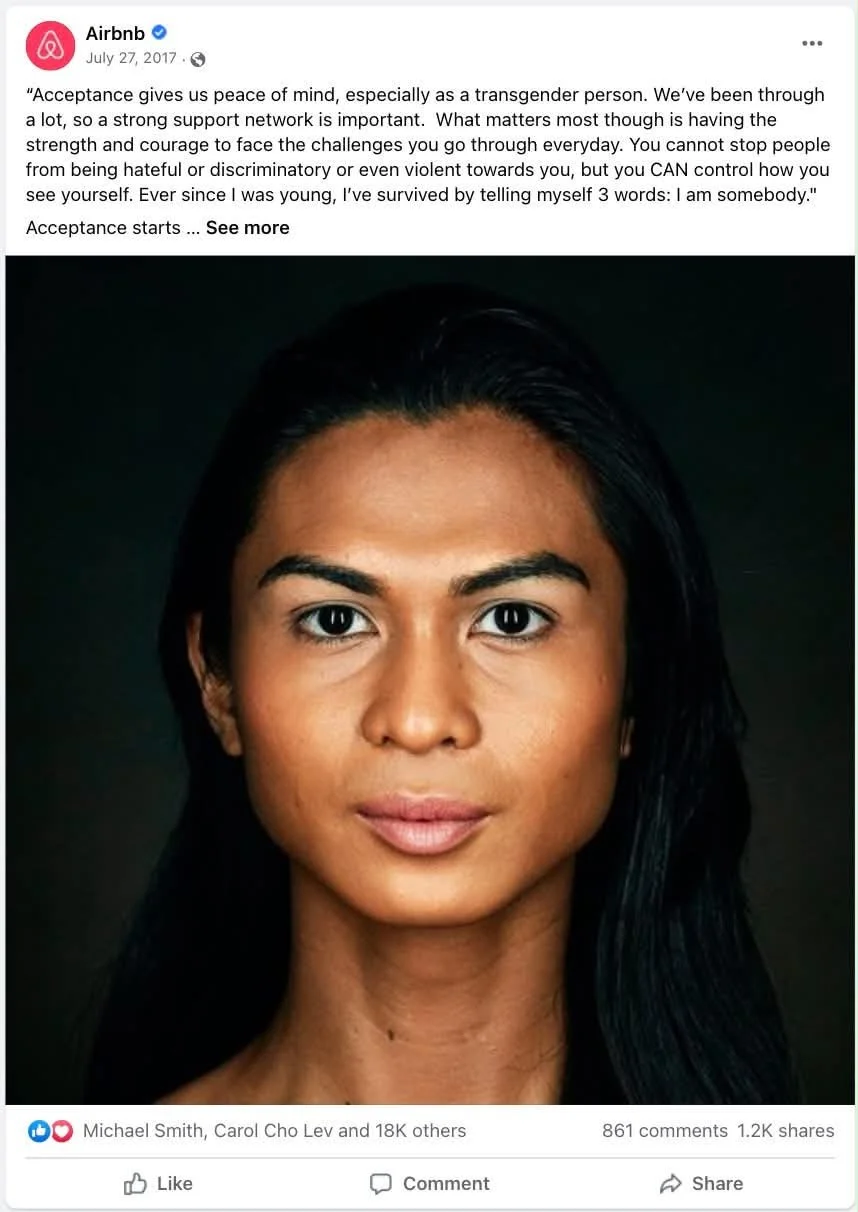
Batingana’s AirBNB Superbowl Ad
Ideas of Beauty
Our ideas of beauty are shaped not only by the products we buy, but also by the fantasies we grow up watching. In America, children dream of becoming princesses, sashaying through life in ball gowns with Disney’s imprint on the seams.
In the Philippines, young girls encounter a different kind of royalty through mutya pageants, where the candidates wear gowns fashioned by neighborhood seamstresses and designers, their faces adorned with painstakingly applied makeup, sometimes a few shades lighter than their natural complexions.
Pageantry offers an approximation of the fairy tale: a world where an ordinary girl can become the evening’s queen. For Batingana, the spectacle of beauty queens and supermodels became more than just entertainment; it was a vision of who she might one day become.
“At night I would watch Miss Universe and Fashion TV,” says Batingana. “I would watch those supermodels and those beauty queens in their gowns, and I would practice walking with a book on my head. I would then practice the wave, the turn, the pose. Deep inside, I wanted to be one of those girls on stage, a beauty queen or a supermodel.”
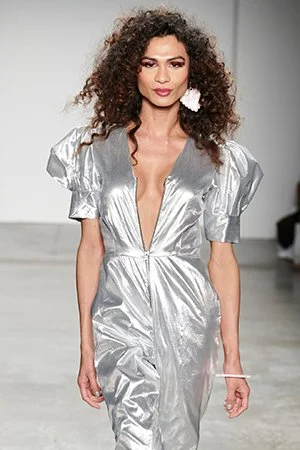
Filipina model Rain Batingana walks the runway in a metallic silver creation by RICHERETTE, the fashion label of designer Richie Rich, during New York Fashion Week 2023.
From Mindanao to NY City
For Rain Batingana, the women she admired embodied a kind of freedom she deeply aspired to growing up. “I lived a life where I had to hide who I was because I came from a religious household, because I was scared of being different. For so many years, I made myself small,” she says. “So, to be celebrated now for the exact things I used to hide—that is healing for me.”
Batingana arrived in the United States in 2015, first settling in San Francisco. That same year, she won the crown at Queen Philippines USA, marking a significant milestone in her journey as a model. She was signed with Slay Model Management, a trans-exclusive modeling agency founded to connect transgender models with professional opportunities in fashion.
The quiet radicalism of embracing her natural beauty as a sun-kissed kayumanggi model and her growing visibility challenged narrow ideals of beauty and representation. Her emergence as an immigrant trans model came amid a particularly dangerous period, when the U.S. saw a record number of reported killings of transgender people of color. Against this backdrop, her rise in the fashion industry carried enduring significance beyond the runway.
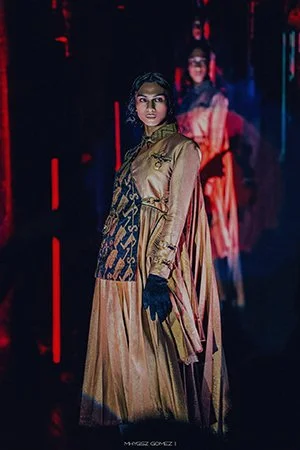
Model Rain Batingana showcases Xioti Chiu's black-and-gold ensemble featuring Inaul, the traditional handwoven textile of the Maguindanao people of Mindanao, at a fashion presentation in Manila, in 2023.
Beyond Fashion
Her work soon extended beyond fashion: she was featured in Airbnb’s widely publicized #WeAccept campaign, which aired during Super Bowl LI in February 2017. That same year, she made her way to New York Fashion Week, carrying the dream she had nurtured since childhood.
Moving to the United States had given her the opportunity to pursue modeling more seriously, but New York offered something beyond professional advancement: the possibility of belonging.
“When I moved to the U.S. I told myself, ‘This is it. I am going to finally give my dream a chance to be real.’ New York is a melting pot. It really is the city where dreams are made. You walk on the street, and you see every kind of person, every color, every shape, every story. And for the first time, I did not feel like I was too different. I felt like I belonged.”
That sense of belonging grew through the friendships she found in the city, among people who recognized her potential even when she struggled to see it herself. “My friends were very supportive,” says Batingana. “They hyped me up. They pushed me when I was scared. They would tell me, ‘Rain, go, you can do it. This is your time.’
She says a city like New York is never lonely when you have great friends rooting for you.
Keep on Singing Her Davao Song
The world may celebrate her beauty and talent, but Davao remains the foundation of the woman she has become.
“No matter how far my work takes me, I will always be that Rain from Davao. That will never change. The platforms may get bigger, the lights may get brighter, but my roots are still in that soil in Davao,” she says.
The quiet radicalism of embracing her natural beauty as a sun-kissed kayumanggi model and her growing visibility challenged narrow ideals of beauty and representation.
She wants people unfamiliar with Mindanao to understand its cultural richness and the resilience of its people. “In Davao, we are taught to be disciplined, to be respectful, to be strong in faith. That is why I can survive in New York. That is why I can survive this industry. Because Mindanao made me tough but soft at the same time.”
For young people who dream of following in her footsteps, Batingana offers a final reminder: “Believe in the dream you had as a child. I imagined this when I was still in elementary school. I held onto that image for so many years. If you can see it in your head, you can hold it in your hands,” says Batingana. “Your imagination is not childish. It is a preview.”

Elaine Joy Edaya Degale is a Black-Filipina writer and lecturer at community colleges within the City University of New York (CUNY), and has an Ed.M. and M.A. from Teachers College, Columbia University.
She graduated cum laude from Mount Holyoke College where she studied International Relations and Development, and continues to support literacy and food programming efforts in indigenous communities through her Community-Based organization, OperationMerienda.org.
More articles from Elaine Joy Edaya Degale
