
2026 Filipino Diaspora Summit fuels leadership roles of non-resident Filipinos (NRFs) as partners for Philippine development
/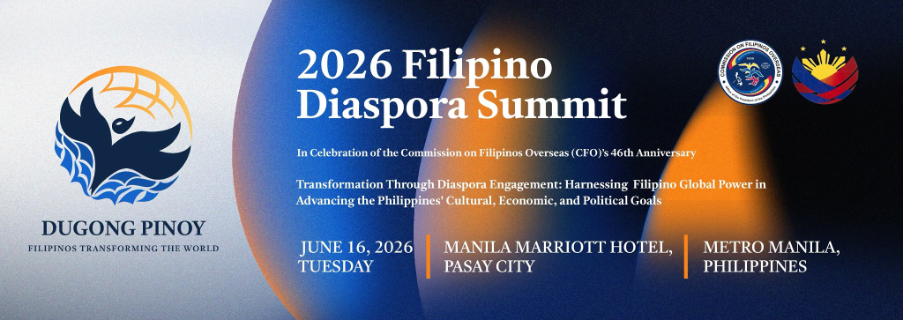
The 2026 Filipino Diaspora Summit, held on 16 June 2026 at the Manila Marriott Hotel, concluded as a landmark gathering that redefined the Philippines’ engagement with non-resident Filipinos (NRFs). The Summit showed that when diaspora leaders connect with their homeland and with one another, they can greatly increase their capacity to support Philippine development.
The Summit brought together approximately 350 NRFs, government officials, private sector leaders, and civil society organizations from 30 countries across six continents.
"Clearly, NRFs hold a strong transformative power in advancing the cultural, economic, and political engagements of the Philippines," said Secretary Dante "Klink" Ang II, Chairperson of the Commission on Filipinos Overseas (CFO).
For decades, conversations about Filipinos abroad centered primarily on remittances and economic contributions. The 2026 Summit fundamentally shifted this narrative by positioning the Filipino diaspora not merely as economic actors, but as multidimensional partners whose expertise, innovation, leadership, networks, and cultural ambassadorship represent enduring assets for Philippine national development.
DAY 1: FOUR PANELS, ONE VISION
The first day of the Summit featured four substantive panel discussions that explored critical dimensions of diaspora engagement for national development.
Political Engagement: Amplifying Diaspora Voices
The political engagement panel, moderated by Atty. Karen Olivia Jimeno of Bilyonaryo News Channel, brought together diaspora leaders who have leveraged their political capital and public service to advance Filipino interests in their host countries.
Senator Shelly Calvo of the 38th Guam Legislature stressed the importance of diaspora advocacy and representation in shaping community policies, rather than merely being heard.
Councilmember Tyler Dos Santos-Tam of Honolulu highlighted the importance of building intergenerational connections and solidarity among Filipino communities, drawing on Hawaii's history of migration.
Ms. Maria Zelda Rojas of the European Network of Filipino Diaspora (ENFiD) - Austria discussed how organized networks across 13 countries turn advocacy into action through collaboration, diplomacy, and youth engagement, creating a difference.
Mr. Larry Asera, a 2006 Pamana ng Pilipino Awardee, shared his family's migration story and the importance of civic participation in amplifying diaspora voices. Mr. Walter Villagonzalo, a 2022 Pamana ng Pilipino Awardee, urged fellow NRFs to take on leadership roles, leveraging their unique position as connectors among diverse communities.
Economic Engagement: Beyond Remittances to Strategic Investment
The economic engagement panel, moderated by Dr. Toby Melissa Monsod of the UP School of Economics, explored how diaspora capital, expertise, and networks can be mobilized for productive investment, job creation, and sustainable economic development.
Ms. Mariela Fletcher, National Chair of the National Federation of Filipino American Associations (NaFFAA), emphasized the diverse ways NRFs contribute beyond financial support through expertise, innovation, networks, mentorship, and investments that drive sustainable growth.
Ms. Roxanne Sarthou, President of the Filipino Communities Council of Australia (FILCCA), highlighted that the true strength of the diaspora lies in its capacity to build caring, connected, and resilient communities through service, advocacy, and institution-building.
Atty. Aimee Alado-Blake, Chair of the ASEAN UK Business Forum, called for stronger collaboration among government, business, civil society, and the global Filipino community to transform engagement into meaningful investments.
Assistant Director Anna Rose Harshwardhan of the Securities and Exchange Commission (SEC) emphasized financial literacy and investor protection, reminding NRFs to make informed financial choices that contribute to their future and the country's economic growth.
Cultural Engagement: Preserving Identity Across Generations
The cultural engagement panel, moderated by Dr. Jocelyn Celero of UP Asian Center, explored how culture serves as a bridge connecting Filipinos abroad to their roots, identity, and the homeland.
Mr. Virgilio Cuizon, a 2004 Presidential Banaag Awardee, reflected on over five decades in Germany, emphasizing the importance of promoting Philippine arts and cultural heritage to strengthen identity and foster intergenerational connections.
Mr. Nash Ang, the 2022 Migration and Media Awardee, advocated for a people-centered approach to migration that recognizes migrants as valuable stakeholders and enhances cultural ties and participation across generations.
Ms. Marnie Manicad, President and CEO of Team Marnie Manicad Productions International (MMPI), highlighted the transformative power of storytelling in shaping perceptions of the Philippines and preserving culture for future generations.
Dr. Eric Zerrudo, Chairperson of the National Commission for Culture and the Arts (NCCA), stressed that preserving Filipino culture connects future generations to their heritage and creates opportunities for cultural engagement through various programs.
Engaging the Youth: Empowering The Next Generation
The youth engagement panel, moderated by Mr. Cleve Arguelles of De La Salle University, highlighted the critical role of young Filipinos in shaping the future of the diaspora and advancing national development.
Ms. Corina Dutlow, CEO of the Australian-Filipino Community Services (AFCS), emphasized creating meaningful opportunities for younger generations to connect with their heritage, communities, and the Philippines through community-led initiatives centered on service and leadership development.
Ms. Genevieve Jopanda, President of the Filipino Young Leaders Program (FYLPRO), shared how leadership development and immersion experiences cultivate a new generation of global Filipino leaders committed to building bridges between their communities abroad and the homeland.
Mr. Julio Amador III, Executive Director of the Philippine-American Educational Foundation (PAEF), highlighted how educational exchange programs help transform identity into engagement by giving NRF youth meaningful opportunities to learn, contribute, and build lasting ties with the Philippines.
Mr. Jay-vee Marasigan Pangan, Chairperson of the Youth Connect Cooperative (YCC), challenged institutions and communities to create inclusive spaces where young people can contribute, lead, and shape the future alongside previous generations, emphasizing that empowering youth begins by ensuring they have a voice at the table.
Usec. Joseph Francisco Ortega of the National Youth Commission (NYC), noting that youth are projected to comprise 80% of the country's voting population by 2028, called for stronger collaboration to create opportunities for young people to lead and contribute to national development.
DAY 2: TRANSLATING COMMITMENT INTO ACTION
The second day of the Summit translated dialogue into concrete action.
B2B Matching Session
In partnership with Go Negosyo and the Department of Science and Technology (DOST), the CFO staged a business-to-business (B2B) matching session that brought together award-winning local Filipino entrepreneurs with NRF investors. The session showcased dynamic micro, small, and medium enterprises (MSMEs) and technology start-ups across artificial intelligence, sustainable manufacturing, creative industries, and wellness sectors, creating direct channels for diaspora capital to flow into the domestic economy and catalyze local job creation.
Heritage Tour
In partnership with the Department of Tourism, Culture, and Arts of Manila (DTCAM), the CFO organized a Manila City Heritage Tour for diaspora delegates. Visiting the Manila Clock Tower, Centro de Turismo Intramuros, and the National Museum of Fine Arts, delegates deepened their appreciation of Filipino history and bolstered their commitment to contributing to national development.
Cultural Send-off
The Summit concluded with a cultural send-off organized in partnership with the Tourism Promotions Board (TPB). Featuring performances by Sindaw Philippines Performing Arts Guild and the Filipino Image Society Hong Kong, the program celebrated the richness and diversity of Philippine culture while reaffirming the diaspora's role as ambassadors and drivers of nation-building. A special video message from Filipino-American artist Apl de Ap of the Black Eyed Peas also proudly affirmed his Filipino heritage.
A WATERSHED MOMENT FOR DIASPORA ENGAGEMENT
The 2026 Filipino Diaspora Summit represents a fundamental shift in how the Philippines recognizes and engages its permanent global diaspora. No longer viewing overseas Filipinos primarily through the lens of remittances, the Summit positioned NRFs as multidimensional strategic partners whose collective networks, expertise, innovation, and sustained commitment can drive transformative change across the nation's cultural, economic, and political spheres.
Delegates departed with renewed commitment, new networks, and concrete partnerships, understanding that their engagement is no longer an isolated individual effort but part of a coordinated global movement of Filipinos transforming the world while strengthening ties with the homeland.
YOUR FEEDBACK MATTERS
To help the CFO continuously improve future diaspora engagement initiatives, we strongly encourage all Summit delegates to complete our digital feedback form available at https://summit.cfo.gov.ph/feedback-form.
ABOUT THE CFO
The Commission on Filipinos Overseas (CFO), established under Batas Pambansa 79, is dedicated to the welfare and empowerment of expatriates or non-resident Filipinos (NRFs). The CFO is distinct from the Department of Migrant Workers (DMW), which primarily addresses the needs of Overseas Filipino Workers (OFWs) and other temporary migrants.
The CFO, which is an agency under the Office of the President, works to strengthen the social, economic, and cultural ties of global Filipinos with their home country. Its primary stakeholders include Filipino permanent migrants, dual citizens, spouses and partners of foreign nationals, individuals under the Exchange Visitor Program, au pair participants bound for Europe, and Filipino descendants overseas.