
The Monsters We Brought With Us
/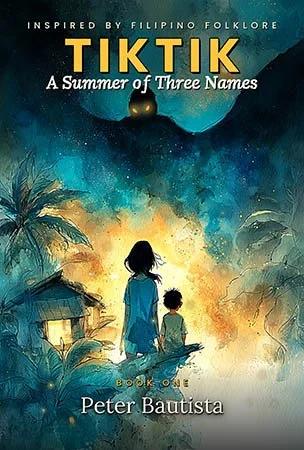
Bautista’s first book, Tiktik: A Summer of Three Names
My cousins told me to stay away.
"Why?"
"There's a dwende living there."
"A what?"
They explained that a dwende (goblin) lived inside the mound. If I disturbed it or stepped on its home, it could curse me and make me sick.
I was somewhere between ten and twelve, old enough to be skeptical and young enough not to test the possibility. My cousins were not whispering or trying to frighten me. They were firm but matter of fact. Do not step on the mound. Do not disturb whoever lives there.
I said okay and walked around it. I did not believe in the dwende. But I believed my cousins enough not to step on its house.
Until then, Filipino folklore had mostly reached me as a story. Older relatives told me about creatures they had heard about growing up. I saw them in Filipino komiks and in old black-and-white movies during summer visits to the Philippines. The mound was different. It attached one of those stories to an actual place: a tree on my lolo's property, a patch of earth my cousins knew how to behave around.
It did not turn me into a believer, but it made the stories feel physically present.
Of all the creatures I encountered during those visits, the manananggal left the strongest image. Onscreen, a woman separated at the waist. Her upper body grew wings and flew into the night, leaving her lower half behind. It was bizarre, frightening in concept, and impossible to forget.
It would be easy to retell that memory now and make the fear bigger. But I did not spend nights in the Philippines worrying that one would fly over the house. For me, the manananggal remained entertainment. I remember fascination more than terror.
I was born in Manila and moved to the United States when I was four. I grew up very American, but in a Filipino family. During visits to the Philippines, parts of being Filipino became more active. I understood Tagalog better than I could speak it. Calling older cousins Kuya or Ate felt natural there even when it felt strange in the United States. At the beginning of a visit, I sometimes needed to be reminded to perform mano, bringing an elder's hand to my forehead as a sign of respect. By the end of the summer, the gesture came naturally again.
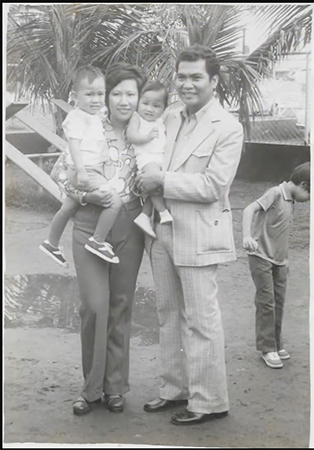
Author with parents and younger brother in the Philippines during the early 1970s
The folklore worked in much the same way. In the Philippines, it was everywhere. It appeared in relatives' stories, komiks, old films, and the landscape itself. Back in California, it became quiet. Those stories simply had fewer places to emerge.
At school, explaining one of them would have required explaining the world around it. The spectacular part traveled easily. A woman splits in half and flies away. But the stories didn't quite mean the same thing without the people who told them or the places where I'd heard them.
Years later, when my own children were little, I went looking for books rooted in Filipino culture that I could read with them. I could not find the particular kind of book I wanted to place in their hands. I wanted an adventure built around the strange and frightening creatures I remembered from my childhood.
I began imagining that I might write one, but I did not write it then. Work, raising children and running a household took up my time. The idea never disappeared completely. I just kept putting it off.
As my children grew older, I began to get some of that time back. I started thinking again about the manananggal, the tikbalang (a humanoid equine creature) the kapre (a hairy, cigar-smoking, tree-dwelling spirit) and the warning call of the tiktik (a shape-shifting creature).
The idea eventually became my middle-grade novel, Tiktik: A Summer of Three Names, about a Filipino American girl sent to her grandmother's village, where family secrets and creatures from Filipino folklore turn out to be connected. Writing it let me spend time with stories I had received only in pieces, and to understand why they had stayed with me and what I might do with them now.
This fall, one of those creatures made a much larger journey. DreamWorks Animation's Forgotten Island, which opened in theaters on September 25, introduces the Dreaded Manananggal, voiced by Lea Salonga, as the most feared creature on its island.
When I learned that the manananggal would appear in a major American animated movie, my reaction was immediate recognition. A creature I once knew from relatives, komiks, and old black-and-white films was about to appear before children who might never have heard the word before.
I cannot say what every child will make of it. Hollywood can introduce the manananggal to a new audience, but the version someone remembers from childhood may be different, shaped by whoever first told them the story.
On October 7, I spoke about those same creatures at the Philippine Consulate General in Los Angeles. I'd been invited to speak at the opening of “LORE: A Filipino American Story,” an exhibit marking Filipino American History Month.
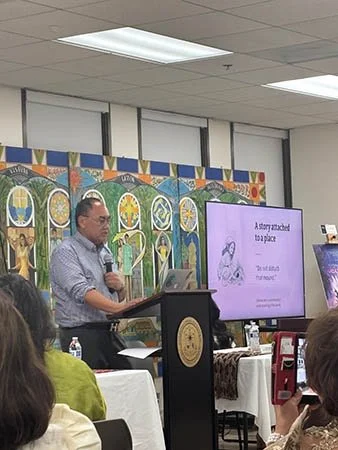
Presenting at Philippine Consulate in Los Angeles
I began with the mound. When my cousins warned me about the dwende, they were also teaching me how to behave on my lolo's land. The creature came with a rule. More than 40 years later, I still remember both.
Then I asked the room the question I had been asking myself since I started writing the book. Who told you? I asked people to turn to the person beside them and name the creature they remembered and the person who first described it.
One woman told us about her yaya, the nanny who helped raise her. Whenever she misbehaved, her yaya warned her that a tiyanak would chase her. The tiyanak is a creature that cries like a lost baby to lure people close. She still remembered exactly how the warning went.
The tiyanak was only part of what she remembered. There was also her yaya, the warnings she gave her, and that particular time in her childhood.
My dwende came from my cousins, and her tiyanak came from her yaya.
After my talk, Kirby Araullo spoke about Forgotten Island, and Waverley Lim spoke about The Mask of Haliya. Listening to them, I thought about how quiet these creatures had been for me in California. Now a manananggal flies across American movie screens, and Filipino creatures appear in graphic novels and middle-grade books like mine.
For me, the manananggal remained entertainment. I remember fascination more than terror.
As a kid, I could only find these creatures on summer visits, in komiks and old black-and-white movies. That night I was sitting in a room full of people who had brought them to Los Angeles.
My children never got the book I had imagined reading to them when they were little. By the time I finally wrote it, they were older. Raising them came first, and I would choose the same way again.
This fall, American children had a chance to meet the manananggal on a movie screen. I hope some of them left the theater and asked a parent, grandparent, aunt, uncle, or cousin whether they had heard of it. I hope the answers differ.
My last slide asked the audience one more question. Where would your story begin?
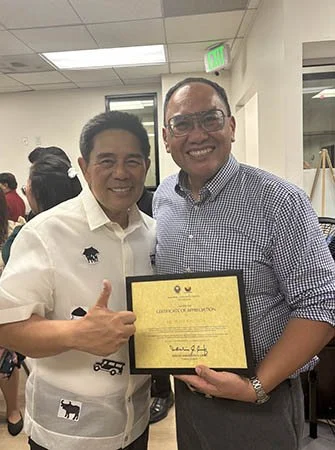
Receiving certificate of appreciation from Consul General Adelio Cruz
I already know where my story would begin -- beside the roots of a tree at my lolo's house in Nueva Ecija, with a mound I did not believe in and still chose not to disturb.
Peter Bautista is a Filipino American author who lives in Southern California. Born in Manila and raised in the United States, he is the author of the middle-grade novel Tiktik: A Summer of Three Names. Its sequel, Tiktik: A Christmas of Three Names, is scheduled for publication in November 2026. He is also the creator of readtiktik.com, where readers can explore Filipino folklore and take the Filipino Creature Quiz. Follow him on Instagram and TikTok at @readtiktik.