
Soulful Iloilo
/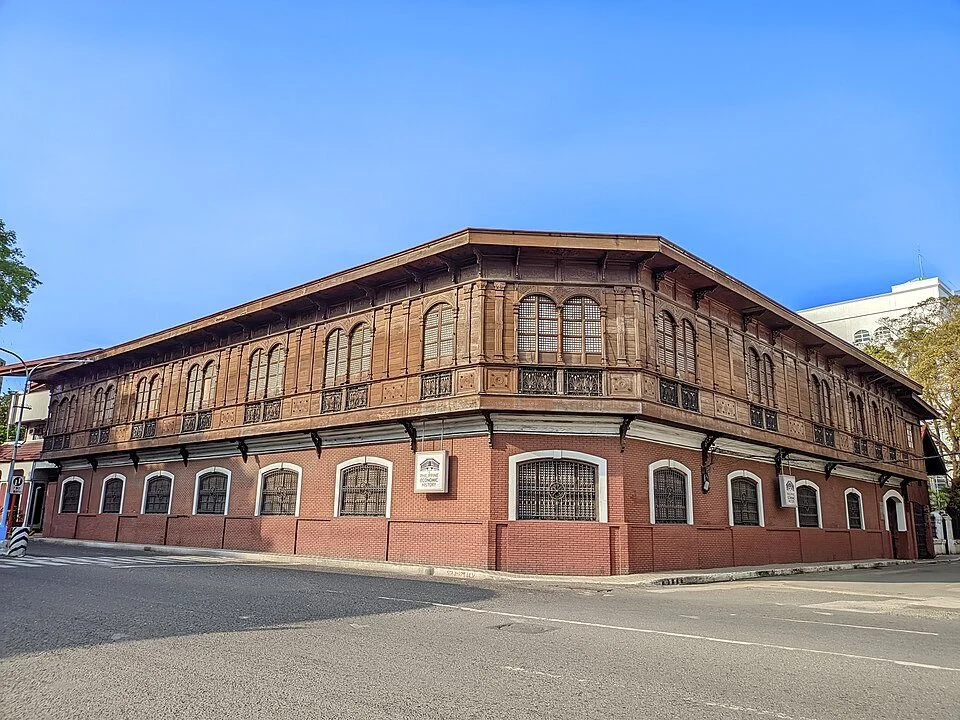
First Museum of Philippine Economic History (Source: Wikipedia)
That is the kind of fusion my fellow foodie and contributor Dr. Vic Salas has termed con-fusion of the worst sort. I blame it on the past three generations–and growing– of palates corrupted by local fast food sweet spaghetti. The food manufacturing conglomerates have jumped on this lucrative bandwagon. Supermarket shelves overflow with Filipino spaghetti sauce (and ketchup), all uniformly and execrably sweet.
But thankfully, there is more to do in Iloilo City than merely add to the alarming rates of Philippine diabetes: one out of five Filipino adults is pre-diabetic, and another estimated five million are full-blown cases, with probably three million more untested, and still to be diagnosed. Old churches may bore you, but there is nothing quite like the town of Miag-ao’s Santo Tomas De Villanueva’s magnificent yellow sandstone and coral facade with its bas relief of the desanctified St. Christopher holding on to a coconut tree as he keeps the Christ Child safe.
Mansions and Third Spaces
A few hundred pesos gets you past the heavy hardwood double doors of a handful of neo-colonial pre-WW II mansions to ogle at how the Filipino one-percent used to live. Your inner nepo baby can fantasize what it might be like to have had crony haciendero and cacique, or oligarchic rent-seeking ancestors. The Consing Mansion facing the Molo Plaza lets you soak it in for free, sans the heirloom furniture though. Also known as the Molo Mansion, its ground floor has been adaptively reused as an emporium for Filipiniana souvenirs. Food, ice cream and coffee kiosks cover the grounds, with ample parking in the back. Occasionally, the mansion’s second floor is open for art exhibits or even yoga classes.
Iloilo stands out for its wealth of non-commercial Third Spaces. These are communal places apart from work and home, where you can quietly steep in the Culture. The civilizing concept of a Third Space is akin to that of a respite in this often cruel, stress-filled world. Third Space is welcoming, neutral ground where one can come and go freely, without formal obligations such as the offer of legal tender. Best of all, many Iloilo Third Spaces are right in the City, such as its well-tended Plazas and the famous Iloilo River Esplanade where you can safely stroll, and in some areas, even bike, go fishing, walk your dogs or join a zumba class. All right, the last might set you back P20, but it’s one of the few things you can still buy with that coin these days. Also popular is the Sunset Boulevard where, by late afternoon, released office workers and families may park their cars and picnic, or graze upon the wares of itinerant fishball and fruit vendors, while gazing upon (you guessed it) the flaming Iloilo sunset.
Then there are the free government-run museums with cheerfully solicitous student docents plucked from among state college and university Tourism and HRM classes. The former Elizalde-Ynchausti Trading House, now the Museum for Economic History, is the first of its kind in the Philippines. Seamen contributed significantly to prosperity throughout Panay and the Visayas. Thus, it’s apt that there is a Maritime History Museum in the old Post Office or Aduana. The former Iloilo Provincial Prison with its magnificent skylight has likewise been repurposed into the National Museum of Western Visayas. Visitors may participate in activities like trying out the various ways of wearing a handwoven Visayan patadyong, or enjoy playing Philippine games like sungka and sipà.
The UP Visayas Museum of Art and Cultural Heritage (UPV MACH) is also free, and open on Mondays, which is the usual day when most museums are closed. Here one gets commensurate bang for one’s proverbial buck, as there are seven air-conditioned galleries under one roof, featuring native weaves, traditional farming and fishing implements and prehistoric pottery from Isla de Gigantes and other Iloilo sites. Changing exhibits on contemporary and classic Filipino art, have featured paintings by Filipino masters, such as works by Juan Luna, Felix Resureccion Hidalgo and Fernando Amorsolo, on loan from the Lopez Museum. The Lopez Family which founded Meralco and ABS CBN, has its roots in Iloilo City. UPV MACH actively collaborates and partners with individuals and institutions.

UPV Mach Heritage Building Designed by Juan Arellano with Riccardo Monti Sculptures
Art and Architecture
The entrance to the historic Art Deco building, which was designed by the government architect Juan Arellano, is flanked by massive bronze sculptures depicting Law and Order by the Italian sculptor Francesco Riccardo Monti whose major works are also in the University of Sto. Tomas and Sto. Domingo Church. Four more figures symbolizing civic life grace the tall arched doorway. Monti was assisted by the local Molo artisans: Juan Siendo, Pedro and Cirilo Sabiano, in the execution. He and Arellano had worked together previously on the Manila Metropolitan Theater. Those are also Monti’s solemn winged angels on top of the Quezon Memorial pylon. The UPV MACH building was originally the Iloilo Municipal Hall but was commandeered by the invading Japanese Army during World War II. In peacetime, it was turned over to the University of the Philippines.
Although the high school and the College of Management and the Extension Law School are still on the Iloilo City Campus premises, the main building is now all UPV MACH’s and is administered by the UP Visayas Office of Initiatives for Culture and the Arts (OICA). This was the fulfillment of the first UPV Chancellor Dionisia “Dan” Rola’s dream. Her personal art collection has found a permanent home in a mezzanine gallery.
UPV OICA Director, Prof. Martin Genodepa (a sculptor in his own right) explained that by engaging students, scholars and the community in the experience and study of art and cultural heritage, UPV MACH seeks to raise their awareness and appreciation of diverse yet inclusive social, political and economic realities. Apart from the numerous galleries and exhibition spaces extending to the corridors, there is an intimate performing arts hall which has staged free recitals by the pianist Cecile Licad and plays by local faculty and student repertory groups.

UPV MACH Prof. Martin Genodepa (in white shirt, right of center) with Cecile Licad concert on screen in background
UPV alumnus Sen. Franklin M. Drilon has been instrumental in the fruition of many of these cultural initiatives, including performances by the Philippine Philharmonic and Ballet Philippines at the Iloilo Convention Center (ICON). ICON, the airport and the Esplanade were among Drilon’s many projects. He joked about how he was Senate President by day, then the Iloilo district engineer by night. His pork barrel was the gift that keeps on giving to his home province. Because of its modern infrastructure, even with Iloilo rush hour traffic at its worst, one can still usually get from point A to B of this 75 square kilometer city, within a tolerable 15-30 minutes or so by car, and even faster on a pedal bicycle. Iloilo is also known as the bike capital of the Philippines. Compare this with the 40 minutes to an hour just to make it from Cubao to Makati, or from UP Diliman to the Ateneo, on a good day that is, and the very real risk to one’s physical safety of riding a bicycle on Metro-Manila’s major thoroughfares.
The coexistence of modern convenience with old world charm is why it is said that in Iloilo, “the past is always present.” Considered one of the most livable cities in Pilipinas Nating Mahal, it is a favorite among retirees and digital nomads. Those who are staying for longer than the usual holiday might want more lasting social and intellectual interactions, beyond fleeting 80 decibel conversations at the usual bar or club.
Reading Culture
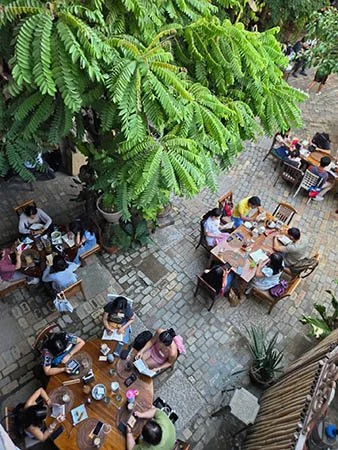
Silent Book Club 5000 at LS Cafe, Mandurriao, Iloilo City (Source: Facebook)
The previous Iloilo City mayor, Jerry P. Treñas, whose only daughter Raisa Treñas-Chu carries on his legacy, has called his bailiwick “The City that reads.” Crowds mill about the Iloilo Mega Book fairs which pop up several times a year and invite queues at the Big Bad Wolf Book Sales in Iloilo malls like SM, Robinson’s or the Ayala Atria. For those who cannot afford to buy books, the City Government has set up free open-air libraries: first, in Plaza Libertad, just a stone’s throw away from City Hall, and three more for now in the Plazas of Molo, Mandurriao and Jaro.
Like-minded readers get together every month outside the libraries. The Iloilo Books4Books Club started online during the COVID 19 pandemic when FB friends would post about what they were reading. Exchanges of books followed. After the lockdown, they started meeting regularly face to face. Yuri Catedrilla Alejandrilla doesn’t let his BPO job interfere with managing these convivial monthly meetups and discussions at the Book Latte in Mega World Festive Walk. The gatherings usually number between 12-20 regulars. They decide on which book to take up. Often, it’s the original text of a newly released Hollywood blockbuster such as Wuthering Heights or Frankenstein, or a limited Netflix series like East of Eden. Thus, the meetups may be a blend of book and film club. Philippine classics such as Noli Me Tangere in the easily understandable translation by Soledad Lacson Locsin have also been selected. Book Latte is open 24 hours a day and has a mini library in its mezzanine. Patrons waiting to check into their hotels or to go to the airport can browse over their coffee and meals.
Attendees to the Silent Book Club 5000 (the Iloilo City zip code is 5000) might reach over 40. Monthly meetups are usually at the LS Training Center’s picturesque al fresco cafe in Mandurriao. As in other Silent Book Clubs worldwide, you bring your own book to read while you quietly sip your beverage and munch on your snack. After 30 minutes, you put your books down and chat with the others at your table. They might be strangers, but what brings you all together is your shared love of reading and the life of the mind. This is safer and less stressful than dating apps in searching for companionable kindred spirits.
Unlike other options on social media which might require you to pay several hundreds to the organizer, who turns around and solicits for so-called “social impact” charitable projects (whatever those might be), the Silent Book Club and Books4Books meet-ups are for free. No solicitation allowed. You just pay for whatever you might consume at the venues. Silent Book Club 5000 organizers even raffle off gently used books, hand-made journals and bookmarks.
Outside Iloilo City itself, there are private initiatives to encourage literacy and an appreciation of the creative arts. Another Drilon, the painter Rock, transplanted his Magnet Gallery and Cafe from traffic-paralyzed Katipunan Avenue in Quezon City to his seaside hometown Dumangas, when he returned to Iloilo, to care for his elderly mother. Magnet in Dumangas, Iloilo also has a visual arts gallery and cooperative, a film society and a free community library. Poetry and Spoken Word nights are open to all. Volunteers lead monthly story-telling sessions with children. Rock’s wife, the One News anchor Ces Drilon, has been a picture-book reader, patiently providing her own translation in a mixture of Ilonggo and Filipino for a young live audience. She also sent a third of her personal library to Dumangas. There are similarly privately funded and managed libraries in the Iloilo towns of Tigbauan and Carles.
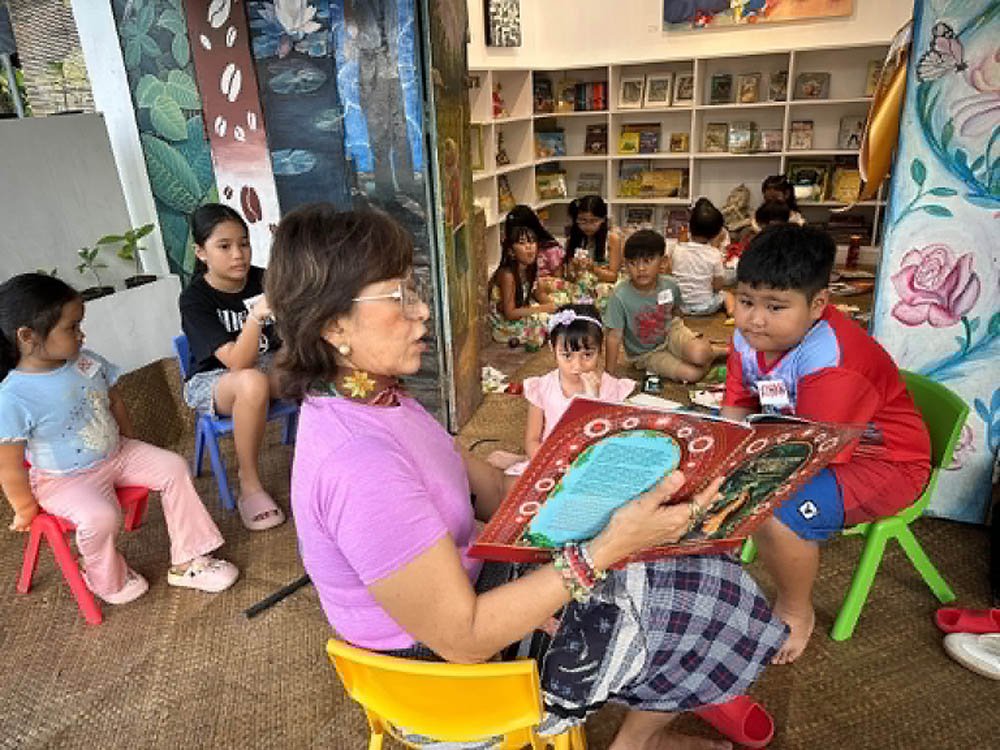
Ces Drilon at the Magnet Community Library in Dumangas (Photo courtesy of Rock and Ces Drilon)
Creatives Everywhere
The creative culture of Iloilo is not only in its cuisine, architectural heritage and museums, or in the colorful street murals and monuments which one may freely enjoy. There are talented buskers everywhere. Their live acoustic strumming and singing are more conducive to leisurely strolling around the malls, than the usual intrusive pounding and throbbing of electronic beats over the PA system. In return for the brief pleasure that a busker gave you by openly sharing her song, you can walk away or respect the artist through a monetary token of your appreciation. This is not mendicancy, but a gracious exchange.
Considered one of the most livable cities in Pilipinas Nating Mahal, it is a favorite among retirees and digital nomads.
Artists everywhere need community support to survive and to thrive. On weekends, the five members of the Ambahan Typewriter Poets Collective whose Hiligaynon tagline “Te ka’y gapaminsar ako, gasulat ako.” (I think, therefore I write), usually set up near the Molo Mansion parking lot, or outside Book Latte along the Mega World Festive Walk. Aside from the typewriters, their self-published books of poetry and fiction, as well as calligraphy implements and scrolls are also laid out on their tables. One may ask for a personalized poem, or bit of flash fiction, or have a scroll inscribed in baybayin badlit or Hanuno’o Calligraphy, the specialty of erstwhile M.D., Bert Palmares.
As poet Ges Jaicten observes, people often do not realize that they need poetry in their lives--until they have one personally written for them. Although money changes hands, it is not a purely commercial transaction. There is an unquantifiable and indefinable trust between the “buyer” of the poem and the poet who creates this, involving nuances of meaning, labor and costs. It is this trust in its many forms, that helps to strengthen a community as well as our souls, just as good food does for our bodies. In Iloilo, you find plenty of both.
Maria Carmen Sarmiento is an award winning writer and the former Executive Director of the PAL Foundation. She can be reached at menchusarmiento@gmail.com; menchusarmiento@ymail.com.
More articles from Maria Carmen Sarmiento
