

The Manong Who Never Loses
/
FilipinoDama.com
I learned the game from my neighbors and cousins when I was seven, maybe eight. The first thing you learn about dama (native checkers) is not how to make a move. It’s that the game punishes politeness. In Filipino dama, captures are not optional. If a jump is on the board, you must take it — and not just any jump, but the longest one available, the line that eats the most pieces. Hesitate, play the safe move instead, and the manong will reach across the board, make your capture for you, and shake his head like you had tried to pay for gasoline with prayer.
That rule — mandatory capture, maximum capture — is where all the arguments come from, and the arguments are half the game.
Is a line of three men worth more than a line of two if one of the two is a dama? Someone's uncle insists the count is in pieces; someone else swears his own uncle, a jeepney dispatcher of great integrity, counted quality over quantity.
Voices rise. Bystanders are consulted. A tricycle driver who has not played in years delivers a ruling like a Supreme Court justice. Then the caps go back on the board and the game continues. The rules of dama were never written anywhere. They lived in the manongs, passed down by argument, the way a dialect survives by being spoken.
Old Game
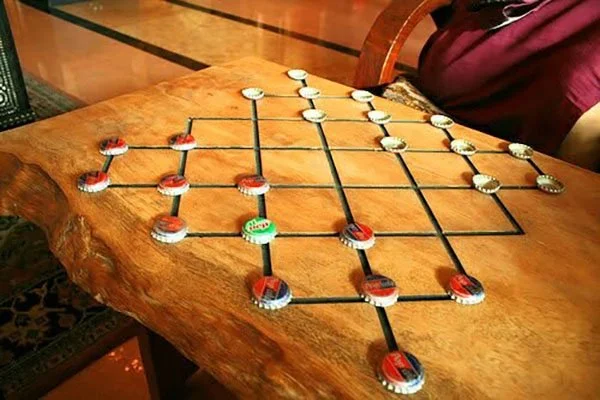
The traditional Dama game (Source: Memories of Old Manila Facebook/Beatriz Manansala)
The game itself is older than any of us knew. Dama descended from the Spanish damas, brought over in the colonial era, and when the American anthropologist Stewart Culin surveyed Philippine games in 1900, a form of dama was already there among them — played then on boards of drawn lines and intersections.
Over a century it shifted, the way spoken things do: onto the 8x8 checkered board, onto plywood and bottle caps, into the plazas and barberias. Filipino dama grew its own distinct body of rules — men that capture backward as well as forward, the crowned piece becoming a "flying" dama that slides the whole diagonal like a bishop with a grudge. It became ours. And still, nobody wrote it down.
My own dama years came in two waves, and the first is still vivid to me: a knot of cousins and neighborhood kids crowded around one board, winner-stays, everyone else loudly coaching whoever was losing. That was how the rules reached me — not from a book but from children barely older than I was, who had them from children barely older than them.
The second wave came in high school, when the games had already thinned to occasional ones, a match here and there when a board turned up. And then, they went quiet altogether. Nobody decided to stop playing. I did not even notice at the time that anything was being lost.
Undocumented
Undocumented games do not die loudly. There is no funeral for a board game. The bench empties one player at a time, the kids drift a few meters away into their phones, and one day the plywood board is just gone — used to patch a fence, maybe. When a manong dies, his openings die with him, his traps, his rulings on the quality-versus-quantity question. What is lost is not entertainment. It is a whole afternoon culture: the teasing in Tagalog, the lessons about patience and consequence, the etiquette of losing to your elders until the day, unthinkable and inevitable, when you finally beat them.
So I decided to write it down. All of it. I documented the Filipino rules move by move, in English and in Tagalog, and then I went one step further and rebuilt the game itself as a free browser game at FilipinoDama.com — no downloads, nothing to buy — so that it runs on the same phones that pulled the kids off the bench in the first place.
There was a certain justice in that, I felt. Building it forced a strange reckoning: a computer cannot shout, so every argument the plaza settled by volume, I had to settle by decision. Encoding the rules taught me that the arguments were never a flaw in the game. They were the way the game was remembered.
Across Distances
What I keep thinking about now is distance. There are millions of us scattered from Daly City to Dubai to Doha, and a plywood board does not travel — but a link does. A kid in California can now play the exact game her lolo played outside a barbershop in Romblon, flying dama and all, and when she visits home she will not need anyone to go easy on her.
The writer decided to write down all the unwritten rules of the Filipino board game dama, move by move, in English and in Tagalog, and rebuilt the native checkers as a free browser game at FilipinoDama.com.
The browser version was never meant to replace the bench. It is a bridge back to it. The real dream is smaller and more stubborn: that somewhere, a father who half-remembers the rules looks them up, draws a grid on a pizza box, raids the refrigerator for bottle caps, and sits down across from his daughter.
The manong who never loses is not really a person, I have come to think. He is an office, like barangay captain’s — vacated and filled, generation after generation, for as long as there is a board and someone willing to be beaten at it until they learn.
Someday, if I am lucky and stubborn enough, the office will fall to me: some plaza, some bench, some kid across the board hesitating over a capture. I already know what I will do. I will reach over, make the move for them, and shake my head — because that is how the game is taught, and the game, salamat sa Diyos, is still being taught.
John Rey grew up in Romblon, Romblon, an island province in the central Philippines, and is the builder of FilipinoDama.com, a free browser version of Filipino dama with illustrated rules in English and Tagalog. He built the site so that the game his cousins and neighbors taught him would stay within reach of the next generation, wherever in the world it grows up.
