
Teacher Gigi Can Make You Love Math
/
Dr. Gigi Carunungan, Ed. D is a visionary educational leader dedicated to transforming learning environments that grow students’ potential in the 21st century. "Everything meaningful comes from connection: between ideas, between people, and between heart and mind,” is her guiding principle in life. (Photo courtesy of Dr. Gigi Carunungan)
What if math were taught differently, specifically through visual storytelling? This is exactly the approach of Dr. Gigi Carunungan, Ed.D.
When you meet her for the first time and ask, “What do you do?” She’ll say, “We write and publish picture books for children.” Who doesn’t love picture books? Then you’ll follow-up, “What kind of stories do you write?” She’ll reply, “Math stories.”
Instant buzzkill, especially if you belong to the team, “I don’t like math.”
Dr. Carunungan is fully aware of this, saying, “When sharing about our math stories, the word math often changes the tone of the conversation. ‘I’m not into math’ is a typical reaction, or the occasional, ‘In school, I was good at math.’ The word math tends to evoke strong emotional memories—mostly negative, though a few times positive—often tied to how successfully or unsuccessfully one performed in the subject during school.”
Dr. Carunungan explains that math anxiety stems from how it is taught—as rules to memorize rather than ideas to understand. When children practice solving math problems before they truly understand the relationships behind the concepts, they begin to associate math with fear of failing because they can't memorize every step. Over time, that fear is passed down through generations. “It’s a cultural pattern—not that people are “bad at math,” but that math has lost its connection to human experience.”
The stories in her picture books link math to daily life. They take place in a small town with diverse, relatable characters. In Maya the Clothes Maker and Ramon the Button Maker, kids learn how to recognize patterns. In Manuel the Table Maker, they are introduced to triangles and polygons. In Farmer Antonio and Ruby the Ice Cream Maker, the concept of skip counting is introduced, and Pipa the Architect teaches area and square inch tiles. There are more math stories in the accompanying YouTube channel, MathXplorers.
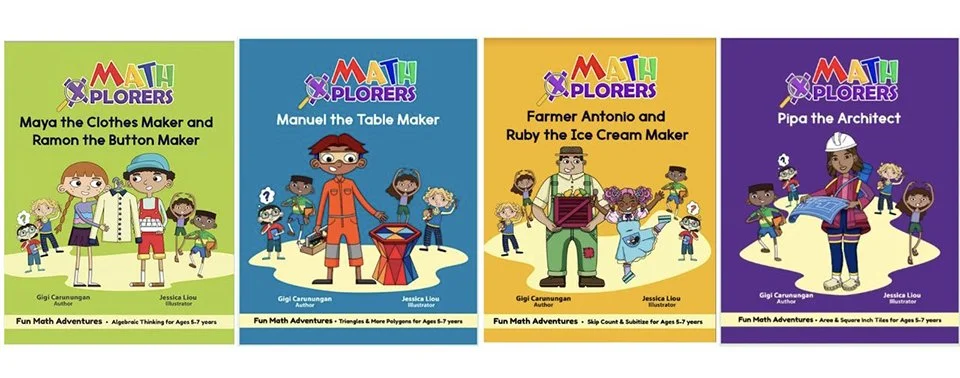
MathXplorers are books by Dr. Gigi Carunungan that teach math through storytelling. The series won the "Innovation Award" from the Independent Book Publishers Association (IBPA) in 2024. MathXplorers is also available as video stories on YouTube.
MathXplorers is the system Dr. Carunungan developed to nurture confident problem-solvers who can think and act mathematically in any setting. Because of MathXplorers, she was selected to take part in the Independent Book Publishers Association’s “Innovative Voices Program” in 2024, recognizing her contribution to her community as an independent publisher from a marginalized group.
The idea for MathXplorers came from her doctoral research. “Math education has failed and continues to fail most of our population. I aimed to understand why and create a solution to address the issue.”
She found that when math is taught through storytelling, it engages both emotion and logic. Through mathematical modeling, “we distill, connect, and solve using abstract math ideas in simulated real-world contexts.”
The study concluded that when children make sense of the situation, problem-solve for the characters, and predict through relational understanding, they remember better, engage longer, and, most importantly, see math in their world—not as something distant or intimidating.
“Mostly, I see eyes light up. Math makes sense with stories. When adults watch how the math story videos introduce math ideas, such as ‘The total number of the same kinds of buttons is a set’ or Equal and not equal, they remark how these concepts were not highlighted when they first learned mathematics in primary school.”
Can this approach still work for adults who don’t like math? She says, “Absolutely. Adults can rediscover math the same way children do—by reconnecting it to life. When parents read our stories with their kids, they often say, ‘I wish I had these stories when I was a child. Now I get it.’ They begin to see math in patterns, in cooking, in budgeting, in equations that solve real-world challenges. This process heals their own math trauma and helps them teach with confidence and joy.”
This May, Dr. Carunungan published a new book, Teaching Through Math Stories, a guide for elementary school teachers to design engaging lessons to make math learning fun.
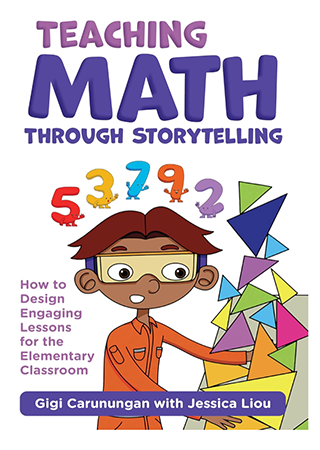
In June, Dr. Gigi Carunungan published Teaching Math Through Storytelling (Teachers College Press, Columbia University, 2025).
Dr. Carunungan learned creative problem-solving at a young age, saying, At age 11, she joined the Philippine Educational Theater Association - Central Institute of Theater Arts in Southeast Asia (PETA-CITASA). It’s an educational theater company that designed a framework for creating performances called the integrated arts approach, and merged it with a process of building from simple to complex works using elements of art and composition.
This approach influenced the way she sees education. In addition to creating theater pieces, it inspired her to design lessons for teaching and learning to ignite people’s ideas and grow creative abilities. “I developed curricula for topics outside the realm of theater using the integrated arts approach, like political economy, civics, entrepreneurship, and more.”
Twenty years in theater shaped her career choices. “Theater is called the mother art because it integrates all the arts. I was an artist, teacher, and leader. When I was 16, I wrote my first song for the theater. By age 21, I had the chance to serve as the musical director of Macbeth under Fritz Bennewitz, the director of the Berlin National Theater.”
After graduating with a B.A. in Philippine Studies with an integrated set of majors in literature, music, and political science from the University of the Philippines, she says, she wanted to grow into a profession that helped people. “My father sparked my potential. I sought a career that combined service and creativity. I was never a traditional type of educator. As a mom of two boys bored in school, she launched her first start-up in the Philippines called OurTurf, an after-school multimedia learning program that evolved into an online teen company. “I sought to introduce the internet as a canvas for teens to grow their voices and creativity. Adobe, HP, and Intel supported the start-up.”
Moving to the U.S. allowed her to pursue a graduate degree in Education, majoring in Curricula and Special Education at the New Mexico Highlands University, New Mexico, followed by a doctoral degree in Educational Leadership from San Jose State University, California. She is currently based in San Francisco.
As an educator, she designed and taught standard K-12 school subjects using the integrated arts approach and design thinking. “I couldn't grow OurTurf in the U.S. because in the Philippines, we see the youth as the future, whereas here there is a tendency to see teens as ‘difficult and irresponsible.’ Additionally, there is so much more emphasis on sports. Creativity is not encouraged in high school. Pass the tests to graduate with the highest grades—that's what mattered.”
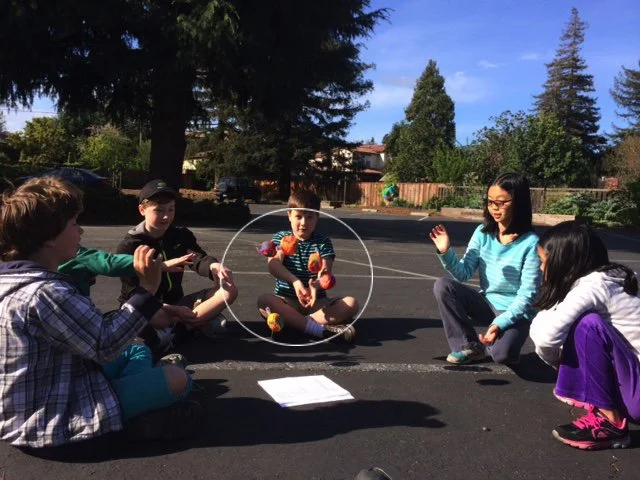
Through her work, Dr. Gigi Carunungan has empowered students to think critically, design creatively, and solve real-world problems. (Photo courtesy of Dr. Gigi Carunungan)
Her background in the integrated arts approach led her to specialize in neuroscience and learning. The senses provide multiple pathways to learning, she says. Schools tend to depend on books. “Texts are organized information or knowledge focused on topics based on the author’s judgment or bias. In mainstream schools, subjects are taught in isolation — math separate from art, story separate from science, and more.”
Dr. Carunungan co-founded Synapse School and Imagination School in the Silicon Valley, California. These kindergarten to eighth-grade schools provide integrated, holistic, and thematic STEAM curricula.
At Synapse School and Imagination School, she addressed the fragmentation of learning. Instead of disconnected topics, the curriculum was built around themes, hands-on activities, project-based work, and solutions-driven approaches.
“The aim was to shift learning from mere memorization to analytical thinking, fueled by curiosity and focused on applying knowledge by fostering creativity and collaboration with peers to create a better world. Learning should be a living, integrated system, not just a checklist. Students need a purpose for learning, not just to pass tests.”
With Artificial Intelligence, students should not spend too much time on rote memorization of facts, she says. She created a framework that implements “Maslow's hierarchy of needs, enabling students to learn through self-actualization as part of their daily school experience. Additionally, they engage in higher levels of knowledge acquisition and use, guided by Bloom’s taxonomy, with thematic guidelines fueling the integration of elements into a working solution to real-world problems created by students.”
Dr. Carunungan explains that math anxiety stems from how it is taught—as rules to memorize rather than ideas to understand.
She constantly asks herself: “What do students need to know for an unpredictable future? How should they learn these skills and concepts? What kind of learning environment will cultivate future innovative and ethical leaders?”
While Silicon Valley is the technology and innovation capital of the world, sadly, she says, K-12 schools in the valley do not match that reputation. “Albert Einstein reminds us, we can’t solve problems by using the same kind of thinking we used when we created them.”
She created the Helical Learning Model, the methodology that drove the learning in both Synapse and Imagination Schools, she explains. “The Helical Learning Model is a constructivist, hands-on approach that guides students through a progressive cycle of discovery, analysis, and creation. Learning begins with simple, engaging activities that spark curiosity, then moves toward increasingly complex, imaginative, and collaborative projects. Through interactive, multi-modal experiences, students explore concepts, apply knowledge to real-world problems, and reflect on patterns and outcomes.”
Teachers facilitate guided analysis, helping students connect ideas, form generalizations, and construct deeper understanding across subjects. She explains further that by grounding theory in shared class experiences and creative problem-solving, the Helical Model cultivates higher-order thinking, communication, and interdisciplinary connections, enabling learners to engage meaningfully with science, mathematics, the arts, and the humanities.
“The five stages of learning that define the Helical Model are Play, Explore, Connect, Imagine, and Remember.”
She believes that the biggest challenge to implementation is shifting old mindsets. Many people still equate rigor with rigidity. She shows teachers that rigor can coexist beautifully with play — that curiosity enhances understanding. “Once they experience the Helical Model in a workshop or read and watch the math stories, teachers and parents recognize what I call the ‘magic,’ the ‘aha,’ and the ‘excitement’ in learning. Students are excited to learn and leave school with a positive sense of self and the world.”
The measure of success? Her students love math! She also received the “Education Innovation Award” this September from PhilDev, a non-profit organization enabling Filipinos to thrive in STEM through education, innovation, and entrepreneurship.
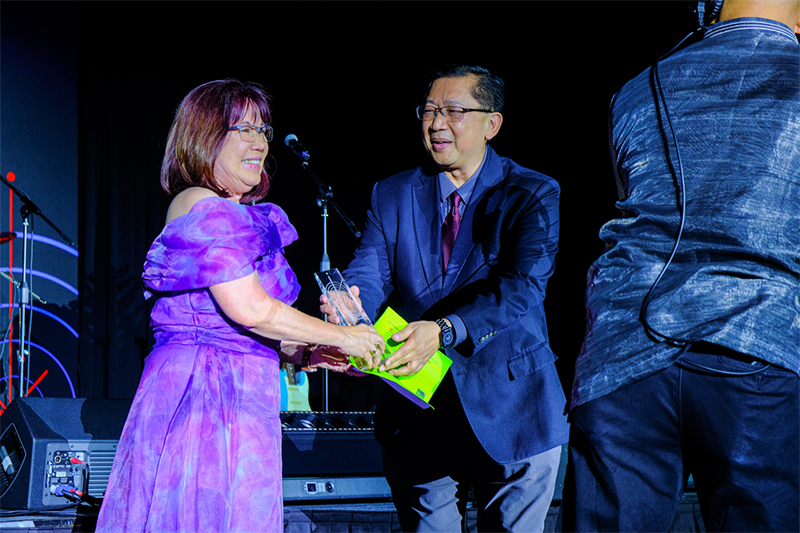
Dr. Gigi Carunungan receives the PhilDev Education Innovation Award 2025 from Rigoberto Advincula. (Photo courtesy of PhilDev)
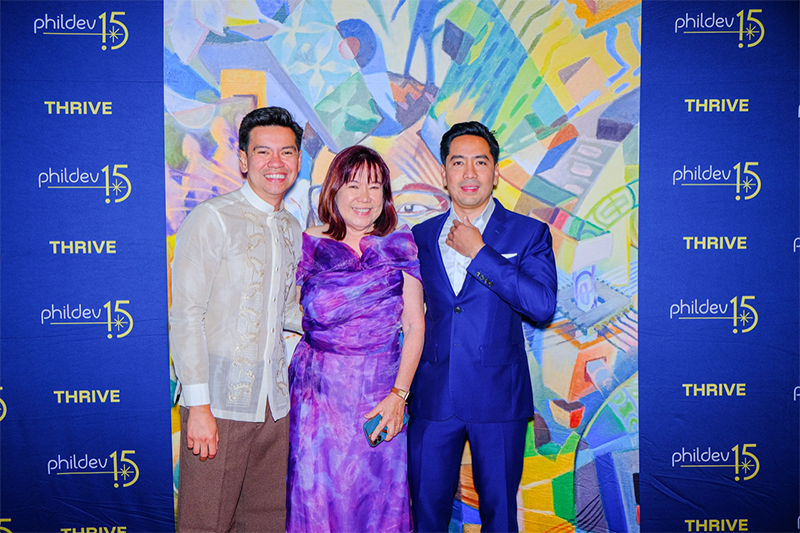
Dr. Gigi Carunungan with her sons Amyel and Victor Oliveros at the PhilDev Thrive Gala and Awards 2025. (Photo courtesy of PhilDev)
“What’s most rewarding about my profession is witnessing transformation—when a child, teacher, or even a parent who once said, ‘I’m not good at math,’ suddenly discovers joy and confidence in learning. Seeing curiosity replace fear is deeply fulfilling.”
Through the program she has built — from to MathXplorers to Teaching Math Through Stories, and the Helical Learning Model — she gets to watch ideas come alive: teachers rediscover their creativity, students connect math to their own lives, and classrooms become communities of imagination and inquiry.
“The reward is not just academic growth. It’s seeing people light up with the realization that they can think, create, and contribute — that learning is, in itself, a joyful act of becoming.”
Claire Mercado-Obias is a writer, food stylist and pastry chef based in New Jersey.
More articles from Claire Mercado-Obias
