

Southern Encounters: A ‘Mindanawon’ Identity
/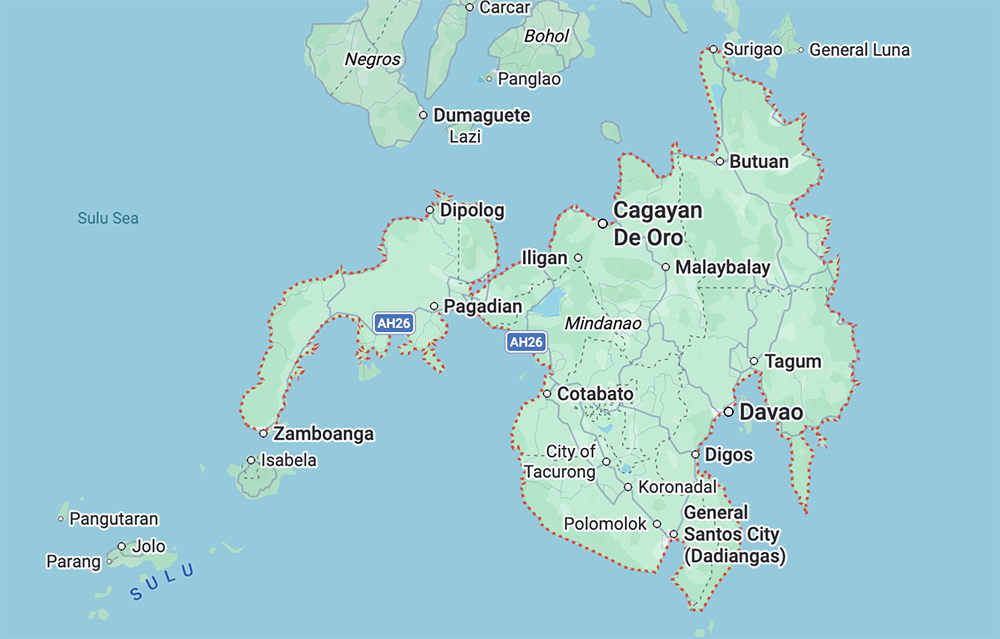
Mindanao (Source: Google Maps)
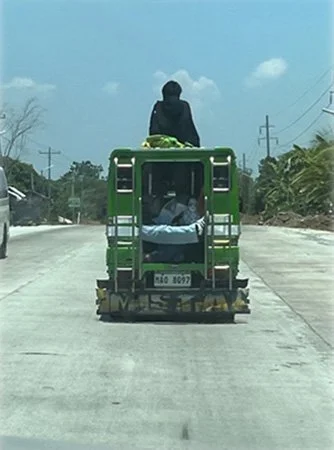
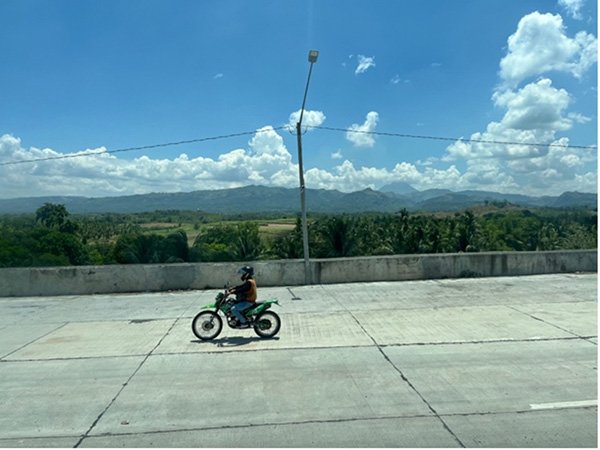
Maharlika Highway connecting Cotabato and General Santos. (Photos by Patricio Abinales)
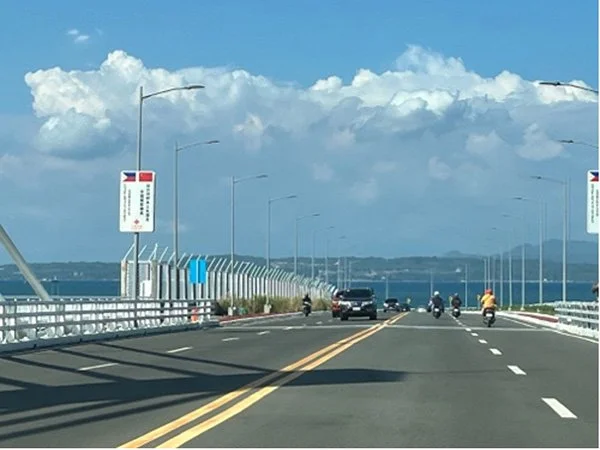
Davao City Diversion Road (Photos by Patricio Abinales)
This groundswell of support is rooted in a different vibe that animates politics on the ground, one that is antipodal to what happens, or what is shown to be happening in the capital. In Manila, there is optimism that political reforms are just around the corner. In General Santos, however, everyone looks forward to the Ateneo-educated grandchild to cement the family legacy, build more roads, and repair bridges.
In the capital, changing minds is paramount; locally, it is telling people that the progeny has the talent and goodness of the aging patron. Meanwhile, in the auditoriums of academe, the halls of Congress, and TV talk shows, conversations about a working democracy are performative and fictional; at the town plaza or the barangay hall, the natter is about food and money.
Infrastructure has likewise changed the landscape in which people traveling “engage” with each other. The small stalls where passengers of jeep, habal-habals, even “provincial” buses demand to stop to eat the local bibingka, buy a kilo of the kape barako or muscovado sugar, and drink coconut water have disappeared. In their stead are a parade of advertisement boards luring the same passengers to the malls at each city endpoint. And just to make sure they do, the malls add perks like free cars and even free trips to holy places! There is every reason for the malls and businesses to put up their ads on the streets.

Roadside billboard advertising the Hajj (Photos by Patricio Abinales)
But that is not all. The self-advertising tarpaulins that were once only found in Marawi in the 1990s now compete with the corporate billboards in southern Mindanao, suggesting a newfound self-confidence replacing the old ethno-social insecurities arising from living in the frontier, being Moro, and promdi (hayseed). Here is an advert for the daughter who passed the medical board exam; a tarp announces that a son has passed the bar. Even a bachelor’s degree in nursing merits a roadside canvas. The reason behind this social upgrading is straightforward. OFW remittances, especially, have given families that extra income to spend on promoting their social advancement.

A Cotabato State University tarpaulin (Source: Google Photos)
Sara’s appeal comes from this economic instrumentalism. Her promise to defend the “progress” she and her father brought to the south makes it more powerful. They say BBM falsely claimed this “progress,” which will end if his successor wins in 2028. “Ato ni si Inday,” they say. All allegations against her are schemes really aimed at “us.”
The “us” here is not anymore ethno-linguistic nor religious–the usual bases of distinctions and, often, violent differences.
It is not about being Tausug or Magindanaoan, Ilonggo or Hiligaynon, B’laan or Manobo, Cebuano, or a Boholano. In an island with a large part belonging to the informal sector (more than 80 percent in the Bangsamoro Autonomous Region, BARMM), the overlap between the illicit and the licit makes bosom buddies out of corporate executives, distributors of smuggled goods, coordinators of food stalls and ukay-ukay, and managers of local cooperatives.
The “us” here is about being “Mindanawon,” of a people of an island that has always been getting short shrift by the Lords of the Imperial Capital. This sense of being aggrieved is wide-ranging: from protests about Mindanao not getting its proper share of national revenues, to the nasty, irresponsible asides about the island’s purported sub-Saharan backwardness by nattering nabobs like Richard Heyderian.
I never sensed this unanimity before, when I was a graduate student doing fieldwork. I began to have an inkling of it when friends like Mindanews founder Carol Arguillas and the Jesuit exile Fr. Albert Alejo began using it regularly. The moment when I knew “Mindanawon” had achieved gravitas was when Resil Mojares casually asked, “What is the origin of the word Mindanawon?” My national artist friend and fellow Bisaya had noticed that it now has substance, given the sheer number of people referring to them as people of the island.
The further confirmation came in a workshop discussing how to add Mindanao’s stories to national history, expressing their commitment to express with “one voice” the diverse histories of the Moro groups, the indigenous communities, and the settler areas. There were debates over context, identities, and concepts, but the group, led by senior scholars Magindanao Datu Michael Mastura and Iligaynon Rudy Rodil, and rising academic stars like Patricia Dacudao (Ateneo de Manila but from Davao) and Giovanni Caballero (Mindanao State University-Iligan Institute of Technology), were unanimous that Mindanao’s peoples be treated as one.
Which brings me to the opposition chatter in the imperial capital. There is something Quixotic and faintly amusing in the social media posts of the opposition (complete with selfies!), the supposedly "sophisticated" anti-dynasty spiel of academics in campus auditoriums, and the sound bites of pundits in their ill-fitting suits. These manifestations stem from the belief that a TV interview or an academic explanation – filled with graphs and dull concepts - will suffice to sway people to their cause. Do they truly think that denouncing political clans from the comfort of the capital will make people in Toril, Pigkawayan, Midsayap, or Tagum turn against those in power?
The “us” here is about being “Mindanawon,” of a people of an island that has always been getting short shrift by the Lords of the Imperial Capital
The only opposition politicians who understood that “all (Philippine) politics is local” and that the important battles are won in the towns and provincial cities are Mayors Leni Robredo and Vico Sotto. Both know that making effective social policy and holding power involve a ground-level, long-term war of positions. This means seeing through the completion of infrastructure projects, which, in Leni’s case, includes a mutual accommodation arrangement with her erstwhile opponent Ferdinand II. It necessitates face-to-face engagement with constituents, which, in turn, demands an in-depth familiarity with local slang and variations of the city lingo— something Kiko, Risa, Leila, and Bam-Bam are ill-equipped for. They can shake people’s hands, but they can’t talk to them about their daily lives in their argot. Don’t even bother to ask about the pundits and the political scientists.
In the middle of this growing pride over island identity is Sara Duterte. People here say she is not the daughter of the bel esprit tumid Rodrigo Duterte, but the vorpal yet humble offspring of decent Elizabeth Zimmerman. Manila will have a serious problem if her opponents cannot bring down Sara Duterte. For if she wins in 2028, there will surely be political retribution from someone whose kids are named Shark, Stingray, and Stonefish.

Patricio N. Abinales recently visited Cotabato, General Santos and Davao, his first since 2008. A professor emeritus at the Department of Asian Studies, University of Hawai'i-Manoa, he now lives in Quezon City.
More articles from Patricio Abinales
