
Mama’s Last Lesson
/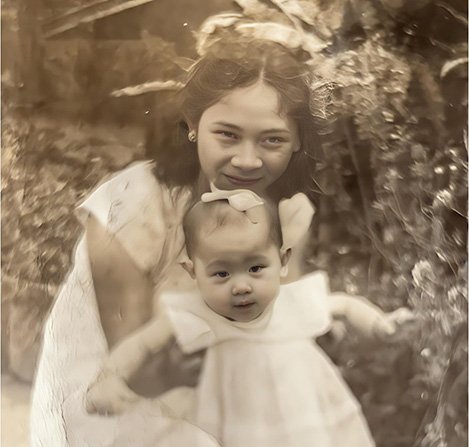
The author and her mother, Rosario Valdes Lamug, in Manila (Photo courtesy of Nanette Carreon-Ruhter)
Four years later, her prayer was answered in a way that shook me. She was diagnosed with stage four breast cancer and given three months to live, and my thyroid cyst never troubled me again.
I flew home from Taipei, where I was teaching. By then, her cancer had metastasized, leaving her paralyzed from the waist down. A spinal operation was meant to stop the paralysis from reaching her heart.
The hospital room smelled faintly of disinfectant and lavender lotion. Her hands were thinner than I remembered, her fingers tracing the rosary she kept close even in sleep. I had taught poetry for years, but nothing in words prepared me for the sight of my mother—still beautiful, still proud—battling her own body with grace. Before the surgery, she called me to her bedside and dictated her own obituary in Spanish, an article for The Manila Bulletin. Even in the face of death, her mind was lucid, disciplined, and she was still the teacher.
When my eldest son, Pep, her first grandchild, flew home from Madrid during his junior year, she came alive again. Her eyes lit up as they spoke in rapid Spanish, reminiscing about her years in Madrid and her dear friend, Mariconchi, her landlady and Pep’s. For those moments, she seemed to forget the pain, the paralysis, even the tubes that tethered her to the world. She was once more the elegant professor, the woman in command of her language and her memories.
When we brought her home, we hired a nurse to help take care of her. I slept beside her each night, listening to the rhythm of her breathing, wondering what filled her mind during those long, silent hours. The tracheostomy had taken her voice, so our conversations were made of glances, of half-smiles, of tears that neither of us wiped away. Sometimes I would lie awake beside her, imagining the words trapped in her throat…the things she wanted to say but no longer could. I wished I could borrow her silence, learn its strength, its quiet surrender.
I had written her a long letter about my unhappiness and my decision to get a divorce, one that she read but never answered. I knew she was angry, though she never said it outright. It wasn’t Filipino custom to confront complicated or emotional issues. So, details were left unsaid, and silence did the speaking for us.
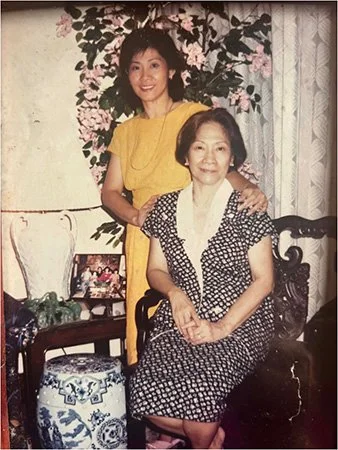
The author and her mother in Hong Kong in the mid-1980s (Photo courtesy of Nanette Carreon-Ruhter)
The irony was surprising. Years earlier, she had wanted to leave her marriage for the same reasons I wanted to end mine. When she couldn’t, she urged me to ask my father to leave for America, to separate quietly, without scandal. Yet now, she wanted me to stay. Not because she did not believe in my pain, but because she could not bear to see me repeat hers.
For years, I mistook that silence for pride. “What would people say?”—that refrain haunted me. She had spent her life preserving our family’s good name, receiving the Isabella la Católica medal personally from King Juan Carlos of Spain for her efforts in preserving Spanish language and culture in Philippine universities. Reputation was her armor; integrity, her creed. I, her stubborn daughter, wanted none of it.
When her time was near, my Tita Vicentica begged me to tell Mama I would patch up my marriage, to give her peace in her last moments, but I couldn’t. The words caught in my throat. I could not send her off with a lie.
So, when she slipped into a coma, I leaned close to her ear and whispered, “Ma, I love you. Do not worry about Cholo and Butch.” And then, more quietly, the only truth I could give her:
“I promise you, I will be happy.”
I like to think she heard me.
And from where she is now, she knows—
I have kept that promise.
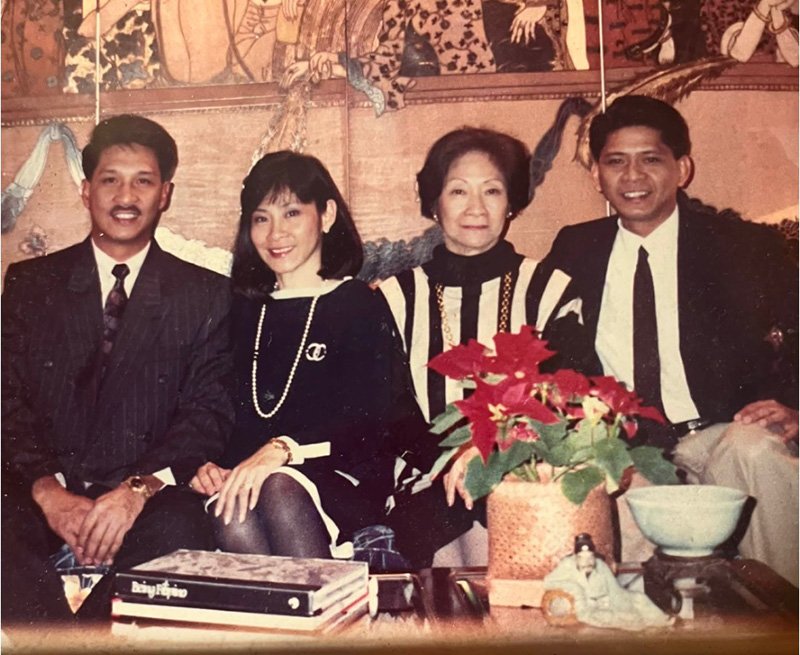
The author with her brothers, Pocholo and Butch, and mother in Hong Kong in the early 1980s (Photo courtesy of Nanette Carreon-Ruhter)
Epilogue
In time, I came to understand what she had meant by strength. It wasn’t the silence I had once resented, but the courage to live with love that costs you something: to choose grace even when words fail.
My mother never said, “I love you,” in the way I had longed to hear it. Her love was in her worrying—her need to protect us from disappointment, her wish that our lives be easier than hers had been, her insistence that we behave with grace so others would look up to us. It was in the way she flaunted my achievements to her friends, as if each one proved that she had done something right. That was her language of love: quiet, guarded, yet constant.
I inherited many things from her: her discipline, her resilience, her faith; but what endures most is her belief that God listens, that love, especially the one between a mother and her daughter—despite its silences, its imperfections, redeems us in the end.
When her time was near, my Tita Vicentica begged me to tell Mama I would patch up my marriage, to give her peace in her last moments, but I couldn’t
Every time I stand before my students, teaching language and literature, I remember her: the woman who gave her voice to words, and, when she lost it, taught me how to listen for the ones left unspoken.
“My Mother in the Mirror”
At seventy-seven,
I meet my mother in the mirror,
not only in the gentle slope of my nose
or the familiar curve of my smile,
but in the way certain words escape my lips…
as if they had been resting on her tongue,
waiting for mine to speak them.
“Hay moros en la costa …” she would caution,
eyes narrowing with playful warning
whenever truths needed shelter.
“Amigo de su gusto,”
she’d say with that knowing lift of an eyebrow,
a whisper of wit and wisdom intertwined.
When I hear myself say them now,
I feel her beside me again.
I understand her more now,
the fierce, protective love
that hovered like a shawl
she could not help but wrap around me.
My sons tease me for this instinct,
and I smile, remembering…
There was a time I wished Mama
would loosen her embrace
and let me take the reins of my own life.
Only motherhood teaches
how tightly love can hold
even when the heart longs for release.
I followed her into the classroom,
she into chalk-dusted rooms
and I into bright, board-marked mornings,
both of us surrounded by the scent of books
and the hum of young minds opening.
She mothered her students,
I learned to mother mine.
They called me Mommy C, Mama R,
as if her tenderness flowed through my veins
and reached them through my hands.
Mama showed me how a home could exhale warmth,
how a dining table dressed with flowers and linen
could turn a simple meal into memory.
She taught me that “thank you” was a prayer,
and hospitality a blessing offered with grace.
Elegance, she showed me,
needed no grandeur
only thoughtfulness, care, and heart.
Wednesdays carried the scent of candles and hymns.
Baclaran was her sanctuary,
a weekly pilgrimage of folded hands
and whispered petitions
to Our Mother of Perpetual Help.
Now I find myself doing the same,
asking the Blessed Mother
to cradle my sons and grandchildren
in the same mantle of protection
Mama once wrapped around us.
There are moments I still speak to her,
in the hush before morning breaks
or in the soft dim of night.
I tell her of the ordinary and the sacred,
of gratitude that overflows beyond words.
I ask her to keep watch,
over my boys, over their children,
over the corners of my heart
still learning how to forgive.
Some memories sting.
I once wrote her a long letter
about my marriage,
the deep wound of deception,
the unraveling that followed,
and my decision to walk away.
Even from an ocean away,
I felt her heartbreak tremble across the waters.
She had prayed I would never walk
the path she once walked.
I was her “perfect daughter,”
and in that moment, her dreams for me trembled.
But time, like the tide, reveals what must surface…
shells once buried rising
to be claimed by light.
Through mercy, her love found its way back to me,
through grace, I found my way back to her.
For she dwells not only in my reflection,
but in my habits,
my prayers,
my ways of loving as a mother
and now as a grandmother.
She echoes in my grand daughters’ laughter
and in the tenderness
I offer those entrusted to me.
My mother lives here,
in the quiet rooms of my heart
and in the generations unfolding beyond me.
And when I see her in the mirror,
I no longer turn away.
I smile
and whisper,
“Gracias, Mamá.”
Todavía estás por aquí.
The author is deeply grateful to Dexjordi Lyle Sison for his thoughtful help with the photos.
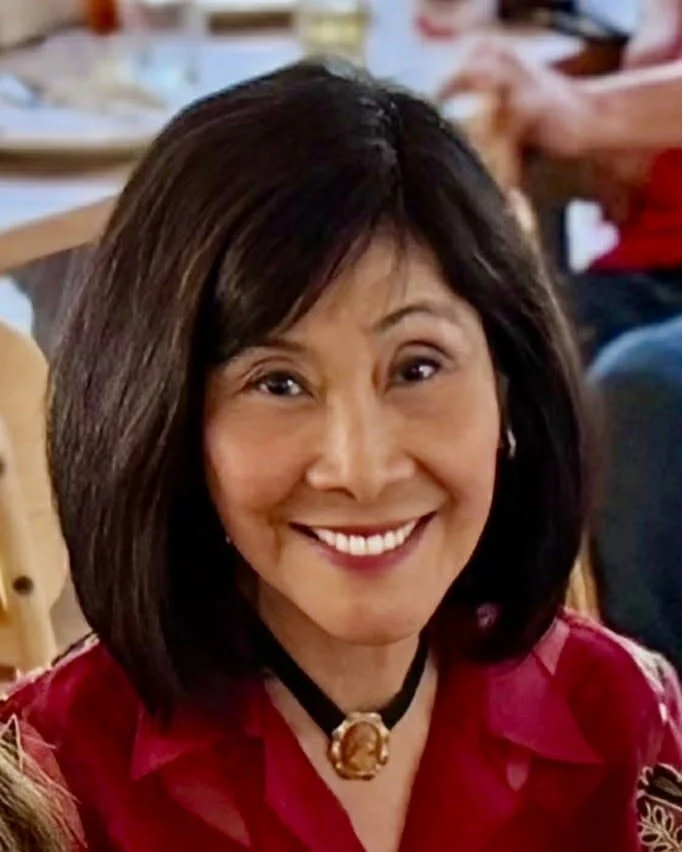
Nanette Carreon‑Ruhter stands as a Honolulu‑based writer shaped by years in international classrooms and a deep devotion to Filipino stories. She previously taught at Hong Kong International School, Taipei American School, and Singapore American School, and has guided creative writing workshops for Filipino immigrants throughout Hawaii. Her essays explore family, identity, and the ways memory becomes a home that travels across generations. She is finishing her memoir, Before Time Slips Away, written for her seven grandchildren. When she’s not writing, she’s on the pickleball court, in the kitchen, traveling with family, keeping close ties with friends and former students around the world, and enjoying life with her husband, Jim.
More articles from Nanette Carreon-Ruhter
