
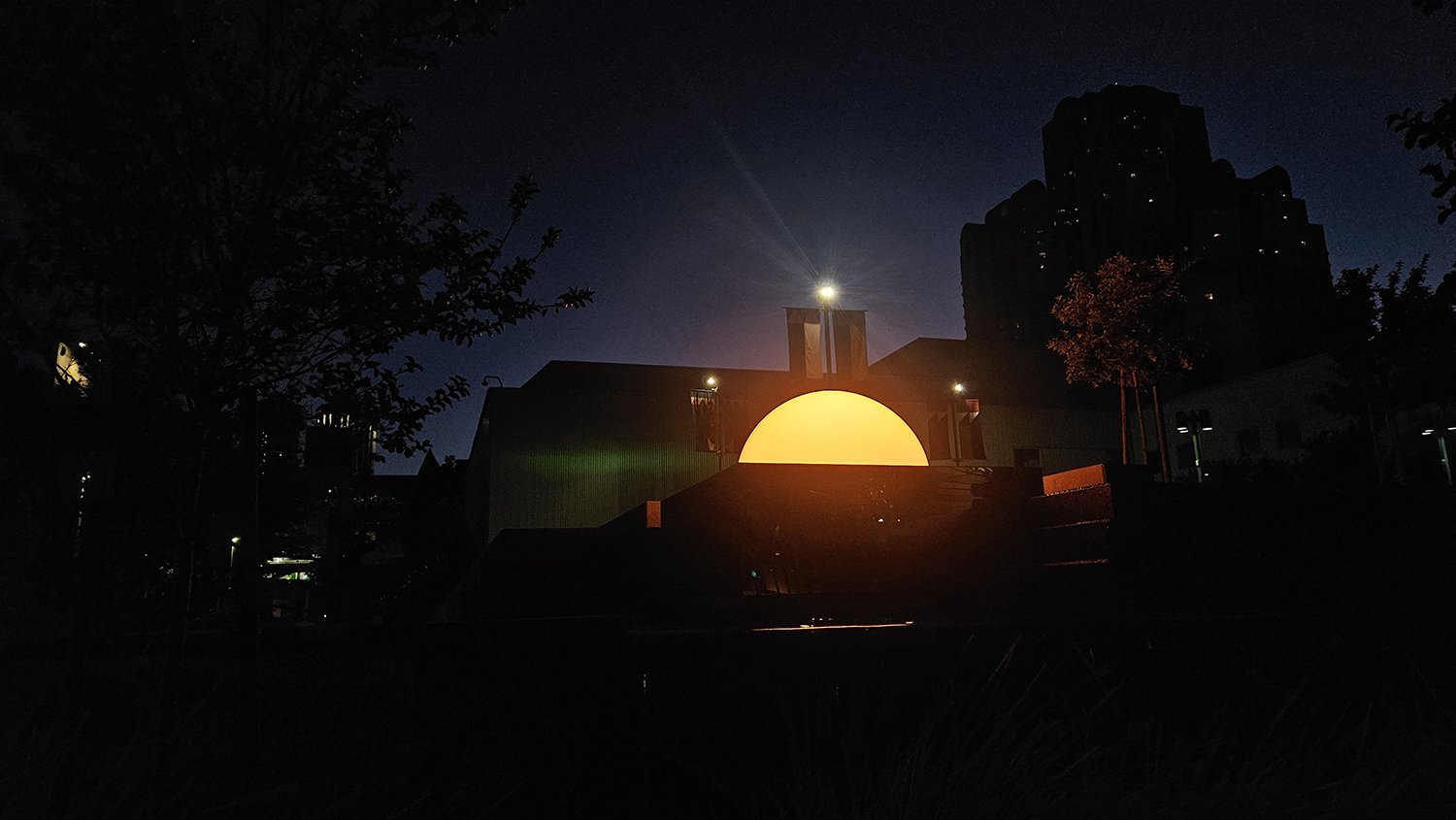
Sari Dalena: A Film Guerrera
/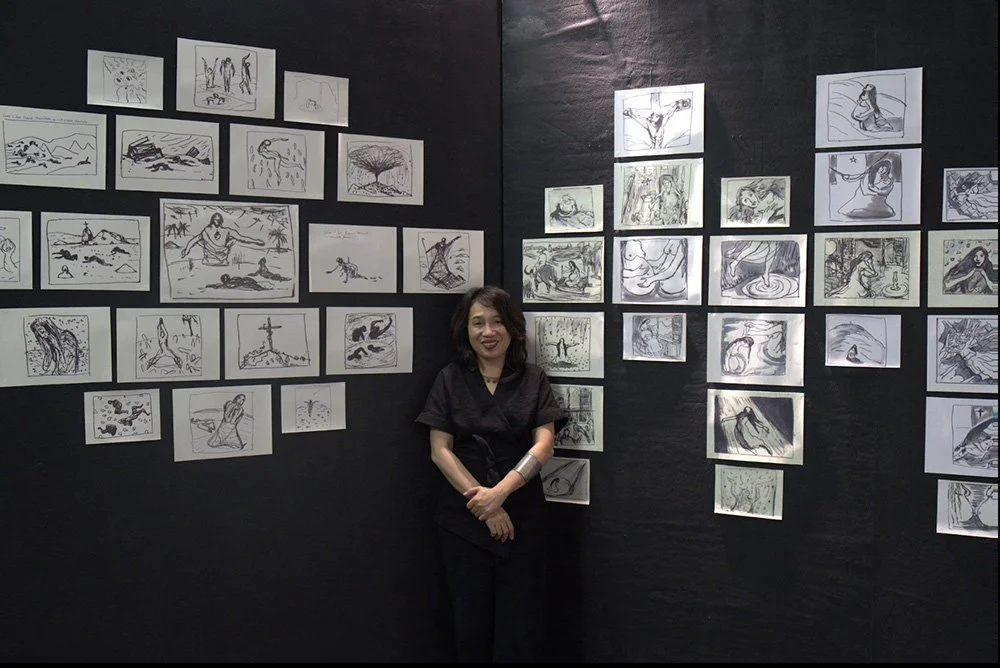
Sari with Storyboards by Danny Dalena
That challenge gave birth to Cinemartyrs, a full-length feature film that won the Best Director for Sari and the Special Jury Award at the 2025 Cinemalaya Independent Film Festival. The film, which explores historical trauma and guerrilla filmmaking in Mindanao, was 25 years in the making and traces its source back to her first feature-length documentary in 2001, Memories of a Forgotten War.
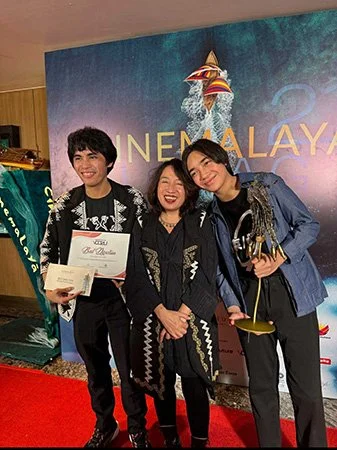
Sari with sons Kino and Paris with the Cinemalaya trophy
A Family of Cinephiles
As a child, Sari, whose parents are celebrated and consummate artists, recalls that one of her family’s favorite pastimes was watching movies. They include a lot of classic films, from the German expressionist Cabinet of Dr. Caligari at the Goethe-Institut along Aurora Blvd, to the Japanese samurai films of Akira Kurosawa in a Japanese film festival. Her father also rented VHS and Betamax tapes so they could watch Charlie Chaplin, Buster Keaton, films by Vittorio De Sica and Alfred Hitchcock in their sala in Kamuning, Quezon City.
Sari was 13 years old when she watched her father, the realist-impressionist artist Danilo Dalena, paint on a large canvas an image of devotees praying inside their hometown church in Pakil, Laguna. She relates, “Smack dab at the center of the frame was a dog wantonly splayed on the church aisle. I asked, out of curiosity, why he painted a dog inside the church.” Her irreverent father replied, “Anak, ang aso na ‘yan, ako ‘yan! (Child, that dog, it’s me!)”
She found the reply absurd and it made her giggle. But it left a deep impression on her. The Asong Simbahan painting was part of the Dalena patriarch’s Pakil series depicting colorful scenes from the Turumba fiesta, the moro-moro during Lenten season, and the askals/aspins (street dogs) lolling around the church when the town plaza became too hot during summer.
Mowelfund Scholar
Almost 10 years later, Sari became a film scholar at the 16mm Experimental Film Workshop at Mowelfund Film Institute (MFI) with Raymond Red and Louie Quirino as mentors. She pitched the story, Asong Simbahan, to the MFI Director Nick Deocampo as follows: “My film tells the story of a young woman who goes inside an old church filled with dogs to confess. Dreamlike and lyrical images will be used to portray the young girl’s disturbed emotions and thoughts of sexual awakening and repentance.” It was chosen as one of the five short films to be produced in the workshop.
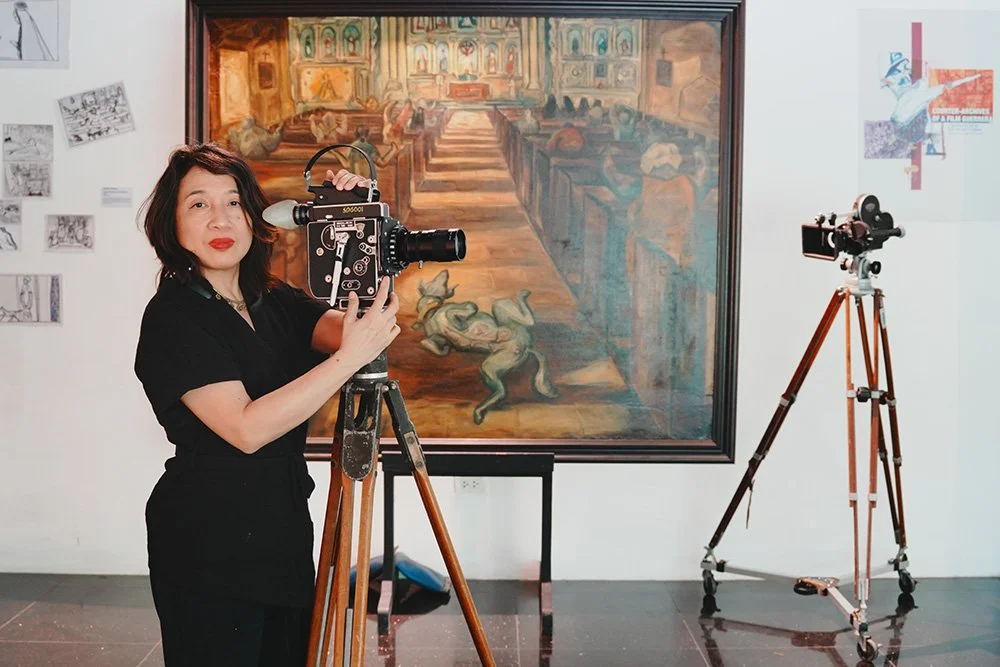
Sari with a Bolex camera and “Asong Simbahan”
Deocampo paired her up with Robert Quebral as cinematographer. Later on, Neil Daza came on board as additional cinematographer along with Jojo Gonzales and Dennis Empalmado as sound recordists. The workshop also provided basic production equipment such as Bolex, Arriflex, or Éclair ACL 16mm cameras, a few rolls of KODAK 16mm film stock, Nagra audio recorder, and post-production support such as discounted lab processing, developing, printing and access to Cinemonta 6-plate editing flatbed at the Philippine Information Agency (PIA). Mowelfund’s Ricky Orellana helped in finishing the film.
Asong Simbahan was shot on location in Pakil. Sari’s father Danny agreed to play the part of the painter and he even drew beautiful storyboards to help visualize the film. For the role of the protagonist, she enlisted her sister Kiri, who was just 18 years old at the time, and a Human Ecology student at UP Los Baños. Her other sister, Aba, a painter and sculptor, took care of the costumes and production needs while mother Julie Lluch, who rose to become a respected terracotta sculptor, helped with logistics. Sari says, “We rounded up the town lolas, mostly close relatives, as suggested by my beautiful grandmother Lola Loleng. The frisky dogs of Pakil came with their owners. Then, we ran to the lake to catch the last rays of sunset, the fading magic hour, where we had Kiri walk on water.”
“At the 1994 Gawad CCP para sa Alternatibong Pelikula at Video Awarding ceremony,” Sari recalls, “poet Maningning Miclat graced the event and read her beautiful poem, Ginugunita Kita. In my very first short film, Sari Saring Pinay for Sari Sari Store in 1992, Maningning was game to play the role of The Artist. Meanwhile, Raymond Red announced after a long deliberation with jury members that they were awarding Asong Simbahan 1st Prize in the Experimental (Film) Category.”
After Asong Simbahan, Sari Dalena was drawn to the impact of the cataclysmic 1991 Mt. Pinatubo volcanic eruption. She developed a story on prophetic visions based on the Old Testament that had parallels to events in the country. It related the devastation inflicted on a nation gone astray with the volcanic eruption that buried Central Luzon and drove the Americans out of Subic Bay Naval Base.
The film titled Puting Paalam/ White Funeral has a story line that goes: The bride, played by Myra Beltran, an independent contemporary dancer and choreographer, roams aimlessly in the desert. Later on, she turns away from God and becomes a harlot. Says Sari: “The bride represents the Philippines and because of her harlotry, people became sick. Murder and thievery prevailed. Lahar floods came soon after. Villages were buried and people were displaced. The bride repented her sins, healing the land. It was a resurrection of the people and a return to their ancestral land.”
From Mowelfund to NYU
Sari’s initial success brought her to New York University where she took up her Master in Fine Arts or MFA in Filmmaking. The rigorous graduate film program at NYU allowed her to collaborate with film and art students on various projects, mostly short features or documentary films, culminating in a graduate thesis film with no less than the multi-awarded American filmmaker and actor Spike Lee as her thesis adviser. The latter showed interest in Philippine history and liked the themes of immigration and diaspora tackled by Sari’s thesis film.
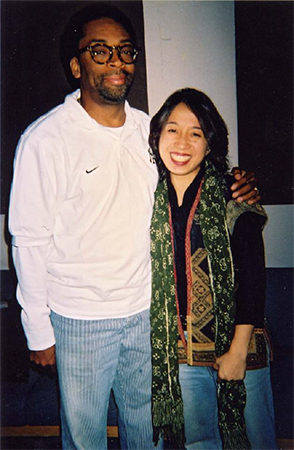
Sari and Spike Lee at New York University
The film, Rigodon was co-written and co-directed by her husband, Keith Sicat. It follows the lives of three Filipino immigrants in the age of racial profiling and government crackdowns after the September 11th attacks in New York City. Amado (played by actor Arthur Acuña) is a boxer too old to continue his profession in his native land. He goes to the United States only to meet the harsh conditions every migrant face as they dream of the families they leave behind. Salome (played by actress Chin-Chin Gutierrez) is the dreaming war-bride who has been married to an American for 10 years, but whose visions still haunt her as she pursues her “American” dream. And Dante (played by actor Joel Torre) is the rebel-poet who has been helping his fellow immigrants for over a decade but who himself needs help now.
Rigodon, according to the young, intense director, is the metaphor used in this film for the various colonial “partnerships” the Philippines endured. It is as well the dance of political spheres of influence, social groups, and the millions of individual Filipinos who have migrated to far-away lands for a new life that seems to go around in a spiral.
In a dissertation interview, Sari likened the filmmaking process of Rigodon to child birth due to the exacting demands required of her as a filmmaker. She was thankful to the Bayanihan-level of assistance accorded her and Sicat by the Filipino community in New York, as well as the institutional support of NYU and its artists’ collective. The Filipino community helped scout for locations for the film as well as tap contacts in the creative industries who could assist in the pre-production phase.
Rigodon took two years to complete, including the pre- and post-production. The cast portraying the three main characters involved a series of networks that required familial as well as institutional connections. Philippine-based actor Joel Torre flew straight from the airport to the film set in New York City to begin his role as Dante, while renowned theater stalwarts Arthur Acuña, Ching Valdes-Aran, and Banaue Miclat’s performances merged seamlessly to create unforgettable images. Banaue also sang Lucio San Pedro’s and Levi Celerio’s Sa Ugoy ng Duyan in the film.
A Retrospective
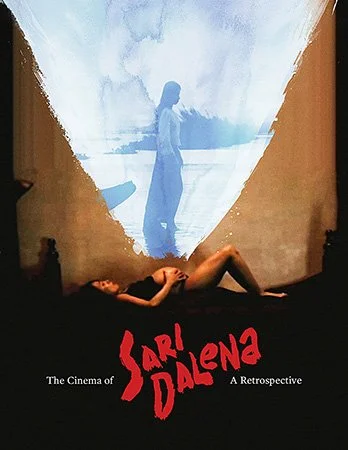
Sari Dalena Retrospective
“I had been thinking about a Sari Dalena retrospective for some time, but seeing Cinemartyrs gave the idea its urgency,” says Patrick F. Campos, film scholar, University of the Philippines associate professor and former director of the UP Film Institute (UPFI).
He curated Counter-Archives of a Film Guerrera: A Retrospective of Sari Dalena’s Cinema, which brings together “so many strands of Sari Dalena’s work: her formal rigor, her political commitments, her personal and family history, and her place in a longer lineage of unsung women filmmakers.”
Campos continues: “It reminded me that many younger viewers do not realize how long she has been working or how prolific she is, partly because she has remained independent in the sense of refusing to bend her practice for wider approval. Very few women have sustained that kind of body of work across both alternative and mainstream contexts. It felt like the right time to look at her work as a whole and to celebrate it.”
Sari’s feature films, documentaries, hybrids, experimental works, and video art are being screened in a multisite retrospective which started in March and continues until May. Following screenings with exhibit, masterclasses and talkbacks were held at the UPFI in Diliman as well as at Mowelfund Center in QC, and UP Mindanao and The Green House Cinema, both in Davao City, plus a few more stops.
This author had an opportunity to watch Sari’s Retrospective of short films at Dengcar Theater of Mowelfund Center on April 15 and 22. The first set of shorts includes Bullet Days, Kamikaze (Divine Wind), Asong Simbahan, Mumunting Krus and Puting Paalam.
The short films, all in B&W, are artistically and technically crafted. The last three films are Sari’s personal favorites, as she says, “Those were pure, magical times, to create the very first short films undertaken in collaboration with my family.” She intuits that it was also about testing film conventions in terms of form and subject matter. It also coincides with a period of spiritual awakening for her, this “filming Godscapes – a young woman walking on water, children playing a game of rituals with dead animals and flowers, a final bridal march into a new heaven and earth taking place in the harsh landscape of lahar.” Sari emphatically says she loves the freedom of making experimental films, as it taught her to be bold and to listen to her duende, that powerful art force in Federico Garcia Lorca’s aesthetic theory and writings.
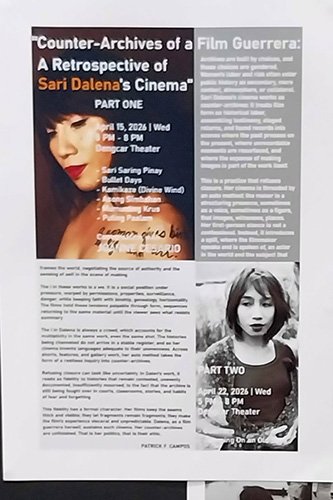
Sari's Retrospective at Mowelfund Poster
Pinay Power in Philippine Cinema
Women figure in the filmography of Sari Dalena. Jamming on an Old Saya is Sari’s documentary on multi-awarded author Gilda Cordero-Fernando’s celebrated fashion theater show 30 years ago. The idea of putting up such a show, wrote Gilda in Philippine Daily Inquirer on June 7, 2015, began with a pile of old saya (skirts with blouse) in her 1930s childhood she rediscovered in the old steamer trunk left over from her antique shop days. She said, “In 1978 they were selling for P12, P24 or P32. Few customers were interested in old clothes they wouldn’t know what to do with, and fearful of their dead owners haunting them.”
With haute couture designer Steve de Leon, production designer Salvador “Badong” Bernal, Tessie Macasaet, Gigi Escalante, and installation artist Ann Wizer, Gilda engaged Wanda Louwallein, and for over-all theater direction, CCP’s then resident director, Nonon Padilla to produce a spectacle which was not only a fashion show, but also a cultural Pinoy gem–very Gilda Cordero Fernando. It was a jam of a production that also birthed a coffee table book of the same title published by Anvil’s Karina Bolasco.
Other films Sari directed and produced are Guerrera/Warrior Women (2012), a haunting short documentary on the lives of activists Judy Taguiwalo, Mila Aguilar, Aida CF Santos, and Hilda Narciso during the early days of student activism and Martial Law; Ka Oryang, Cinema One Originals for which she won four awards: Best Director, Best Picture, Best Music, and Best Cinematography; and Ang Kababaihan ng Malolos.
In the essay, Pinay Power in Philippine Cinema published in 2018, Sari wrote about her observations on the work and contribution of women in Philippine cinema. She shared, “Women clearly dominate the realm of documentaries. That year I had the opportunity to be part of the Daang Dokyu curatorial team, a festival run and organized by the leading documentary filmmakers in the country, all of whom are women. I asked some of them why female filmmakers feel more at home with documentaries than with fiction films, and they cited creative autonomy and flexibility in shooting schedules. More emphatically they said that women innately possess patience and compassion — nurturing traits that are essential to building genuine connections with subjects in the non-fiction filmmaking world.”
Sari’s feature films, documentaries, hybrids, experimental works, and video art are being screened in a multisite retrospective which started in March and continues until May.
That was just the more positive angle, she adds. “In truth, many women face misogyny in the narrative film space. This is why, even if females outnumber males in film school, many women don’t make it to the director’s chair, even if that is where they dream to be. Too many traumatic experiences become the barrier. This is also why I was compelled to make Cinemartyrs – it is a way to put a face on the misogynistic attitudes from crewmembers all the way up to the cultural gatekeepers. The lines uttered in those scenes in the film all came from real life.”
For most of Sari’s films, history and literature are her primary focus. “I am constantly asking questions, looking for ways I can help shed light for younger generations of Filipinos and their sense of identity. To make sure this type of documentary is also dynamic, I play with form, add personal touches, and merge the subjective with the objective. I often find small, personal histories more interesting than broad-stroke chronicles.”
That a Retrospective on a relatively young filmmaker, and a woman at that, was organized in about six months, with the last three being the most intense, according to curator Patrick Campos, is a feat in itself. He was able to foreground the themes the filmmaker has pursued over the years, especially her connections to Mindanao. “So we worked with curators, educators, and filmmakers in different spaces there. It felt especially fitting that the retrospective opened on March 6, the 120th anniversary of the Bud Dajo massacre, which figures in two of her films, including Cinemartyrs, and on the weekend of International Women’s Day." Indeed, Sari has earned her rightful place in the history of Philippine cinema, in the history of Philippine women filmmakers.
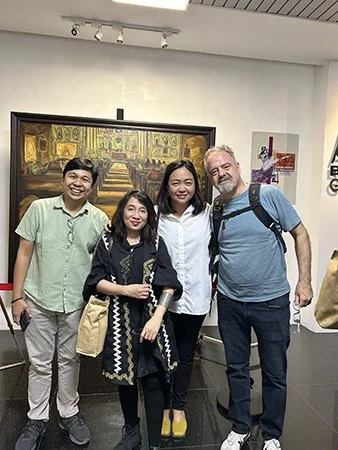
Sari with curator Patrick Campos and UPFI professors
As in her earlier films which were supported by her parents and two sisters, Sari Raissa Lluch Dalena revels in the continued family support in her amazing film journey as she concludes, “Most importantly having a fabulous feminist filmmaker husband (Keith Sicat) who is a big dreamer like me and supportive sons (Kino and Paris) who enjoy hanging around my set makes this process magical. I cannot ask for anything more.”
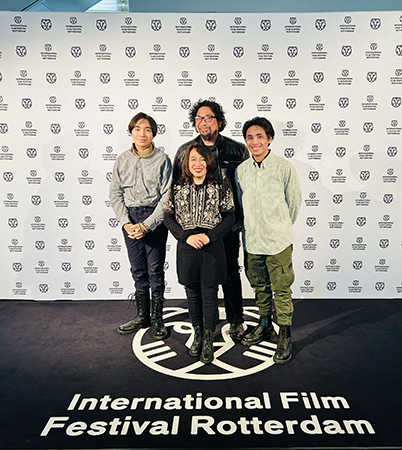
The Sicat Family in Rotterdam Film Festival
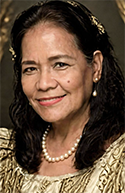
Alma Cruz Miclat is a freelance writer and author of books: Soul Searchers and Dreamers: Artists’ Profiles and Soul Searchers and Dreamers, Volume II, and co-author with Mario I. Miclat, Maningning Miclat and Banaue Miclat of Beyond the Great Wall: A Family Journal, a National Book Awardee for biography/autobiography in 2007.
More from Alma Cruz Miclat