

Santa Monica’s Uncrowned King of Real Estate
/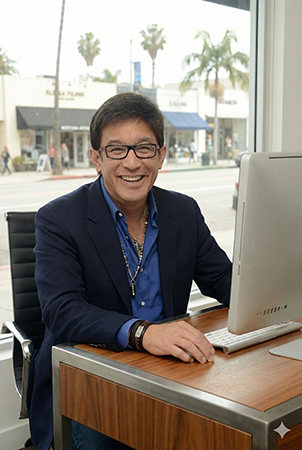
Gary Limjap in his office at Coldwell Banker in Santa Monica.
Coffee, Clothes, and Construction
I learned of Limjap through St. Monica’s Church in Santa Monica, where he’s a principal sponsor of the Simbang Gabi Christmas dinner. Manila is the city of his birth and where he received diplomas from St. Lorenzo High run by the Salesian Brothers of Don Bosco and De La Salle University, run by Christian Brothers. Gratitude spurs his unexpurgated plugs for Catholic education. Limjap immigrated to Los Angeles in 1976 and is 69 years old but could pass for a man under 50, which he credits to his Filipino genes. Genetics might be a factor along with being a philanthropist, childless bachelor, traveler, and lover of his work.

Gary Limjap (Standing, second from right) at Don Bosco San Lorenzo High in the Philippines.
As in all notable biographies that open in Hollywood and vicinity, Limjap started as a waiter in a coffee shop, which is the modern equivalent of Lana Turner’s malt shop. What would have been his second day amidst baristas became his first day with May Company, the onetime department store chain. Three months later, he was a store manager. From there, he went into Purchasing before leaving retail to work in sales for a construction company. Those jobs were compressed into six years leading up to his move to real estate in 1985.
Try Real Estate, Young Man
“I remember my dad said, ‘You should go into real estate,’” he says of a family influence that was reinforced by friends. “Filipino friends in Glendale nudged me into the business.” In real estate he had the potential to become his own boss.
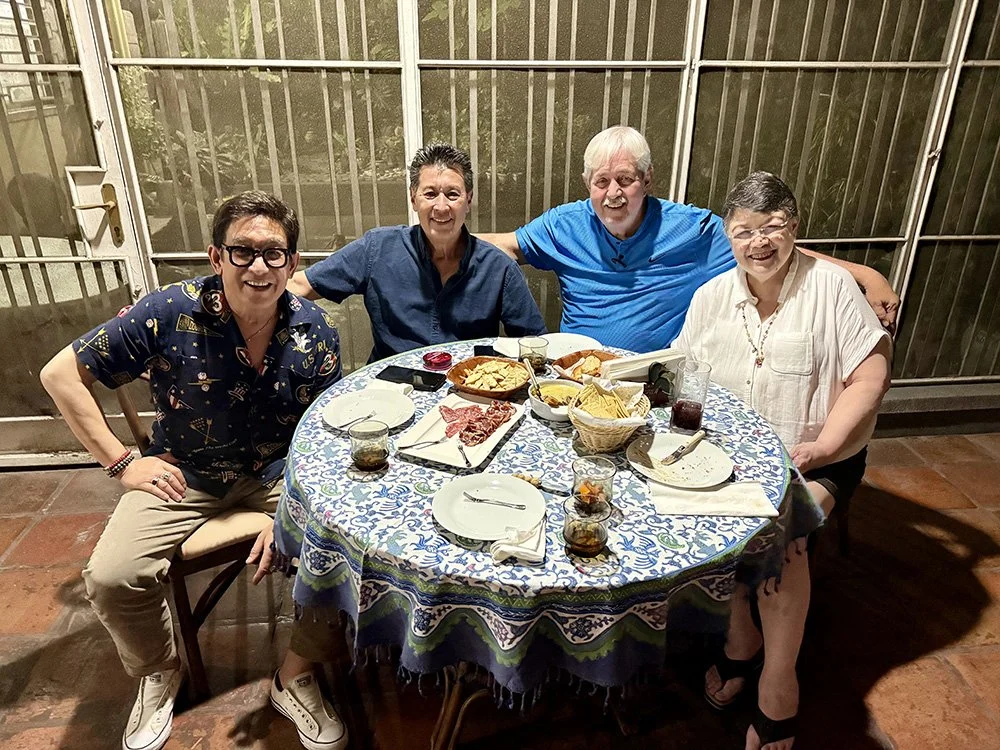
Gary Limjap with Filipino friends Sonny, Dindo, and Laly.
Limjap offers a vague recollection of his first sale. “I can’t remember everything,” he says, “but it must have been a small house in East L.A. At that time, I worked at a clothing company, and I think it was one of the seamstresses that wanted me to sell her property.”
Real estate in Los Angeles wasn’t quite the Wild West in the Eighties and Nineties, but there were inconveniences that baby boomers recapitulate like they were the modern equivalent of pistol duels. “Today, we go to the internet, but back then,” he recalls with suffering fondness, “we had to go to books. There was no such thing as cellphones. We conducted business in phonebooths.”
When our interview turned to his public image, the self-effacing real estate magnate responds, “No, I would not consider myself the King of Real Estate. I always want to be in sync with the goals of my clients.” Royalty seldom mingles with commoners/consumers.
Through the years, many clients have enlisted him for multiple properties. He cites one who used him in 12 deals. On his secret to success, he elaborates, “You don’t concentrate on the money you can make. You concentrate more on the transaction at hand and just making sure that your clients are satisfied.”
As he inventories lessons learned from 46 years in real estate, he says, “For many people, success is a dollar figure. You can make as much money as you want in this business, but if you’re not in tune with the true meaning of the business, you might not last that long. For me, success is every transaction that I close with a happy buyer and seller.”

The St. Monica's Church Simbang Gabi celebration with Mass celebrant, Bishop Matthew Elshoff, OFM.
You Don’t Always Need What You Want
Limjap’s clients often greet him with a wish list but will adapt for the right house. “When you’re looking for a property, you cannot get 100 percent of what you’re looking for.” He explains, “The way I look at it is that if 75 percent of it meets your needs, that might be it.”
He advises clients who are new to Los Angeles to get to know a neighborhood before committing. “Rent [a house] in a neighborhood that you’re interested in. Learn more about it.”
Limjap’s style doesn’t follow the playbook of real estate agencies depicted on reality TV. “I don’t have an entourage. I surround myself with the best people. I have a partner (Sara Elsayed) I’m mentoring who helps me out. I have a marketing guy that handles social media. A transaction coordinator and an assistant who make sure that I have the proper paperwork. They allow me to do what I do best, which is connect with people and help them reach their goals.”
The good news is, according to Realtor.com, home prices in West Los Angeles trended down by 10 percent in 2025. That is, they fell to a median of $1,225,000. Business website Kiplinger lists home prices in Los Angeles as the eighth highest in the U.S. Even with the burden of pricey residences, Metro L.A. is home to the largest Filipino community in America. Limjap’s door is open to Fil-Ams who are ready to plant roots in his town.
Consider This Before You Spend Your Children’s Inheritance
Limjap disagrees with the standard advice that all clients should spend the maximum amounts their budgets can handle because costlier homes appreciate faster than more economical ones. While this assumption isn’t unfounded, the endless hardship of an astronomical mortgage will torment a debt-averse soul more than it will a profligate libertine.
“You should ask yourself what you’re going to be comfortable affording,” says the prudent realtor. “Rather than pushing yourself, you should plan before you buy. Don’t just jump in, because the process has a lot of idiosyncrasies that are easy to miss.”
He advises, “Before you buy, a financial adviser can help you find a way to save more money or pay off debts and improve your credit score.” While he specializes in upscale markets, he’ll sit down with Fil-Ams in any financial stratum to find a place they’ll be happy to inhabit. Lucky ones might discover that a Santa Monica or West L.A. address is realistic without a $1.7 billion Powerball jackpot.
Thankful to Be a Filipino
He works smartly and humbly. “I’m thankful to God,” he says. “It’s a blessing that I’ve been in this business for over 40 years.”
Limjap acknowledges his Filipino heritage as a guiding light throughout his career. He speaks of certain attitudes that differentiated him from other agents. “I have instincts and values that are familiar to Filipinos.”

Gary Limjap in younger days with his overseas family at church in the Philippines.
“In the Philippines,” he continues, “we respect our elders. So, it was a culture shock when I started out. I was knocking on doors and seeing a lot of elderly people who were living by themselves. They told me I don’t have my son or daughter visiting me. That could never have happened in the Philippines.”
It might be a culture shock if the young agent, who was going door to door in 1985, woke up in 2026. “I’ve always been optimistic,” he says before stating a belief that still animates U.S. immigrants. “I still believe that good will always overcome evil, and I still believe this is a land of opportunity.”
Every night the news astonishes jaded pessimists, but he insists, “This is not going to last.” He compares current conditions to economic patterns that are consistent with classic real estate charts. “It’s all cyclical. This is still a country where your dreams can come true if you put in the hours and devotion.”
Through the years, many clients have enlisted him for multiple properties. He cites one who used him in 12 deals.
Limjap described a common mistake among homebuyers. “I’ve had people who kept waiting for interest rates to drop. If they had bought 15 years ago, they would have already made a lot of monies.” He emphasizes, “Real estate is very cyclical. It’s going to go up and it’s going to go down. But if you look at the statistics through the years as in the 1920s, ’30s, ’40s, et cetera, the latest cycle is always higher than the last cycle. It’s always going to go up in the long run.”
The irreproachable voice of Google artificial intelligence states, “The ultimate responsibility of a real estate agent is to act as a fiduciary, which legally and ethically mandates they prioritize their client’s best interests above all others, including their own.”
The obvious goal of making a sale is supplanted by the intangible goal of making a client happy. Limjap prospers by fulfilling every kind of dream. It’s wrong to assume that he was born for the trade. Doubts proliferated from an unnerving first day in the field. Here’s what happened in his own words:
The First Day I Traded My Dignity for a Listing
My first day as a real estate agent didn't involve a sleek suit or a luxury car. It began with my boss pointing to the door and telling me, “You aren’t making money sitting here looking pretty. Go find some doors and hit them until they open.” The expression ‘wet behind the ears’ is an understatement; I was practically underwater. Armed with nothing but a cheap clipboard and blind optimism, I set out to harass the neighborhood. Here I revisit scenes from my first day of humiliation:
Neighborhood Alarm
At the third house, a woman didn’t even let me finish my "Have You Thought About Selling?” script. She opened the door, glanced at the nervous sweat on my forehead, and screamed like I was the murderer in a slasher flick. She started dialing 911 before I could hand her my business card. I haven't sprinted that fast since high school P.E.
The Full Disclosure Listing
I knocked on another door, and a muffled voice replied, “One minute!” I straightened my tie, thinking, ‘This is it. My first lead.’ The door swung open, and there she was: wearing nothing but a very small, very damp towel. I’m not sure what she was expecting to find on her porch, but it clearly wasn't a stuttering 22-year-old rookie asking if she’d considered a market analysis.
My Reality Check
Looking back, I assert that my manager was “building my confidence” and “preparing me for the unpredictable nature of the market.” But frankly, my manager probably just wanted me out of the office so he could eat his lunch in peace without me asking him where the staples are kept. He didn’t build my confidence; he built my cardio.

Anthony Maddela is a staff correspondent who doesn’t just write about subjects; he interviews them.
More articles from Anthony Maddela
