
Painter Camille Dela Rosa’s Inner Cosmos
/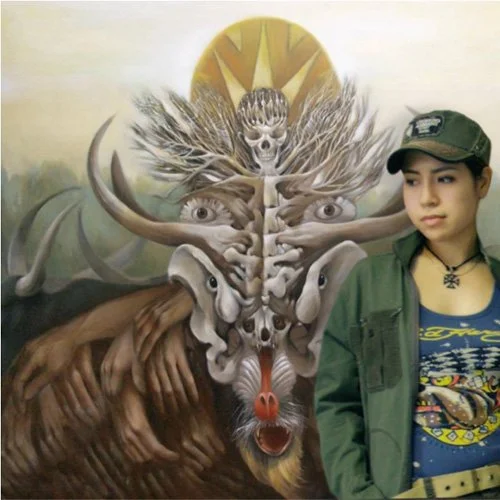
Camille Dela Rosa's art is not about pleasing everyone, but about reaching someone deeply (Photo courtesy of Camille Dela Rosa)
Dela Rosa was born into a family steeped in the arts: her father was the late painter Ibarra Y. Dela Rosa, and her mother, Ethel Dimacuha, an art history professor. Although her father intentionally withheld formal instruction, his aesthetic profoundly influenced her early path. She inherited his penchant for strong color combinations, which was initially evident in her early compositions of landscapes, flowers, and trees.
Following her father’s death in 1998, the self-taught artist dedicated herself to painting, mounting her first solo exhibition at the remarkable age of sixteen. Her early works, spanning from 1998 to 2008, established her mastery of Impressionist techniques. She honed her skills by exploring a widening array of subjects, including her signature vibrant landscapes, ancient churches, intimate portraits, and human figures, earning her the title of "youngest Impressionist painter in the Philippines" from art critic Cid Reyes.
In 2009, Dela Rosa's artistic career took a significant, and arguably defining, turn. Driven by a need to explore deeper existential and psychological truths, she transitioned dramatically to Surrealism. This crucial shift was encouraged by her mentor, Enrico Manlapaz, leading to her 16th solo exhibition, Aenigma, at the ArtisCorpus Gallery.
This new phase marked a radical departure. Her pieces were often described by critics as "morbid, out-of-this-world, grotesque, and phantasmagoric." Dela Rosa's canvases became saturated with anatomical figures, proto-human skulls, cryptic machinery, and complex layers of imagery addressing mortality, technology, and spiritual identity. This became her laboratory for the soul, where she stated, “I didn’t want to just paint what the eye sees; I wanted to paint what the soul experiences.”
The Surrealist phase continued its fertile evolution in subsequent years. Her 2012 solo exhibition, Dominion, delved beyond mere religiosity, while her Enchantress series (2015) featured portraits of women shrouded in esoteric symbolism, transforming female subjects into dominant figures such as mothers, warriors, and queens, drawing heavily from mythology and Jungian archetypes.
Dela Rosa’s achievements extended her reach internationally, including her feature in the Phantastische Venus 2015 exhibition in Germany and the selection of her steampunk painting as the official CD and DVD album cover for the international rock band Sepultura's Machine Messiah in 2017.
Dela Rosa's philosophical depth is most powerfully revealed through the artworks she holds closest to her heart. In a personal interview, the artist detailed the intimate meaning behind her three favorite paintings, spanning her core Surrealist and spiritual phases.
Dela Rosa views Those Who Have Ears, Hear … Those Who Have Eyes, See (2009) as a powerful testament to inner fortitude, stating: “It means the stillness you cultivate inside becomes stronger than the storm outside.” It challenges the viewer to achieve clarity and truth amidst external chaos through spiritual perception.
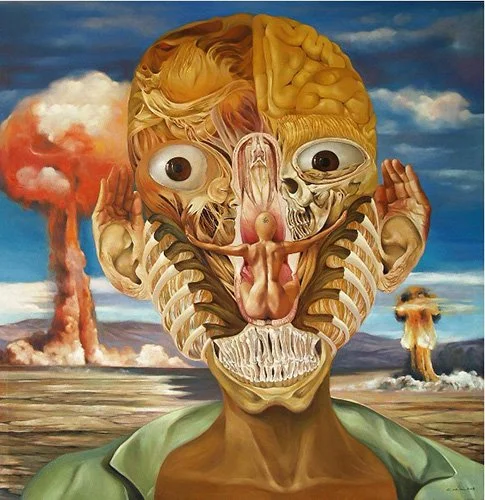
Those Who Have Ears. Hear ... Those Who Have Eyes, See, 2009, oil on canvas, 6 x 6 feet (Photo courtesy of Camille Dela Rosa)
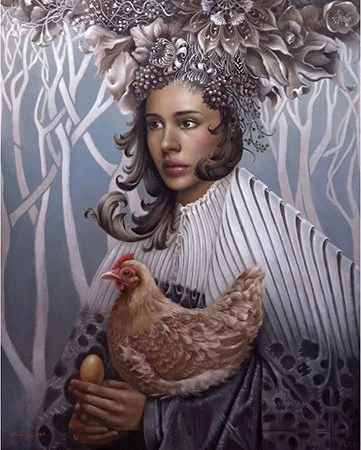
Endless Beginning (2014) explores profound existential and cyclical mysteries, defined by Dela Rosa as reflecting: “The classic ‘chicken or egg’ question reflects mystery, cause and effect, and the eternal cycle of life.” The central woman represents the Great Mother archetype, symbolizing the ultimate source of life and the perpetual process of creation and transformation.
Endless Beginning, 2014, oil on canvas, 5 x 4 feet (Photo courtesy of Camille Dela Rosa)
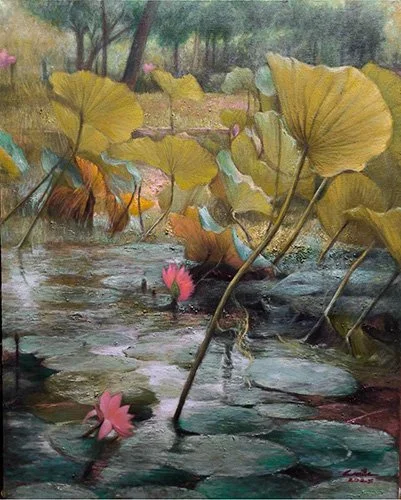
Lotus Pond (2025), representing her newest work, conveys a powerful message of transcendence through nature: “From the mud of suffering rises the lotus of life.” It affirms that spiritual beauty and wisdom emerge directly from overcoming life’s darkness and difficulty.
Lotus Pond, 2025, oil on canvas, 30 inches x 24 inches (Photo courtesy of Camille Dela Rosa)
According to Dela Rosa, her art is "not about pleasing everyone but about reaching someone deeply." Her artistic philosophy centers on the idea that "inspiration comes through the act of creating, and that each stroke of the brush suggests the next."
She offers valuable advice for those aspiring to follow an artistic path:
• Practice, persistence, and patience are essential for growth and development.
• Embracing mistakes as opportunities for growth and innovation is crucial.
• Focus on personal growth, celebrate individual qualities, and appreciate progress on your own timeline.
• Don't compare yourself to others, as this can drain the joy from creating.
Driven by a need to explore deeper existential and psychological truths, she transitioned dramatically to Surrealism.
Camille Dela Rosa's artistic journey, marked by experimentation and profound philosophical themes, has established her as a preeminent painter who continuously pushes the boundaries of contemporary Philippine art. Her canvases remain a vibrant reflection of her fascinating and thought-provoking inner world.
The author extends his sincere gratitude to Dexjordi Lyle Sison for his assistance with the photos.

Leodivico Padua Masuli writes from Quezon City, where he is a security officer. His imagination and creativity were nurtured while growing up on a farm in Libertad, Abulug, Cagayan. He loves nature and enjoys watching documentaries.
More articles from Leodivico Padua Masuli
