
India: The Naked and the Dead
/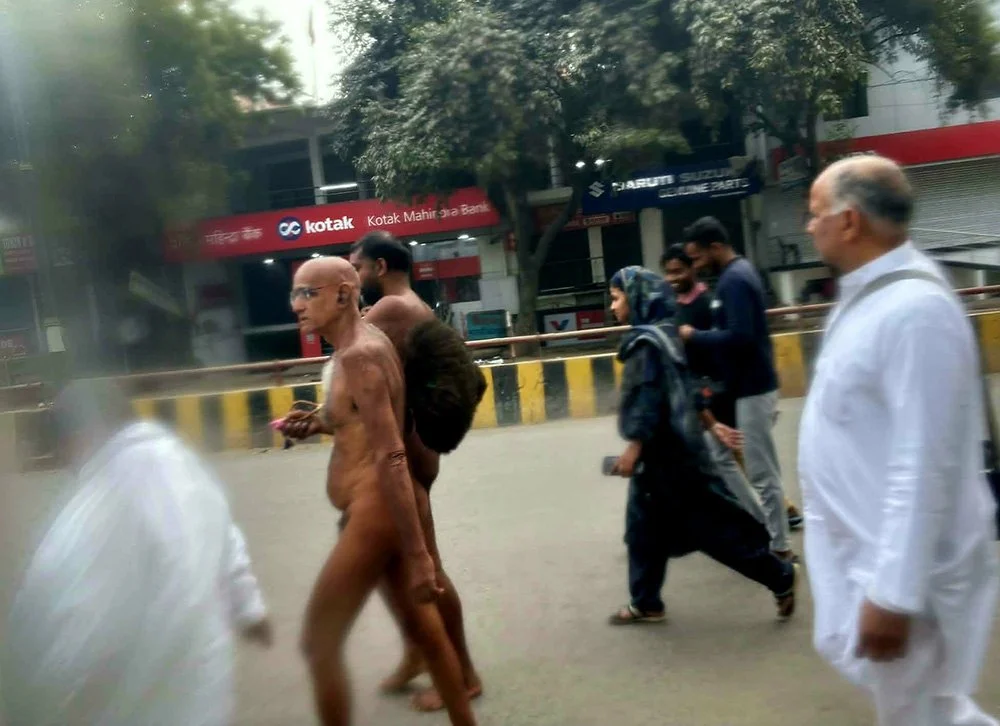
Jain monk walking down a busy road in Jaipur (photo by Chona de Dios)
A man was walking down the road without a stitch on, marching like he was off to work on a Monday morning. Some clad men walked with him, and still others bared it all too. A man holding a flag led their way. There was no commotion on the street; no one even stopped to look.
“They’re Jain monks,” our tour guide said from the front of the bus. “They belong to one of the oldest Indian religions.”
Jain (pronounced “jayn”)?
I’d never heard of Jain, so I Googled.
How ignorant I was. Already, at least five million people in India are Jains, and their practice is called Jainism. They adhere strictly to nonviolence and do not kill any living being—not a fly nor a gnat. They believe that by following some basic life principles like right belief, knowledge, and conduct, they can eliminate karma and break the cycle of rebirth.
But not all Jains are nudists. Most are regular people like you and me who prefer to wear clothes. As far as I know, only monks do that walk-down-the-road-naked bit. They own nothing, move away from family ties, and eat only food offered to them. They are called “ascetics”—folks who renounce all worldly pleasures such as food, wealth, and sex.
Fine, but why are they naked?
Male monks practice nudity to symbolize total rejection of worldly possessions. Female monks wear clothes because—this is what I read—they are believed to be incapable of being as austere as their male counterparts. Hmm. Austere means to be strictly without frills or luxury. Interesting.
I didn’t go to India to search for my soul or learn religion, but maybe if I think deeply, I could say I went there to experience humanity.
On this trip, I realized that most Indian people, because of the religions they practice, have very different beliefs and attitudes from what I live by as a Catholic.
Down the Ganges
Take the Ganges River, for example. It is seen as a living goddess who descended from heaven to purify souls and cleanse sin. It is considered holy.
I returned to Varanasi, a city on the left bank of the Ganges, which is a 2,525 km-long river running from the Himalayas to the Bay of Bengal. Varanasi holds great significance as the “spiritual heart of India.” It is an old city deeply rooted in religion, particularly Hinduism. Much as Catholics visit the Vatican and Muslims go to Mecca, Hindus make their way to Varanasi to wash away sins in the Ganges, perform rituals, and visit temples. But perhaps, most importantly, they are brought there to die or to be cremated.
Ten years ago I witnessed for the first time bodies being cremated on the riverbanks of the Ganges, called “ghats.” Black smoke rose from piles of burning wood and flesh. I watched men mill around, and dogs and cows sniff at remnants on the ground. I didn’t get a real understanding of what was going on.
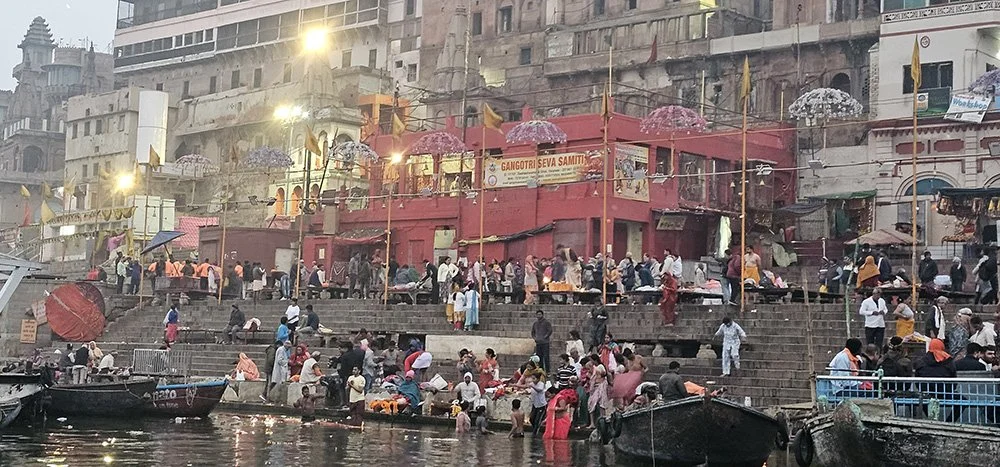
Morning at a ghat on the Ganges River in Varanasi. (Photo by Bella Bonner)
I had to re-see that scene, but I wasn’t sure I could muster the courage to go on my own. I persuaded my best friend Cion to join me on Gate 1 Travel’s 12-day Golden Triangle and Varanasi tour that started and ended in New Delhi. It would include a visit to the Taj Mahal and the Amber Fort, and although I had been impressed with those structures before, Varanasi was what I’d come for.
On my first visit in 2016, my girlfriends and I rode an overnight train to the city. We had been promised first-class seats, but someone botched the job, and we ended up in second or maybe third class. Not good. We were seated shoulder to shoulder on a narrow bunk in a compartment that was more crowded than Quiapo on Black Nazarene Day. If you’ve ever been in a place where everyone brushing up against you looked and dressed radically different from you and spoke words you couldn’t understand, you’d feel butterflies in your stomach and your heart in your mouth. For ten hours, we prayed we wouldn’t need to go to the train’s restroom.
I understand today’s trains offer better experiences, but I was grateful nonetheless that our Gate 1 tour booked us on a 1.5-hour flight to Varanasi instead.
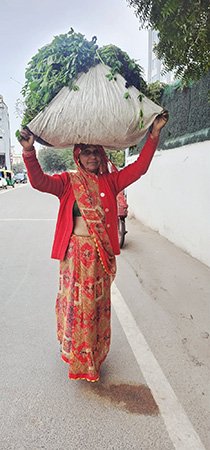
Market day (Photo by Bella Bonner)
Dust and Disrepair
My first impressions of the city were unimpressive. Roads, as were most of those we had traveled in the country, were in disrepair. Dust flew everywhere, leaving tree leaves and plants a spectrum of dull green to dark brown. Cows, goats, dogs, and other animals roamed among people on the streets, selling, buying, walking, talking. Immediately, you think of the poverty of the people. Not a few Filipinos would wonder if the Philippines is better off than India.
India is the world’s fourth-largest economy today. However, it is the most populous country, with 1.47 billion people, and it’s a tough job for anyone to have all the nation’s money trickle down fairly to all its people and cities.
The Philippines, on the other hand, ranks 31st in the world economy but has a much smaller population at 112 million.
Just 10 km from Varanasi is the city of Sarnath. This place holds great importance to another religious group: Buddhists. Sarnath is where Siddhartha Gautama Buddha, after attaining enlightenment, delivered his first sermon. Here one can visit the stupa where he first taught dharma, or Buddhist principles.
It is interesting to note that while Buddha spent most of his life in India and Buddhism is now practiced by seven percent of the world’s population, less than one percent of Indians today are Buddhists. They are far outnumbered by Hindus (80 percent and Muslims (15 percent) and slightly outnumber Christians and Sikhs.
On our first day in Varanasi, we walked down a steep flight of steps lined with an eclectic mix of old temples, palaces, ashrams, and rest houses for pilgrims. Nearer the bottom of the steps were vendors selling garlands, prayer beads, food, and souvenirs. There was a vibrant crowd of people in colorful garb. To say the scene was intense would be an understatement.
The downward steps led us to the sacred Ganges.
It was wide. It was slow-moving. It had a funky smell. And it was murky.
Our tour group of about 20 got on a motorized rowboat run by a local boatman. We glided slowly along the riverbank and gawked at the centuries-old stone buildings that would soon fade in the dark. From newer ghats, we proceeded to much older sections that held more charm and character. We were engrossed in history and architecture when, from a distance, we saw a telltale column of dark smoke billowing into the sky.
Cremation. It was taking place openly along the river. A body was being burned in a pile of wood. It was someone’s mom, dad, child, spouse, or loved one slowly turning from flesh and blood to mere ashes.
Meanwhile, on nearby stairs, another body on a stretcher, wrapped in white cloth, was being brought down by some men. They made their way to the river’s edge, where the stretcher was lowered to the water. The garlands, clothes, and shroud used in the dead’s final journey were removed. A small cloth was left to cover the body.
The river rite was the dead’s final bath, a symbol of purification that would wash away sins. After the bath, the body was brought to the funeral pyre, lit, and left to burn for about four hours, which is how long it takes for a body to burn completely.
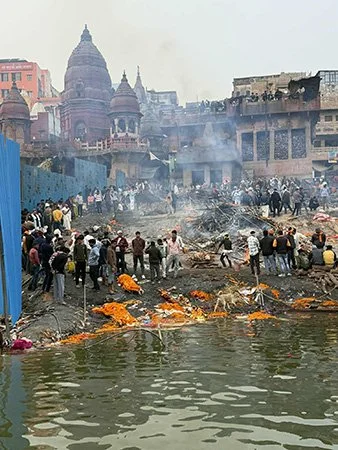
Cremation (Photo by Bella Bonner)
But sometimes they don’t burn completely. I cringed seeing a man walk to the water and toss out a slab of charred meat. Maybe it was an offering. I don’t know.
A dead dog floated nearby.
At the riverbank, cows and dogs scavenged among strewn clothes, marigolds, and pieces of wood. Men—maybe relatives of the dead—hung around and watched. It was not their duty to shovel the wood, corpse, and ashes to the funeral pyre. That was a job for “outcasts,” formerly called “untouchables.”
It is important that the deceased’s ashes be brought to the sacred river to allow the soul to end the cycle of reincarnation and find eternal peace in heaven.
Bodies, one after another, were brought down to this cremation site called the Manikarnika Ghat. Hundreds of bodies are cremated 24/7, making this the busiest Hindu burning ghat on the Ganges.
We returned to the river early the next morning. This time, we were less overwhelmed by the continued purifying and burning process. At another ghat, we took pictures of men and women bathing near shore. They had changed from their streetwear to something simpler and stood in the river happily splashing water on themselves. Further down, launderers washed sheets and laid them to dry on stone walls.
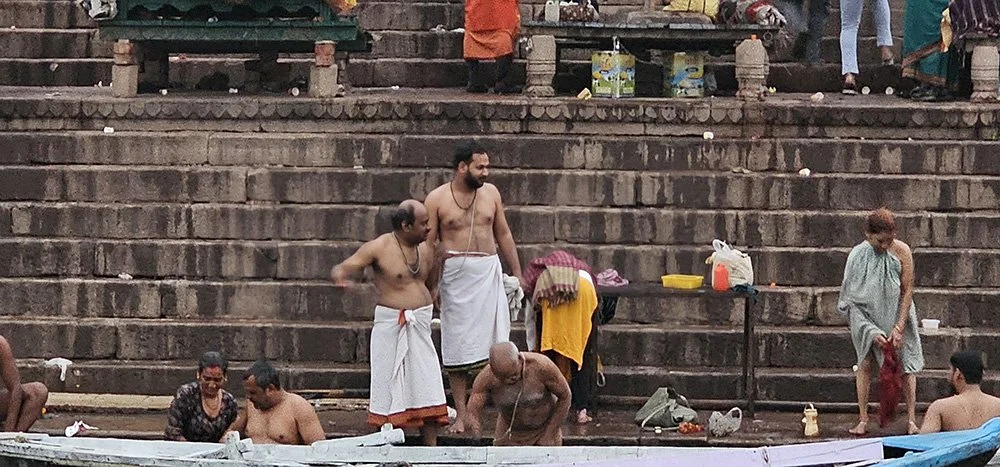
Morning bath on the Ganges (Photo by Bella Bonner)
There was a man on the edge of a boat. He reached over to the water and washed his face. But then he cupped his hands and took a sip from the river. No! Don’t! The Ganges, though deemed holy, is one of the most polluted rivers in the world. Daily, it receives massive amounts of human waste, toxic waste, and trash. Lots of people get sick from the pollution, and in some cases, they die.
But belief is a very powerful word, and Hindus believe that bathing in the Ganges washes away sins and purifies the soul. Drinking the water probably has a more profound effect. To have your ashes immersed in the River Ganges would put you on a direct path to heaven. I guess that’s a great payoff.
Mind-Bending
After Varanasi, we returned to New Delhi and headed straight to another mind-bending experience.
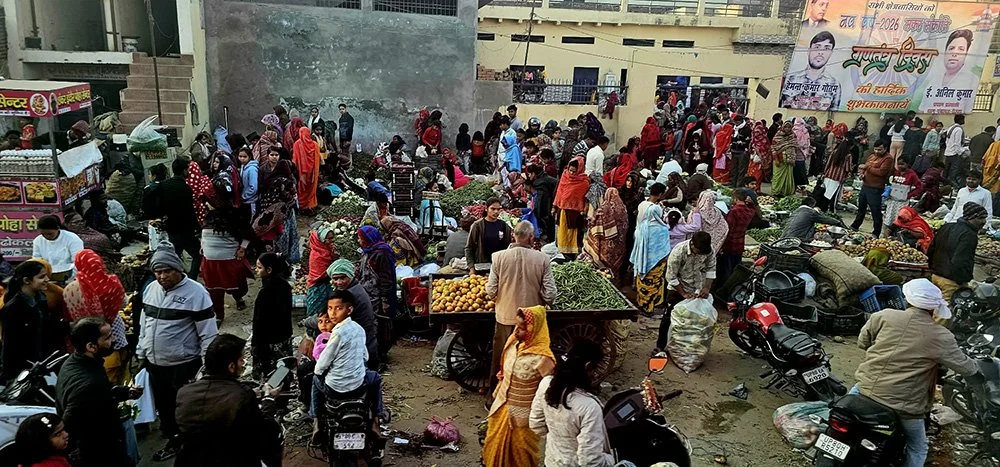
Marketplace in New Delhi (Photo by Bella Bonner)
You see those Indian guys with turbans on their heads? As a young girl in Manila, I thought all Indians wore turbans. They rode motorcycles and lent people money. And because they were dark and hairy, I couldn’t help but be a little wary. Growing up, I realized how naïve and wrong I was.
In India, only Sikhs wear turbans, and Sikhs comprise less than two percent of the population. Sikhism is the world’s fifth-largest religion, with 30 to 50 million followers. They believe in one God and in equality, honest living, and selfless service.
As stalwarts of equality, they do not recognize the caste system. You cannot believe in equality and accept social hierarchy based on birth. Nor do they burn widows with their husbands’ dead bodies, deeming the practice inhumane. Instead, they encourage widows to remarry.
Sikhs do not cut their hair anywhere. Ever. Beneath that turban we see is a lot of long, long hair.
The one thing that impressed me deeply about Sikhism is their resolve that no one should go hungry. When we visited the large Sikh temple in New Delhi, our tour included a trip to the kitchen. It was huge! It had lots of stations and people at work, and that’s a necessity because we learned they continually feed everyone who comes to the temple 24 hours a day, 365 days a year. It doesn’t matter what your caste, religion, or background is. If you are hungry, you are fed.
Up to 100,000 people are fed in the temple daily. All food is donated, and all workers are volunteers. The feeding concept is fundamental, but the delivery, in this case, is phenomenal.
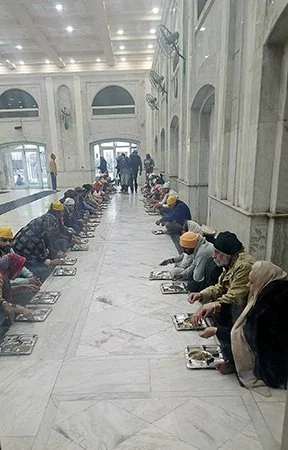
Feeding the hungry in a Sikh Temple. (Photo by Bella Bonner)
I arrived back in Manila two weeks later, happy to again step foot in our parish church. I looked at the crucifix at the altar, bowed my head, and made the sign of the cross.
I believe in one God who is a Holy Trinity, meaning He exists as three persons—the Father, the Son, and the Holy Spirit. I believe Jesus, the Son, was borne by Mary, a virgin, and that He was conceived not by man but by the Holy Spirit. I believe that when Jesus died, He rose again on the third day and spent 40 days on earth and then ascended to heaven.
I didn’t go to India to search for my soul or learn religion, but maybe if I think deeply, I could say I went there to experience humanity.
These beliefs are probably deemed radical or even preposterous by those of other faiths, and that is fine.
Let’s not judge or impose our beliefs on others. For as long as no one hurts anyone or commits crimes in the process, we should be free to practice our faith.
But if I decide to walk down the street buck naked one day, I promise you it’s not because I’m practicing my religion. It’s probably a very warm day in Manila.
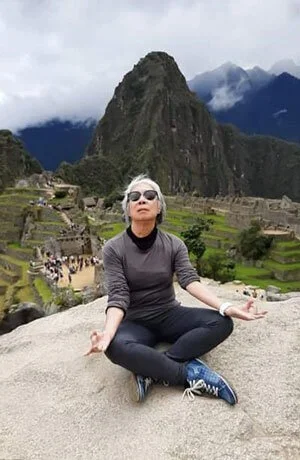
Bella Bonner is a journalism graduate of the UP Institute of Mass Communications. Among others, she worked as a grant writer and hotelier in Texas where she lived for 30 years. She has retired, returned to Manila and spends her days in sports, traveling and writing a personal blog, "Chicharon Diaries."
More articles from Bella Bonner
