

Kalye NYC Restaurant Brings the Spirit of ‘Forgotten Island’ to Life
/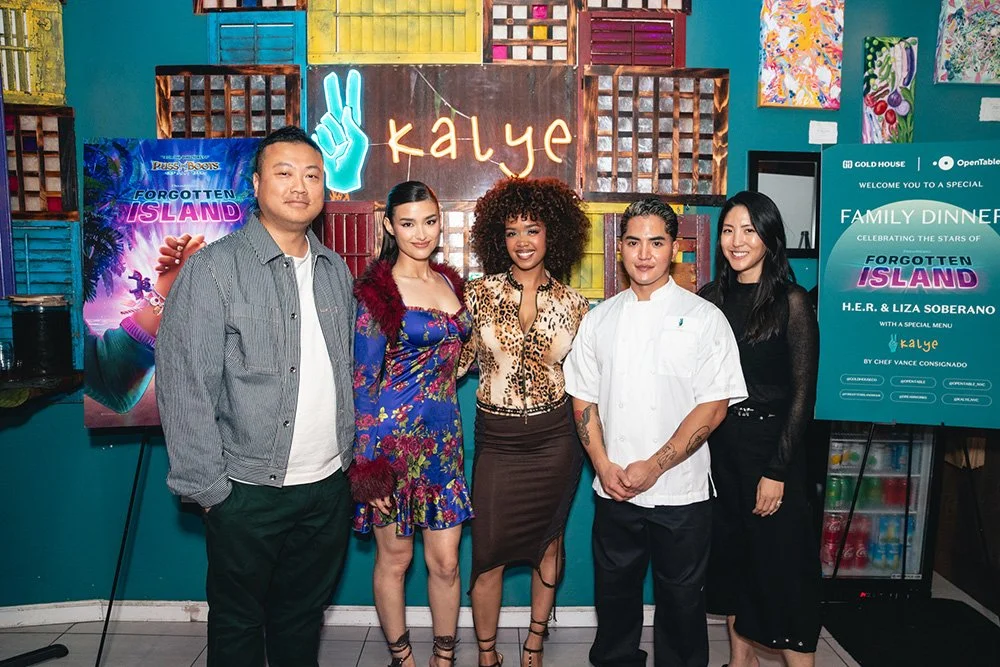
Chef Vance Consignado of Kalye NYC with Forgotten Island stars Liza Soberano and H.E.R. at Gold House’s Filipino Fiesta Family Dinner, presented in collaboration with OpenTable and DreamWorks Animation. (Photo by Elaine Joy Degale)
Growing up, I remember the kalye as the place where rows of barbecue stands teem for the taong masa (the masses), where bottles of Red Horse beer glistened on plastic tables, the smoke of banana ketchup and Datu Puti soy sauce marinades dripped and sizzled over charcoal. Makeshift dining areas spilled onto the boulevard, children ran around, weaving through the chatter of Filipino evening tsismis (gossip). The distinct wail of karaoke machines made each barbecue stall a little pocket of jubilee. This remains one of my favorite scenes of childhood nostalgia, as if Christmas always came early.
Perhaps that is why the kalye feels particularly alive during the “-ber months,” the highly anticipated stretch from September to December when the approaching Christmas season begins to announce itself. In the Philippines, the warmth of the Christmas decorations begin appearing in plazas and shopping malls as early as September 1, as anticipation spills into our streets, music, food and gatherings. Parols, traditional Filipino Christmas lanterns often shaped like stars, illuminate the kalye with colorful lights beneath the evening sky.
Years later, that same spirit of the kalye would find an unexpected echo in New York City. In September 2026, Kalye NYC Restaurant turned into a fiesta with a Filipino-themed family dinner in collaboration with Gold House to fete the release of DreamWorks Animation’s Forgotten Island. The dinner was hosted by the film’s stars, H.E.R. and Liza Soberano, who voice the film’s best friends Jo and Raissa, respectively. The celebration brought the flavors and atmosphere of a Filipino fiesta into a distinctly New York setting, with street food, pancit, lechon paksiw, halo-halo, presented on tables with spreads of banana leaves.
Never Tear Us Apart
When Kalye opened on Broome Street in Manhattan’s Lower East Side, its founders, Rob Mallari-D’Auria and his husband, Henry Mallari-D’Auria, had a simple idea: create a quick-service restaurant centered on Filipino street food. “We named it ‘Kalye’ because Kalye – or street – is a place where people gather,” Rob explained.
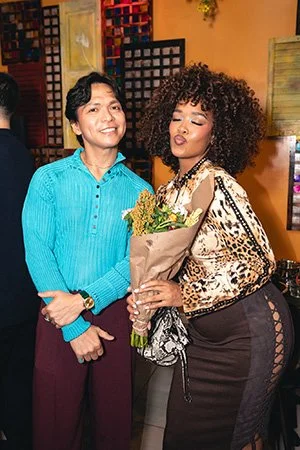
Rob Mallari-D’Auria × H.E.R. (Gabriella Sarmiento Wilson) at Kalye NYC for the Forgotten Island Filipino Fiesta Family Dinner, celebrating Filipino culture, food and representation with Gold House, OpenTable and DreamWorks Animation. (Photo by Elaine Joy Degale)
Kalye hosted an invitation-only dinner celebrating the Hollywood release of Forgotten Island, bringing Filipino food, entertainment and Asian American representation to the heart of New York City. The event also had a larger media component because Gold House, a global nonprofit organization focused on Asian Pacific cultural representation, partnered with DreamWorks/Universal and OpenTable for the event. Gold House brought its own production team to document the restaurant’s significance in AAPI community, which included an interview with Kalye's head chef, Vance Consignado. The resulting short film is intended to document Gold House's support for an AAPI-owned establishment while also contributing to the promotional ecosystem surrounding Forgotten Island.
For Rob, the significance extends beyond one restaurant or one movie. He sees Filipino representation in American cinema as an opportunity to expand the market for Filipino creativity more broadly. “I think it is the best time to actually be out there and telling people our stories,” Rob argues.
On The Wings of Love
Rob's path to the restaurant industry was hardly conventional. Before Kalye, he spent approximately 13 years practicing law in the Philippines. His early career centered on litigation and criminal defense before he shifted to corporate and tax law. But the culinary scene had always been part of his life.
His parents are from Pampanga, a province known for its culinary traditions. His father operates his own business, while his mother owns a restaurant and is, in Rob's words, a “good cook.”
Rob's own culinary interests initially leaned toward baking. Relatives in the United States would send him balikbayan boxes filled with baking equipment and supplies. Whenever they visited the Philippines, he would ask them to bring more.
“I actually dreamt of becoming a lawyer and a baker in the Philippines,” he said.
Instead, love sent him to the United States. He fell in love with an American man. And because same-sex marriage is still not legal in the Philippines, moving to the United States became the practical choice for their future together.
They started Kalye with a simple concept: a quick-service restaurant modeled on the Filipino street-food stalls Rob had grown up around. But the Filipino customers who walked through the door had a different vision. They started asking for kare-kare, for sisig, and it became increasingly clear the Filipinos in the area were seeking a restaurant to sit down and build community, similar to the way Tito Rad’s is a home for Filipinos in Sunnyside, and how Kusina Pinoy Bistro is “a total vibe” for the young and hip Filipino Americans in Little Manila.
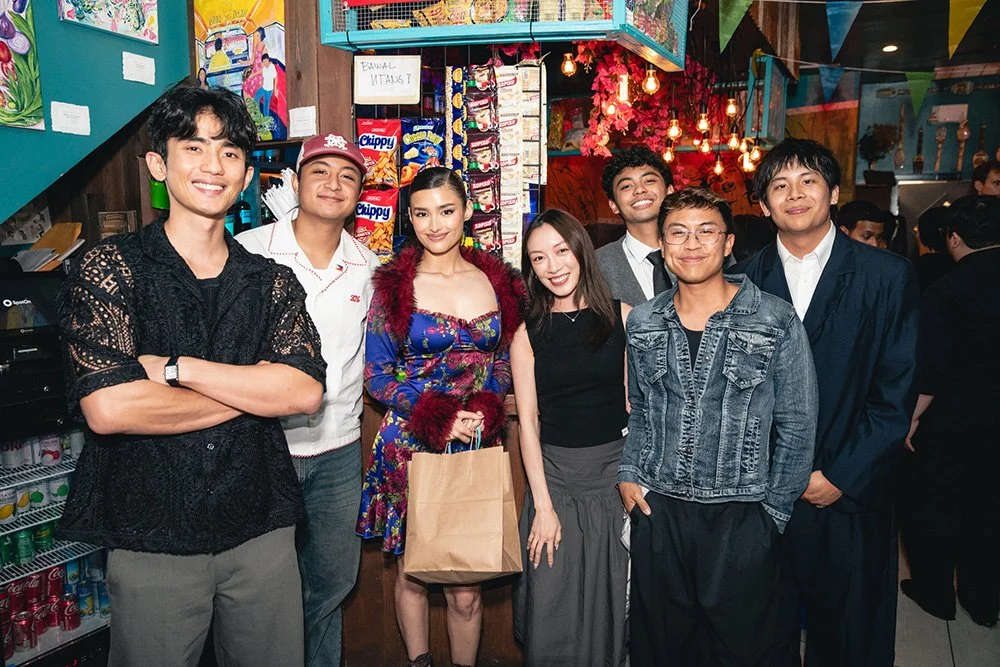
At Kalye NYC, Forgotten Island star Liza Soberano gathered with young Filipino attendees for a Filipino Fiesta Family Dinner celebrating the film. (Photo by Elaine Joy Degale)
“So we gave the people what the people wanted,” said Rob. “We became a restaurant.”
‘Tayo Na!’
There’s a shift in how Filipino identity is perceived in the United States. For generations, Filipino representation in America has often been associated with service, nursing, caretaking and all sorts of domestic labor. Shows like 90 Day Fiancé, alongside the broader culture of Western expatriates in the Philippines, have helped normalize a transactional image of the Filipino wife: one valued for her perceived submissiveness, domesticity and industriousness…all in the name of love, of course!
But we are living in a cultural moment in American society where that narrative is evolving.
Alex Eala in the U.S. Open taught America that Filipinos are also serious athletes. Lea Salonga recently getting a Hollywood Star on the Hollywood Walk of Fame, told the world that Filipinos are also talented singers. Jo Koy taught America that Filipinos are also funny.
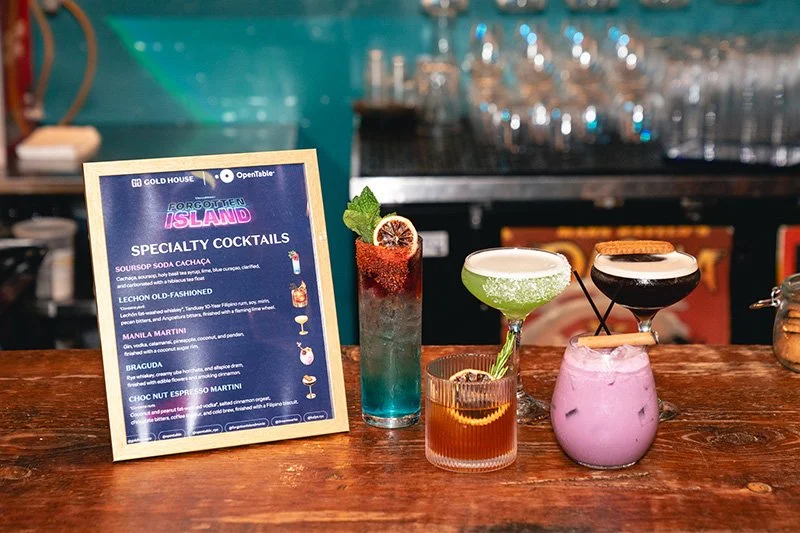
The specialty cocktail menu at Kalye NYC’s Forgotten Island Filipino Fiesta Family Dinner drew on Filipino flavors and ingredients, from soursop and calamansi to pandan, coconut and Filipino rum. (Photo by Elaine Joy Degale)
And for a Black Filipina like me? I am witnessing a moment where Jordan Clarkson of the Knicks can help break a 53-year losing spell, where a NY Knicks championship unites New York City. I am witnessing a Black Filipina artist H.E.R. go viral for singing Maging Sino Ka Man (Whoever You May Be) just months before Dreamworks released Forgotten Island, the first mainstream American animation that is an homage to Filipino pre-colonial ancestry.
For a millennial Black-Filipino writer, it is such an amazing time to be alive.
The dinner was hosted by Forgotten Island stars, H.E.R. and Liza Soberano, who voice the film’s best friends Jo and Raissa, respectively.
Imagine this: for one evening, beneath banana leaves and fiesta banderitas (buntings) and sari-sari store decor bearing the words “Tita Gay Store,” artists gathered around shared plates of Filipino food while music filled the room with the sounds of a diverse community. A Lower East Side restaurant became an ode to Filipino heritage -- a place as exciting as Forgotten Island’s Kakaiba Market, a kalye on the streets of New York City, where the spirit of Philippine mythology lingered under the stars.

Elaine Joy Edaya Degale is a Black-Filipina writer and lecturer at community colleges within the City University of New York (CUNY), and has an Ed.M. and M.A. from Teachers College, Columbia University.
She graduated cum laude from Mount Holyoke College where she studied International Relations and Development, and continues to support literacy and food programming efforts in indigenous communities through her Community-Based organization, OperationMerienda.org.
More articles from Elaine Joy Edaya Degale
