
I Called Him Kuya Vijoe
/I was in Grade VI when it happened.
At that age, the world is still mostly local, measured in school days, familiar streets, and the quiet hierarchy of those you look up to without quite knowing why. In Baguio, the hills shaped everything, and somewhere along those slopes moved my Kuya, Victor Oteyza de Guia Jr.—Vijoe.
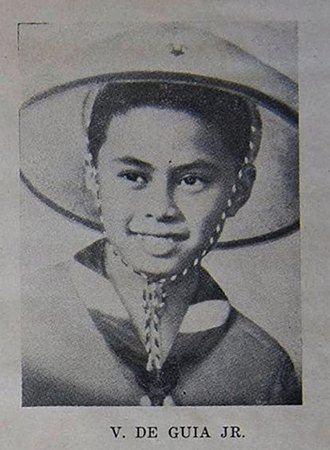
Victor de Guia aka Kuya Vijoe
Before he became part of history, he was simply present in my small world.
I remember him going to the office of his Uncle Bucky at Strike and Spare Lanes. I remember how he was always friendly to me—never distant, never too busy to acknowledge a younger boy watching from the edges. And I remember, most of all, his uniform.
It was not just worn. It was resplendent.
The neckerchief sat cleanly at his collar, held by its slide with quiet precision. The knots—square, taut, exact—spoke of a discipline I did not yet understand but instinctively respected. Every piece of paraphernalia seemed to belong exactly where it should be. Nothing was careless. Nothing was merely decorative. It all meant something.
To a boy in Grade VI, it was a vision of order and purpose.
He was the reason I carried on in the Boy Scouts, eventually becoming an Explorer Scout.
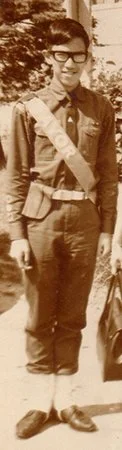
Author Rudy D. Liporada as Scout Boy Mayor of Baguio City during the Boy Scout Week in October, 1967. He was the president of the Saint Louis University Scouting Family and graduated in high school as a Gerry Roxas Leadership Scholarship Awardee.
What began as admiration became practice, then habit, then something like a quiet code. The neckerchief I wore, the knots I learned, the compass I drew with the Scout's motto, oath, and the Explorers' line—"Your best today for a better tomorrow”-- these were not small things. They were ways of holding direction.
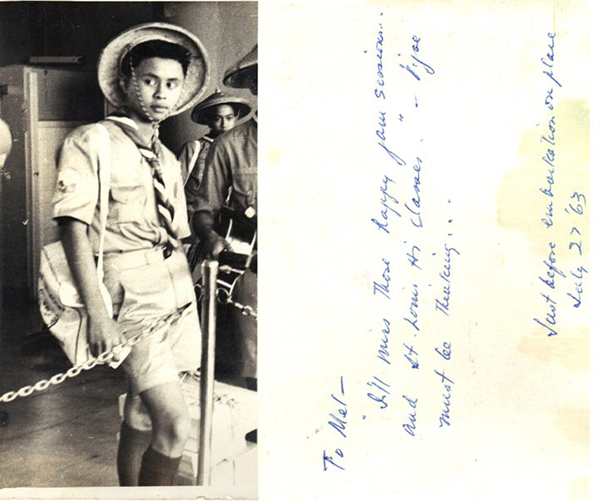
His last photo sent to a friend
Then came the news that stretched the world beyond Baguio.
He had been chosen—one of the country's finest young Scouts, selected to represent the Philippines at the 11th World Scout Jamboree in Marathon, Greece. Their journey would take them far—Manila, Hong Kong, Bangkok, Bombay, onward to Cairo, then Greece. It was more than travel. It was passage.
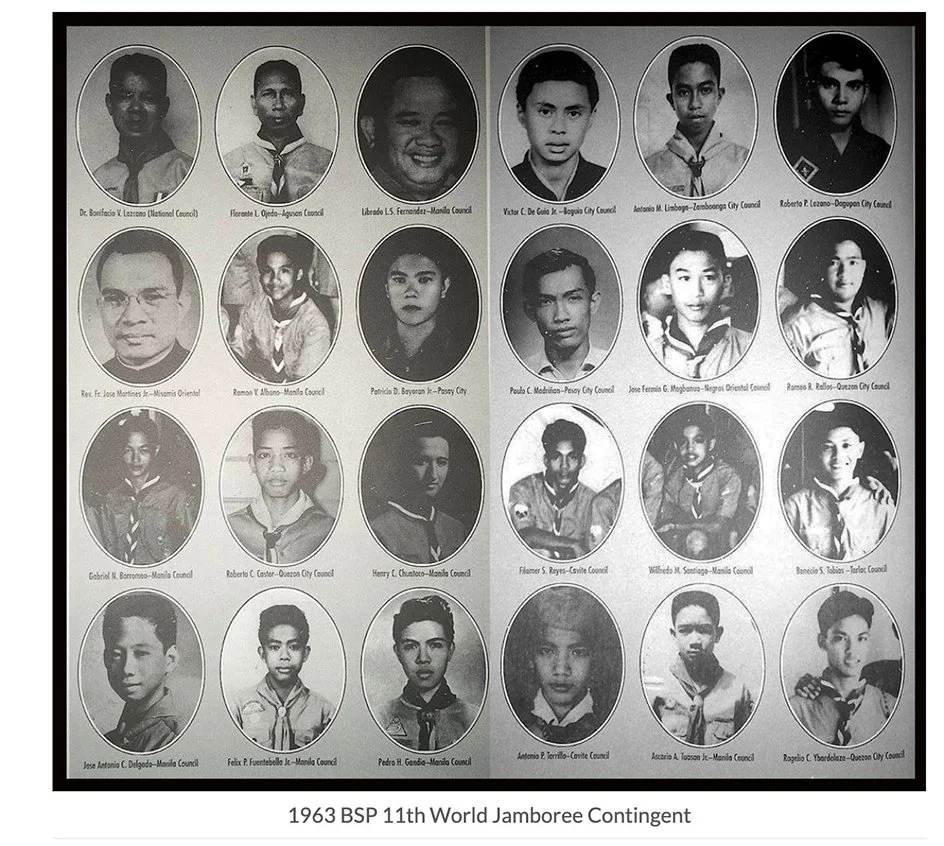
De Guia is on the top row, 4th from left.
He never arrived.
On July 28, 1963, the aircraft carrying him and the delegation—United Arab Airlines Flight 869—crashed in the Arabian Sea near Bombay during a storm, just as it was approaching landing. All sixty-three aboard were lost, including twenty-four Filipino Boy Scouts.
I did not yet have the language for tragedy.
Only that someone I had seen, spoken to, admired—someone who had stood before me in that uniform—was suddenly, irretrievably gone.
And then, he returned.
At Loakan Airport, we waited.
I remember the line of Boy Scouts in full parade dress along the tarmac—still, straight, almost impossibly composed for boys our age. The neckerchiefs were in place, the slides centered, the uniforms exact. Even in grief, the discipline held. Or perhaps it was because of it.
The plane arrived not with spectacle, but with a kind of finality.
He had been chosen—one of the country's finest young Scouts, selected to represent the Philippines at the 11th World Scout Jamboree in Marathon, Greece.
We received him there.
And we kept vigil—at City Hall, at Baden-Powell Hall.
Until the procession began—the city moved with him.
From Baden-Powell Hall, his coffin was brought out and tied with ropes. It was not simply carried, it was drawn, pulled by many hands. There was effort in it, shared and visible, as if grief itself required labor.
It was then that the tom-toms began.
Slow. Steady. Solemn.
Rudy D. Liporada was a feature writing instructor in Zambia, Africa before he moved to the US and became a freelance writer/novelist/columnist ("As the Bamboos Sway"). He graduated from the University of the Philippines, majoring in economics.
More articles from Rudy D. Liporada
