
Alone Amid the Haters on the Fourth of July
/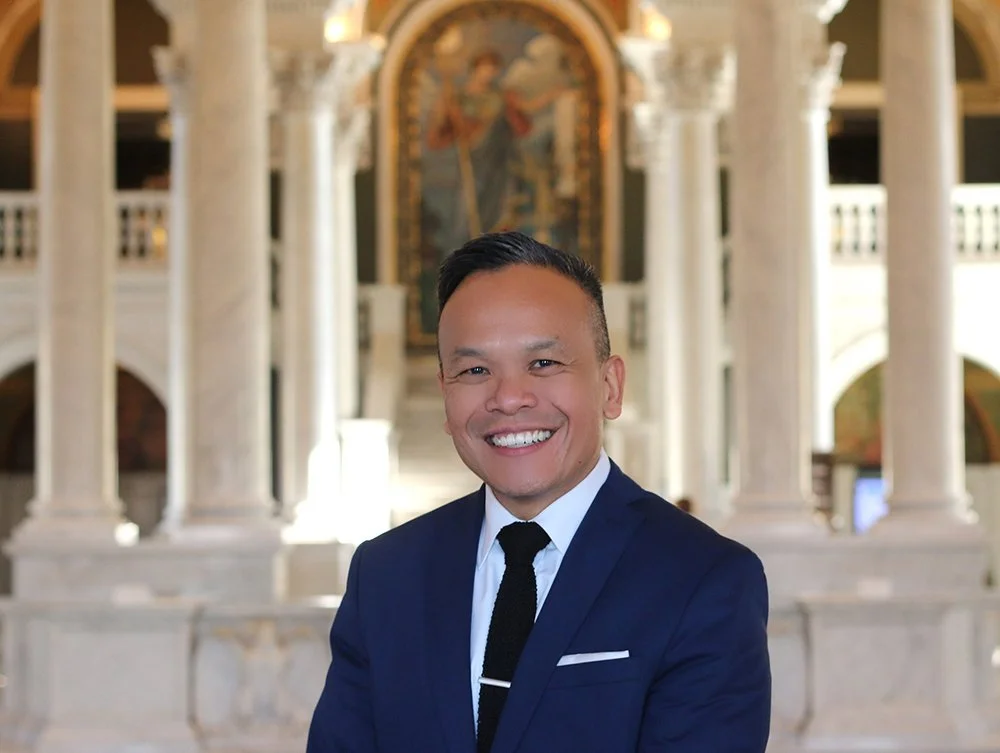
Roswell Encina
“As you can imagine, the Declaration has been at the forefront – it’s all we’ve been talking about. Those first sentences, We hold these truths to be self-evident, that all men are created equal…nowadays, it feels a bit of a challenge,” Encina said. “I feel like each generation has been challenged to try to achieve that, whether it’s the passage of women’s suffrage, to the 13th and 14th amendments, to the Voting Rights Act, to the Civil Rights Act, to the passage of LGBTQ rights.”
With the multitude of events across the country marking the semiquincentennial, Encina hoped that in addition to celebrating how far the nation has come, Americans also took the time to reflect on the work that has yet to be done. But there was no way he could predict how the Fourth of July at the nation’s capital would unfold; much less, how he would find himself central to the events of the day.
Encina unwittingly made international headlines when his image – surrounded by a large group of masked men later revealed to be members of the white nationalist group, Patriot Front – was captured by a Getty photographer on the Metro. (to view the photo go to https://www.instagram.com/p/DaaZFliERY6/?img_index=1)
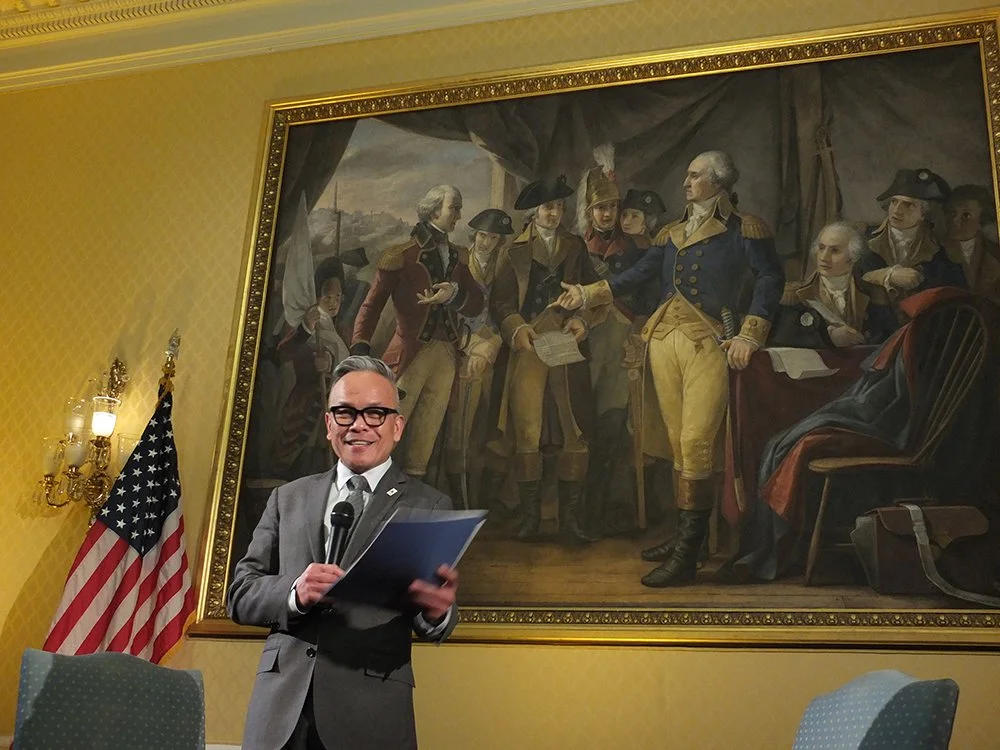
Roswell Encina (Photo courtesy of Bruce Gutherie)
The day began with rising anticipation and fanfare, with people decked out in red, white, and blue milling about. Encina, who hopped on the train from Dupont Circle, was on his way to a Fourth of July party in Maryland.
“It was good to see all these families and all these people being very patriotic and Americana and honestly, just being happy, especially when we live in such polarizing and divided times. So, that really put me in a good mood,” Encina said, adding that most of the passengers were tourists who got off at stops near the National Mall and the Capitol.
“When the Metro was slowing down at the next stop, I noticed a big group of men wearing masks and sunglasses and hats that were about to board our Metro cars. As you can imagine, I thought, ‘What the heck is happening?’”
The only thing that gave him a modicum of comfort, Encina said, was the presence of the Getty photographer – later identified as Finn Gomez – in the same car. Encina also managed to discreetly text his friends to let them know what was happening.
“[The photographer] was very obvious with his lanyards and identification, and he had a camera in his hand,” he said. “So, if anything went haywire, at least I know it would be documented. Because as I was texting my friends, I was thinking if any one of these guys punched or stabbed me, I wouldn’t be able to identify the person. Describing one would be describing 400 others.”
Encina managed to remain alert and maintain his composure for the approximately 25-minute ride to the train’s last stop in Prince George’s County. It was only when the passengers alighted that Encina realized the enormousness of the group’s size.
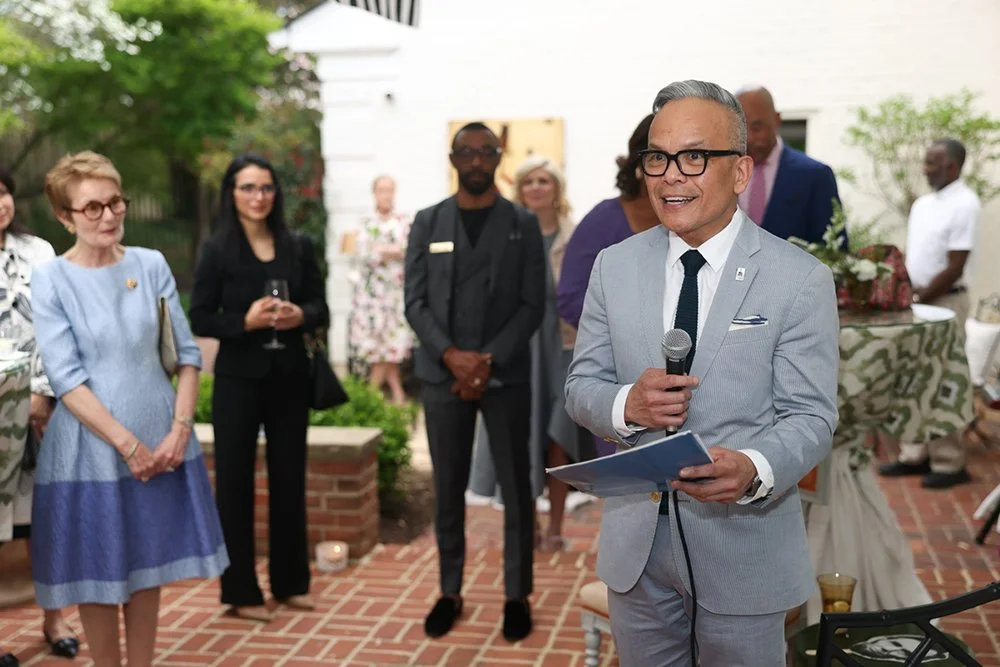
Roswell Encina (Photo courtesy of Tony Powell)
“At first, I thought it was just 50, 75 people. It didn’t dawn on me how many until we got off,” he said. “We got off and you see a flood of these men in almost military precision, single file on the escalator. Some of them reminded me of platoon leaders. They were barking orders for the men to be organized.”
It took days for Encina to fully process his experience and put it into context.
“History is not pretty. People need to understand that the country has always been divided, from the Revolutionary War up to now. You have to look at history as a whole, the achievements and the successes but also the violence and the prejudice,” he said.
The son of a U.S. Navy officer stationed in Connecticut, Encina first came to America at age one. His parents, Rodolfo and Fe, hailed from Santa Rosa, Laguna, where they settled after Rodolfo was assigned to the U.S. Naval Base at Subic Bay. In the years ensuing, the family of three moved back and forth between the States and the Philippines. Encina completed his primary and secondary education at Canossa School in Santa Rosa and graduated from De La Salle University in Manila at age 19.
The family later moved to Virginia, where Encina went back to school to pursue broadcast journalism at nearby Salisbury University in Maryland. For the next 14 years, he worked as a TV reporter for local news, garnering storytelling experience that later transitioned into overseeing communications for public libraries in Baltimore and later, for the Library of Congress.
“Libraries are great equalizers – rich, poor, Black, white, gay, straight…they’re all welcome,” he said. “I’m very proud of the work public libraries are doing. Through that work, I saw how very important stories are. My first job was telling stories; this time, I was sharing stories.”
Shared stories and a knowledge of history are part of what fosters an “informed patriotism,” something that Encina emphasizes at the U.S. Capitol Historical Society.
“We want to make sure that people are civics-oriented and how understanding the past when it comes to how Congress works and how democracy works will help us move forward,” he explained. “People need to be properly informed.”
Encina’s enthusiasm for civic responsibility and advocating for the role everyday citizens play was instilled in him early on.
“My father and mother were always civic-minded. They were very active, whether it’s with the Jaycees, the homeowners’ association or any other kind of civic group – and all their friends were like that,” he said.
“History is not pretty,” says Roswell Encina. “People need to understand that the country has always been divided, from the Revolutionary War up to now.
Encina recalls casting his first vote at 18 at the U.S. Embassy in the Philippines.
“It was the 1988 presidential elections in the States. My father said, ‘We’re going to the U.S. Embassy and you’re going to vote.’ I still remember that day, how excited I was, walking into the embassy, getting our ballot and voting,” he said. “I felt a sense of pride voting for the first time. I think I’ve only missed one or two elections since because of all the moving, but I’ve always believed in the value of voting.”
Voting provides the citizenry with a voice, much like the individual stories Encina cultivates at his current role.
“I’m proud to be an American, and I understand the situation I was put in [on the Fourth of July]. And what makes me proud is that people may have never expected that the person leading the U.S. Capitol Historical Society is the son of an immigrant, a Filipino American, and that’s what makes it really incredible. America does offer these opportunities,” he said.
“Whether you’re an immigrant from Ireland or Honduras or Mexico or the Philippines or China, we all share the same story and shared history with American-born citizens. Together, we’re all part of the country.”

Award-winning journalist Trish Muyco-Tobin has a combined 30 years of experience in TV, radio and print as an editor, reporter, news anchor and producer. She is a member of the faculty at the School of Communications at Webster University in St. Louis, where she also serves as adviser for student publications, including the Webster Journal and Ampersand magazine.
More from Trish Muyco-Tobin
