
He Danced Before He Knew Why
/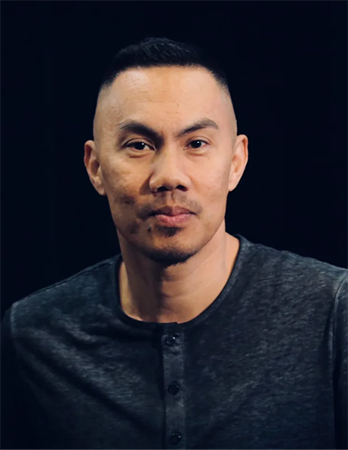
Alvin Erasga Tolentino
What I did not expect was to leave having discovered something.
Alvin led the dance workshop himself. He met us exactly where we were, and what unfolded felt less like instruction and more like permission. The shy, hidden parts of me that don't usually show up in a room full of people, showed up. I wrote afterwards that we had "the privilege to express and also discover more of our budding gifts." I meant every word.
That is the gift of Alvin Erasga Tolentino. He makes space for what you didn't know you were carrying.
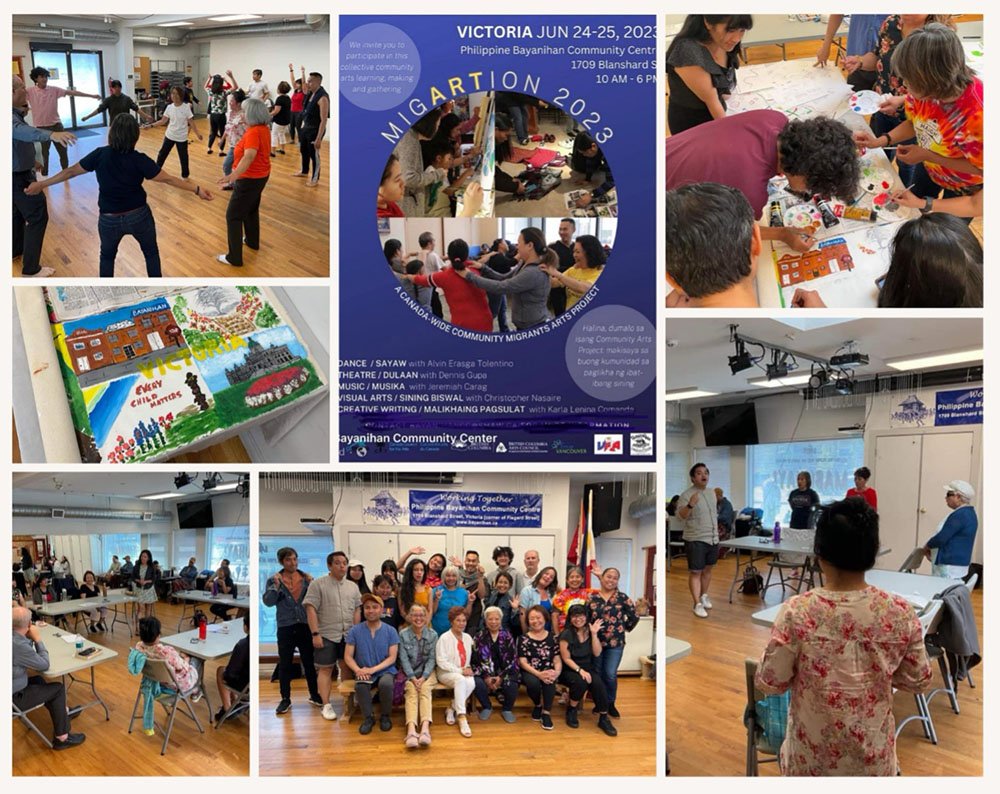
During the Victoria MigARTion in 2023 at the Bayanihan Community Centre. (Photos from Alvin’s archives MigARTion 2023)
A Boy Who Moved Before He Knew Why
Alvin was born in 1969 in Quezon City and spent his first twelve years in the Philippines before immigrating to Canada in 1983. He settled in Vancouver on the unceded, ancestral, traditional territories of the Coast Salish peoples: the Squamish, Musqueam, and Tsleil-Waututh Nations — where he has lived and worked ever since.
I asked Alvin if there was a specific moment–a performance, a person, a place–that made him know this was his path.
He smiled at the question, at least that is how I imagined his reaction.
"I only recall my mom telling me that when I was three or four, I would hold onto a wall and shake my body whenever I heard music or a beat from the radio. I had an innate affinity for moving to the rhythm. It was something I did naturally." He continued, "I didn't choose dance. Dance chose me."
At fifteen or sixteen, he discovered modern dance and was hooked. By twenty-one he had entered a professional career. More than three decades later, he is still dancing, still surrendering fully to the form. His training took him through The Royal Winnipeg Ballet, York University, SUNY Purchase, and the Limon Institute. The Georgia Straight once called his work "contemporary, progressive, and provocative." Mel Tobias of The Philippine Chronicle of Vancouver described him as a daring virtuoso dancer with originality, exuberance, technical brilliance, and powerful grace — a quote that lives on his own bio page to this day.
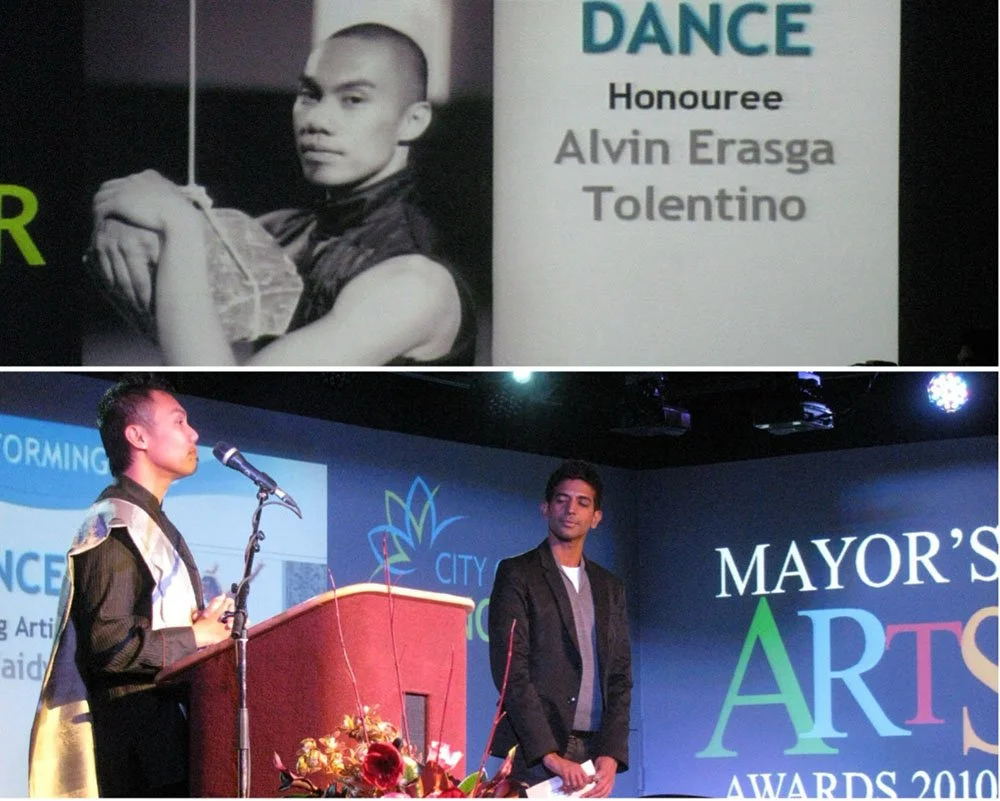
Alvin being honored for his contribution in dance at the City of Vancouver Mayor’s Arts Awards in 2010
(Photos by Todd Wong)
Building Something That Lasts
In 2000, Alvin founded Co.ERASGA, a Vancouver-based contemporary dance company dedicated to research, creation, and the presentation of dance rooted in cross-cultural dialogue and collaboration. It was an act of faith in a field that had not always made space for artists like him.
Co.ERASGA has toured across Canada and performed in Japan, Belgium, France, the Philippines, Switzerland, Singapore, Venezuela, the UK, Thailand, China, Uruguay, and Germany, among others.
Recognition has followed the work. His filmed solo SOLA earned a nomination at the 2000 BC Leo Awards and Canada's 2001 Gemini Awards, then won the 2002 Grand Prix International Video Dance Competition for UNESCO in Paris. In 2010, he received the Vancouver Mayor's Arts Award for Dance. In 2018, the ExploreAsian Pan Asian Award recognized his contributions to the arts and multiculturalism.
In 2025, he was named among the Outstanding Filipinos in Canada by Canadianfilipinonet. And just recently, The Dance Centre awarded him the Isadora Award, one of BC's highest honours for dance professionals. He is also the only Filipino Canadian artist included in Voices Rising by Xiaoping Li, the landmark book on Asian Canadian cultural activism.
But perhaps the most telling recognition is the one he created himself. In 2014, Alvin founded the AET Koreograpiya Award, a biennial prize funded from his own resources to support an emerging Filipino contemporary choreographer living in the Philippines. A man who fought for space in the art world now builds that space for others.
The Body as Archive
I wanted to know how his Filipino heritage actually shows up in his work — not just in identity, but in the movement itself, the stories he chooses, the way he works with dancers.
"As an adult, I came to appreciate the significance of my Filipino heritage as a powerful means of self-expression," he remarked, "reflecting my life circumstances and observations as an immigrant living in the West."
His work delves into ancestral tracing, memory, climate justice, and the enduring impact of colonization — in synergy with indigenous knowledge and the everyday realities of Filipino life. Field is a tribute to rice and the stories of his ancestral families. Colonial confronts the wounds of colonization and asks how we find a decolonial path to free the Filipino spirit. Tracing Malong holds textiles as living repositories of memory.
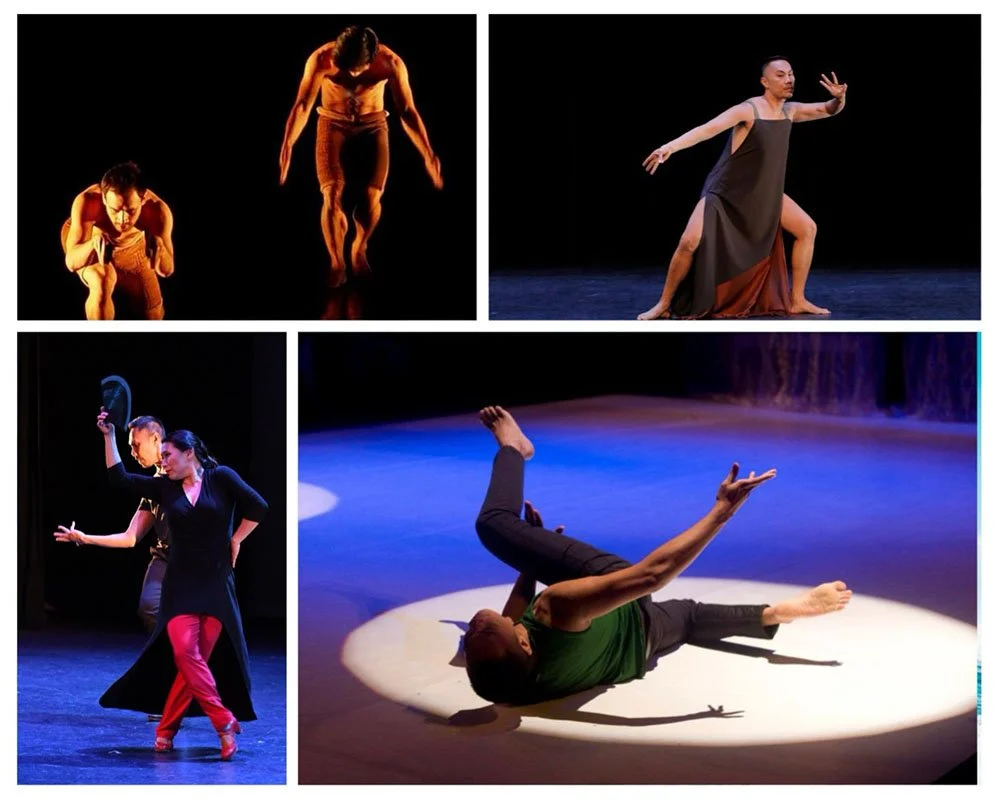
An expression of heritage, not just in identity but in body movement (Photos from Alvin’s archives, Sanka Dee Photography, Erica Marquez Jacinto, and Martin Inthamoussu)
"I've focused on the body and movement as the core of my inquiries," he explained. "My goal isn't to find answers or solutions, but to express things words can't capture."
The body knows things the mind hasn't caught up to yet. His art trusts that.
Art as Belonging
Building a career in dance as a Filipino outside the Philippines was not without its costs, and he did not shy away from saying so.
"Being Filipino working in the West meant facing challenges: discrimination, colonial mentality, systemic barriers, and underrepresentation, especially in my early years as an independent artist in the 90s."
But he kept going. "I persevered, doing my dedicated art works until my community could appreciate my contributions."
What hasn't surprised him, he recalls, is the undeniable truth that art transforms people. "The arts and culture are essential to everyone's lives. They have the incredible power to transform children, youth, adults, and seniors, fostering a sense of community as we gather to share our stories."
"I only recall my mom telling me that when I was three or four, I would hold onto a wall and shake my body whenever I heard music or a beat from the radio.”
Beyond the stage, Alvin has built programs that reach people most often left outside the arts. MigARTion now extends beyond British Columbia to Toronto, and Montreal, offering racially marginalized migrants access to the arts. This summer, he returns to the national tour of Accumulation, Co.ERASGA's production centered on climate action stewardship, touring across Luzon, Visayas, and Mindanao with performances, workshops, and public dialogues. He also recently curated Undivided Colours, a showcase celebrating Asian Heritage Month featuring Asian Canadian artists working across modern dance, Bharatanatyam, Filipino, and flamenco traditions.
I think about the Bayanihan Community Centre. The word itself means coming together — a community carrying a shared load. Alvin has been doing that his whole career, one body, one story at a time.
He is one of the finest Filipino Canadian artists of his generation. And I am grateful that in June 2023, on those two days in Victoria, his art found me too.

Lani Domaloy is a Filipino-Canadian writer, poet, and photographer living on Vancouver Island in Canada. She draws her creative inspiration primarily from her love for the outdoors, nature, traveling, and the arts.
More articles from Lani Domaloy
