

Hands That Healed the World: First Filipina Nurses In Europe
/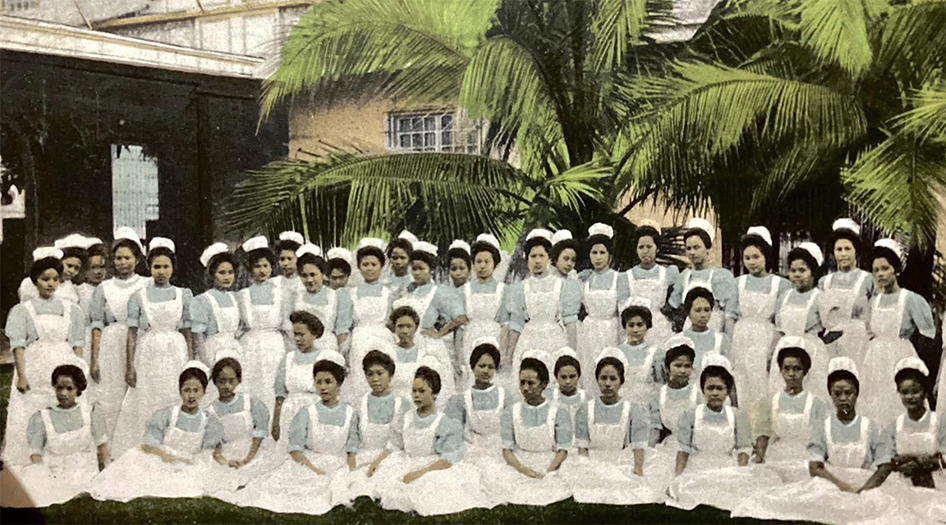
A colored photo of Filipino nurses in 1910 (Source: Facebook)
From Convent to Clinic
In the first years of the American occupation, medicine became a new language of order and progress. The Bureau of Health wanted a “modern colony,” and hospitals became the classrooms of empire. In Iloilo, the Protestant missionaries opened their mission hospital in 1906. In Manila, the Philippine General Hospital rose from reclaimed marshland, whitewashed and orderly as any in Boston or New York. Inside its wards, Filipina students practiced sterilizing instruments and taking temperatures in English, repeating phrases from Florence Nightingale’s Notes on Nursing.
But behind the American veneer stood an older lineage. The Daughters of Charity and the Sisters of St. Paul de Chartres had been teaching Filipino women how to nurse long before the Americans arrived. Their convents were schools of discipline as much as compassion—clean sheets, measured steps, soft voices. The nuns had learned their craft in Paris and Lyon, and their Manila pupils would one day return those lessons to their source.
By 1910, the Philippines could already boast of trained women who could dress a wound, set a fracture, or comfort a fevered soldier. Their hands were steady and sure, their speech gentle but firm. When word came that France needed help, the sisters called upon their Manila alumnae to volunteer. It was an act of obedience, yes—but also of pride. The French motherhouses wanted proof that their colonial daughters had become equals in the work of mercy.
Crossing the Oceans of Empire
The first group sailed in December 1914 aboard the SS Empress of Russia. The ship’s black funnel trailed smoke over the China Sea as it moved from Manila to Hong Kong, then on to Saigon, Singapore, Suez, and the long curve of the Mediterranean. On deck the nurses prayed the rosary together, the beads clicking softly in rhythm with the engines. The sea was a living presence—a thing both vast and intimate. In their letters home, they wrote that they felt they were sailing not toward war but toward history.
Marseilles was gray and cold when they arrived. The harbor cranes groaned, and the air smelled of iron and fish. French officers met them at the pier, uncertain how to greet these dark-skinned women in immaculate white. “Les infirmières des Philippines,” one said, trying the words aloud. They were assigned to hospitals in Lyon, Bordeaux, and Marseille, where the wounded arrived daily by train. Their English made them valuable to American Red Cross units, and their discipline impressed even the most skeptical matron.
“Europe is cold and wounded,” one nurse wrote in her diary, “and it looks to us brown women for warmth.” In the early mornings they carried buckets of boiled water down endless corridors. The floors were slick with blood and disinfectant. Men cried out in a dozen languages. The nurses worked in silence, their faces veiled against the stench of gas gangrene.
By 1916, more volunteers arrived through Indochina, traveling on French mail steamers via Saigon. They were met with curiosity rather than hostility. A French doctor in Tours described them as calm, efficient, and full of courage. To him, they were exotic angels; to the nurses themselves, they were simply doing their duty.
In the Wards of War
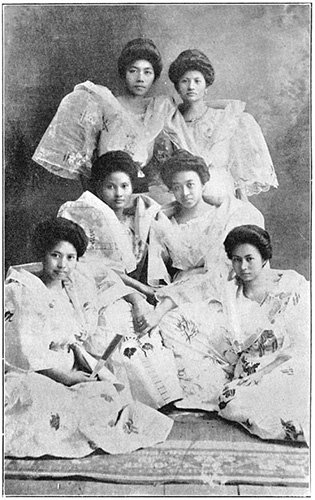
Members of the first class to graduate from the government training school. (Source: Gutenberg.org)
The war stripped away illusions. In the hospitals near the front—at Verdun, Soissons, and Amiens—the nurses found themselves face to face with the machinery of modern death. Trenches vomited up men whose faces were erased by shrapnel, whose lungs hissed from gas burns. Yet the nurses did not flinch. They wrapped the wounded in clean linen and whispered prayers in Tagalog, English, and French.
At the Hôpital de la Sainte Famille in Lyon, Dr. Émile Jacquier wrote of two Filipina nurses “whose calm hands steadied the dying.” In Rouen, Sister Beatriz de la Paz, once a novice in Manila, learned to dress the wounds of Senegalese riflemen, their dark skin blistered by frost. She sang to them in a soft voice, hymns that crossed language and race.
Twelve-hour shifts became fourteen. Supplies ran low. They sterilized scalpels in soup pots, tore curtains for bandages, and mixed antiseptic from vinegar and salt when carbolic acid was gone. One nurse wrote home, “We have learned to make do with little, as at home during floods. But here, it is not water that drowns the world, it is sorrow.”
They slept in drafty quarters, their breath visible in the winter air. Some fell ill with influenza; others lost their hair from exhaustion and cold. Still they worked. “They nursed as if each man were their brother,” said one Red Cross matron, herself hardened by years at the front.
For many of the soldiers, these women from the islands were their last memory of gentleness. “They smiled like home,” wrote a French private who survived Verdun. “We did not know where the Philippines were, but we thanked God for them.”
Between Faith and Modernity
The Filipina nurse was a bridge between worlds. She carried a rosary in one hand and a thermometer in the other. Her faith was Catholic, her training American, her orders French. Empire had divided the globe into colors and classes, but in the hospitals there were only the living and the dying.
The Daughters of Charity in Paris called them “les anges de l’Orient,” angels from the East. Their gentleness became a legend whispered in the wards. Yet, the American colonial authorities in Manila saw a different symbol. Their service was cited as proof of a “civilizing mission fulfilled”—a phrase that made the nurses uneasy even as it praised them.
They had seen too much to believe in empires. “I serve God by serving pain,” wrote Sister Encarnación de la Cruz, who later stayed in Paris as a hospital matron. “No empire owns compassion.” She kept her crucifix on the nightstand and a picture of Manila in her locker.
When the American Expeditionary Forces arrived in 1917, some of the nurses translated for wounded Filipinos who had enlisted as laborers and sailors under U.S. command. The soldiers called them Ate—elder sister. For a moment, the war brought the colony and the colonizers together in the shared fatigue of tending the broken.
The nurses’ letters reveal not self-pity but quiet dignity. “We are brown, and we mend the white,” one wrote. “When they thank us, we smile. When they forget, we pray for them still.”
Homecomings and Legacies
When the Armistice was signed in November 1918, the bells of Lyon rang all day. The nurses walked to the cathedral, their shoes worn thin. They prayed for the dead, then packed their trunks. Some boarded ships for home, others remained to help rebuild. The voyage back to Manila was long and slow, through a world still gasping from war.
They disembarked into tropical sunlight and a new sense of purpose. Europe had changed them. They had learned to speak French, to manage wards, to perform emergency surgery. They brought back habits that would remake Philippine nursing—sterile technique, record-keeping, and the respect for nurses as professionals, not servants.
Among them was Anastacia Giron, who would found the Philippine Nurses Association in 1922 and fight for licensure laws that elevated nursing to a national profession. Her colleagues spread across the islands, teaching in Iloilo, Cebu, and Davao. In every clinic where they worked, echoes of Lyon and Rouen lingered: the way a wound was cleaned, the tone of command, the pride in a crisp uniform.
A few remained in Europe. Parish records in Toulon list Ester Santos, Filipina nurse, married to a French naval surgeon. She ran a small clinic by the docks, treating fishermen and their families. On her gravestone are four simple words: Elle soigna le monde—She cared for the world.
The war had taken her youth but left her faith intact. When she died in 1936, her French neighbors said the church smelled faintly of gardenia, a scent that reminded them of the islands she once called home.
Remembering the Pioneers
For decades, their story was forgotten. The history books that praised the pensionados and the Filipino scouts ignored the women who carried gauze and mercy through Europe’s ruins. Theirs was not a martial glory but a moral one, and that was harder to record.
In the postwar years, the Philippines looked west again—not to France, but to America. Thousands of nurses followed new paths across the Pacific, filling hospital corridors from Honolulu to Chicago. They became part of the nation’s most enduring export of care. Yet behind that story stands the image of those first women in 1914, standing at the rail of a ship, their faces turned toward the setting sun over the Suez.
A photograph preserved in Geneva shows six Filipina nurses standing before canvas tents near Verdun in 1916.
It took nearly a century for historians to find them again. When their names were finally pieced together from Red Cross rosters, convent letters, and family memories—Beatriz, Encarnación, Anastacia, Ester—they returned to the nation’s historical consciousness not as footnotes but as pioneers.
A photograph preserved in Geneva shows six Filipina nurses standing before canvas tents near Verdun in 1916. Their caps are slightly askew, their hands clasped at their aprons. Behind them, the horizon is a smear of smoke. They do not smile. They look straight at the lens as if to say, Remember us.
They remind us that compassion, like war, is global. The same ships that carried armies across the world also carried women who fought without guns. Their battlefield was the human body, and their victory was every heartbeat restored.
In their calm eyes and scarred hands, the Philippines entered the world stage not as a colony or victim but as a healer. And somewhere in the chill air of Lyon or the silence of a French ward long since demolished, one can still imagine the echo of their voices, soft and sure:
“Courage, mon frère. The fever will pass.”
Previously posted in the author's Facebook page.

Alex S. Fabros, Jr. is a retired Philippine American Military History professor.
More articles from Alex Fabros, Jr.
