
Federico Dominguez, Painter of Folklore
/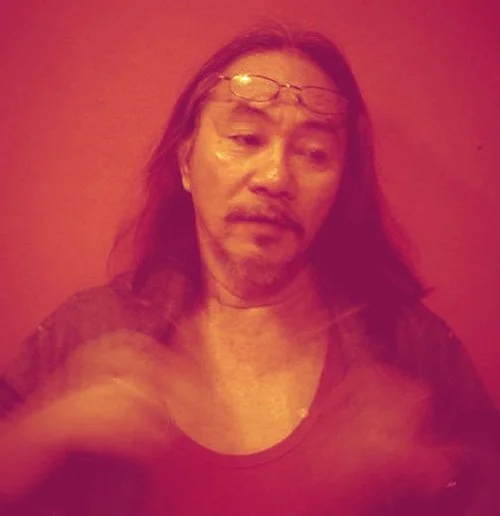
Federico Dominguez (Photo by Jes Aznar)
He is a proud member of the Mandaya, an Indigenous group predominantly found in Davao Oriental. His cultural identity is frequently reflected in his paintings, serving as a meaningful way for him to express himself and showcase the richness of Mandaya culture to the world.
Growing up in Davao City, he fondly remembers spending time near the mouth of the Davao River with his friends. They would eagerly await strong waves that would carry them to the David Gulf, where they would enjoy swimming. Then, they would go to a small island in the Davao River. “We would catch tuway, a shellfish, using thin sticks of a walis tingting (a traditional broom made from the midribs of palm leaves, usually coconut leaves) to take out the meat,” he remembers. “Also, we would climb coconut trees to get butong (nuts).”
He states that his love for the visual arts deepened by sharing experiences with his best friend, Benjie, at the Davao Central Elementary School. In addition to drawing together, they would make toy cars out of sardine cans. After school, they would pass by a movie house, where a famous visual artist, Adlao, would make posters on a permanent canvas. As he sketched, Dominguez and Benjie would follow him, creating their artwork with pencils, crayons, and paper. They went their separate ways when they attended different high schools. Years later, Dominguez spotted him performing with a band at a nightclub. Afterwards, he heard that Benjie moved to America.
While working part-time at an art shop in Davao City that mass-produced paintings, he began learning to work with oil paints, brushes, and canvas. “I achieved discipline and learned from the tips given by senior visual artists in the shop,” he tells me. He eventually studied architecture and fine arts at the University of Mindanao (Davao City) and the University of the Philippines (Quezon City), respectively.
Dominguez’s paintings stand out because of their brilliant colors, which seem to radiate from within. At first glance, they also appear crowded. But upon closer inspection, a story unfolds for analysis and enjoyment. The myriad details and narrative depth grow on you.
In Ing Lam-aw ni Manaog (2016), he explores a Mandaya folklore: When it is a full moon, seven sisters descend from the upper world to take a walk, play, or swim in a pond, where Magbabaya (Great Spirit) inhabits. There is a hunter who eventually kidnaps one of the sisters and makes her his wife. Two sisters are in a pond, and three sisters are flying. But that is only a total of five sisters. Where are the other two sisters? Dominguez explains that they are the two emblems above the three flying sisters. While physical manifestations are expected in the real world, in the spiritual realm, they can be represented symbolically.
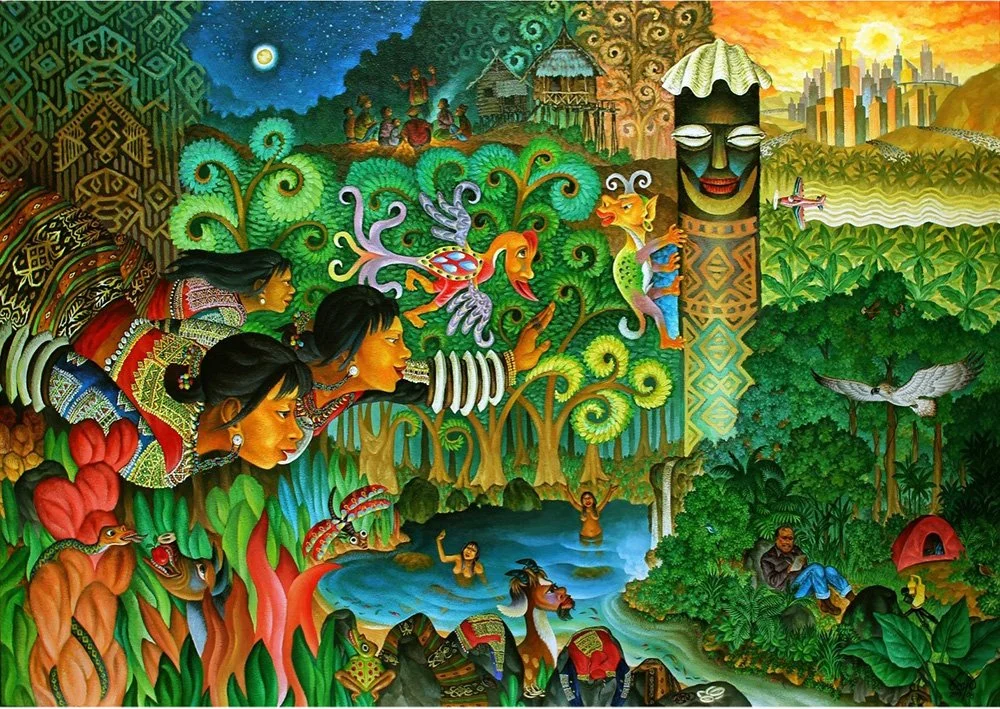
Ing Lam-aw ni Manaog (The Avatar's Pond) by Federico Dominguez, 2016, acrylic on canvas, 60" x 42.5" (Photo by Federico Dominguez)
Dominguez’s paintings stand out because of their brilliant colors, which seem to radiate from within.
Domiguez depicts the battle between good and evil in Magwayen (2015), where he explores the theme of the environment through Magwayen, a sea deity from Visayan folklore. Magwayen is depicted as both benevolent and angry, punishing those who harm the environment while guiding souls in the afterlife. Shells and a turtle symbolize the sea world, whereas totems denote her venerated status. A snake coiled around her arm suggests that she can be fierce. In the bottom corner, a storyteller shares her tale with a group, showing that she is part of an oral tradition. Overall, the painting provides a comprehensive portrayal of Magwayen’s many-sided character.
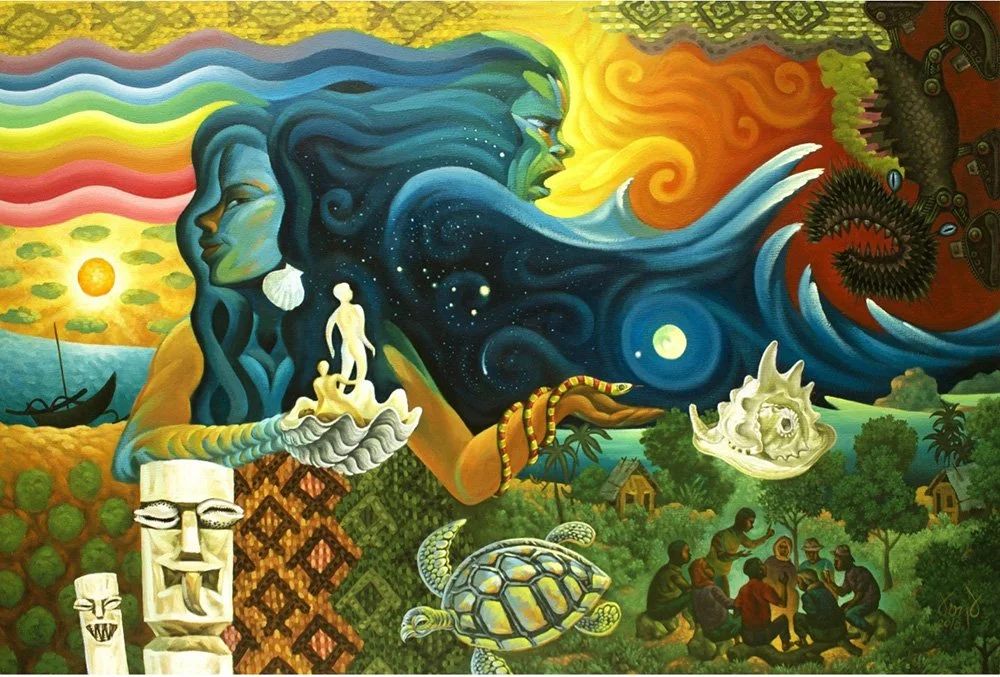
Magwayen by Federico Dominguez, 2015, acrylic on canvas, 56” x 36”. (Photo by FeDerico Dominguez)
My long friendship with my Finnish pen pal, Satu, is commemorated by Dominguez in Storytelling: Sami (Finland) and Mandaya (Philippines) (2022). Like the Mandaya of the Philippines, the Sami are an Indigenous group in Northern Europe, including Finland. The painting showcases the rich storytelling traditions of both cultures, including their differences in climate, traditional houses, and attire. The reindeer and carabao, significant to Sami and Mandaya cultures, respectively, are also featured.
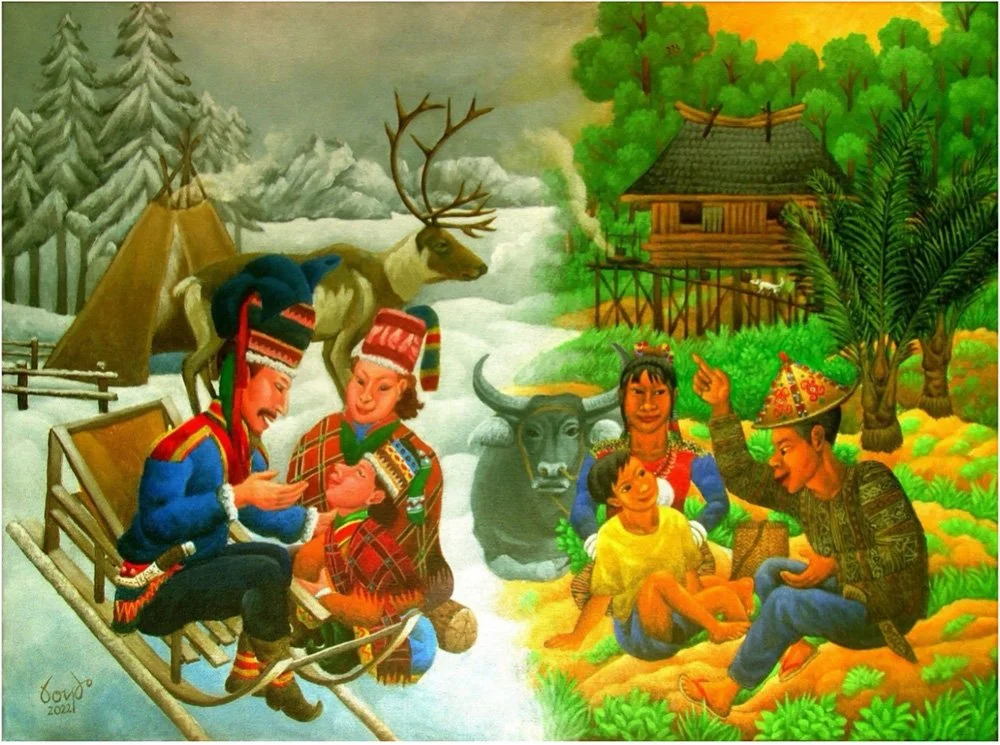
Storytelling: Sami (Finland) and Mandaya (Philippines) by Federico Dominguez, 2022, acrylic on canvas, 20" x 15". (Finnish American Heritage Center) (Photo by Federico Dominguez)
Federico Dominguez conceptually employs folklore to make some larger intellectual and spiritual points, rather than merely for visual appeal. Nonetheless, his paintings are a feast for the eyes, sweeping viewers away with their intense colors, complex storytelling compositions, and explosive energy that have never been seen before.
The author extends gratitude to Annabelle C. Jayco for her interview support and Dexjordi Lyle Sison for his assistance with the photos.
Rey E. de la Cruz, Ed.D., writes for Positively Filipino from Chicagoland, carrying with him both his immersion in the arts and a steady longing for his hometown of Ballesteros, Cagayan—celebrated as the “Gakka Capital of the World.” He reshaped the very idea of film education in the Philippines, becoming the first recorded film student at the University of the Philippines and later the pioneer who brought film into the high‑school classroom at San Beda. As an educator, he introduced the ancient Philippine board game sungka into classroom practice, turning cultural memory into pedagogy. UMPIL, the Philippines’ largest organization of writers, honored him with the Gawad Balagtas for Drama in Filipino “for his pioneering creative spirit that imagined and expanded what can be possible for today’s modern theater.” His plays—dream‑driven, daring, and theatrically audacious—continue to resonate. He defined Theater Without Apology as a writing ethic that rejects softness, insists on precision, and confronts truth without blinking.
More articles from Rey E. de la Cruz
