

Finding the Philippines and Its Economic Future Far from Home
/
Oscar San Pedro (right) and Mark Harder run the gasoline station at Lake Louise, Alberta, Canada. (Photo by Mona Lisa Yuchengco)
My family and I had traveled to Peggy's Cove, one of Canada's most iconic destinations, famous for its lighthouse perched on granite rocks overlooking the Atlantic Ocean. Yet even in this windswept remote corner of the country, there were reminders of a familiar presence. Filipinos were there. It turned out to be just a preview.
The following day, we visited Hall's Harbour along the Bay of Fundy in western Nova Scotia, known for having some of the world's highest tides. At the lobster restaurant overlooking the harbor, I noticed and spoke with Filipino staff. After a long drive over meandering roads through picturesque farms and woodlands who do we find at the journey’s end? Filipinos.
On our final day in Halifax, we stumbled upon the Farmers' Market. What surprised me most was discovering three Filipino food stalls. Above the noon time din of a crowded market, we spoke with one owner in Tagalog. She was so glad to have Filipino customers she gave us one free order of bihon (rice noodles)
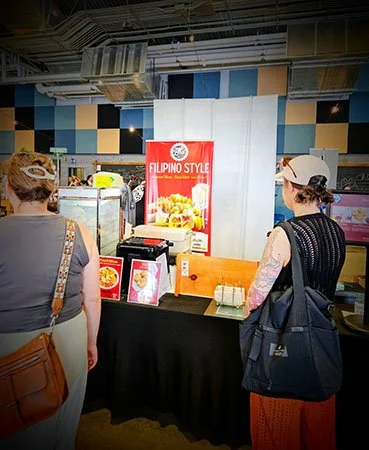
Farmer's Market in Halifax, Nova Scotia with Filipino owned food stall (photo credit to author)
They had become part of the broader community, introducing Philippine flavors and entrepreneurship to Canadian customers.
Three encounters in as many days.
A lobster restaurant. A farmers' market. A tourist destination.
They seemed like ordinary observations from a family trip. Yet they were reminders that Filipinos have become woven into the economic and social fabric of societies around the world.
The Filipino diaspora is no longer simply a story of migration. It is a story about global economic and cultural participation. And increasingly, it is a story about the future of the Philippine economy.
The Invisible Visible Minority
Years ago, in a chapter I wrote on Filipino entrepreneurship for a University of Toronto Press volume on “Filipinos in Canada,” I described Filipinos as the "Invisible Visible Minority." I used it again in my short story, Moving Furniture published in the Akdaan Anthology.
The phrase captured a fascinating paradox.
Filipinos are among the fastest-growing immigrant communities in Canada and one of the world's largest diasporas. They are present in hospitals, universities, corporations, restaurants, small businesses, and public institutions. Yet despite their numbers and contributions, they often remain less visible in national conversations about immigration, entrepreneurship, the cultural discourse, and economic and political influence.
They are visible everywhere and yet frequently, overlooked and never demanding attention.
This paradox is not unique to Canada. It can be observed in communities across the world.
During my graduate studies in Japan, I encountered Filipinos in many different settings. I even spent one New Year’s Day at the Tokyo apartment of a UP professor. At the Smithsonian in Washington D.C. my wife and I were pleasantly surprised when the staff giving the tickets greeted us in Tagalog as she overheard us conversing. We had a short but animated chat.
A few years ago, while traveling in Europe, my family and I encountered Filipino workers in another global environment—the tourism industry. On a cruise ship sailing through the shimmering Mediterranean Sea, Filipino crew members were quite cheerful to see us Filipino Canadians. In a trademark of Filipino hospitality some of them came by and brought a bottle of champagne to the cabin of our sons.
These experiences reinforced a simple observation:
Wherever globalization creates opportunities, Filipinos are often present. They not only worked in industries traditionally associated with overseas employment, but many others were professionals, caregivers, educators and entrepreneurs. But their importance goes beyond their ability to adapt.
Their presence represents a global network of skills, relationships, and trust.

View of Hall's Harbour from the Lobster Restaurant at the Bay of Fundy. Note the difference in the tide levels. At low tide the boats are literally stuck in the mud (Photo credit to author)
From Remittances to Filipino Diasporic Capital
For decades, the economic contribution of overseas Filipinos has been measured primarily through one indicator: remittances.
And rightly so.
The Filipino diaspora counts more than 13 million Filipinos which is one of the largest communities in the world. Their financial contributions have become a pillar of the Philippine economy. Annual remittances exceeding US$40 billion have helped support millions of Filipino families, strengthened household consumption, financed education and healthcare, and provided a stable source of foreign exchange.
Overseas Filipino Workers (OFWs) have rightly been called modern-day heroes of the republic.
Their sacrifices have transformed lives by lifting families out of poverty and some were able to send their children to western schools. One of my Filipino students in the Canadian university I teach was financed by her mother working in Dubai. An excellent student, she is an exemplar of the next generation of the diaspora.
But the story cannot end there. Remittances represent only the most visible contribution of the diaspora.
They do not fully capture the knowledge, expertise, networks, and opportunities created by Filipinos living abroad.
This article develops the concept of Filipino Diasporic Capital to describe the combined human, knowledge, entrepreneurial, social, financial, and reputational resources embodied in the global Filipino diaspora and their potential contribution to Philippine development.
These contributions may never appear in official remittance statistics. Yet they represent economic value.
Human Networks Behind Globalization
Globalization is often discussed in terms of trade agreements, multinational corporations, supply chains, and financial markets. But globalization is also a human phenomenon because behind every international connection is a person.
Every Filipino abroad represents a potential bridge between the Philippines and another economy. Markets can connect buyers and sellers. But the matrix of relationships creates confidence and long-term beneficial economic and social ties based on trust. Diaspora communities possess precisely this advantage.
Immigrants situated between two worlds understand both their country of origin and their adopted societies. They possess cultural knowledge, personal networks, and familiarity with international standards. They can reduce the uncertainties and disadvantages that often dissuade firms from entering new markets.
Countries that have successfully leveraged their diasporas demonstrate the potential of this approach to transnational business.
India's global technology community helped strengthen connections between Silicon Valley and Indian innovation centers.
Taiwan benefited from overseas engineers and entrepreneurs who established knowledge networks particularly based on electronics linking global expertise with domestic industries.
Israel has long recognized the strategic importance of its worldwide Jewish diaspora in supporting innovation and investment.
The Philippines possesses a similar opportunity. Its diaspora may be one of the country's greatest strategic assets in the twenty-first century.

The iconic lighthouse at Peggy's Cove in Nova Scotia (Photo credit to author)
A World That Continues to Connect
Some observers argue that globalization is sputtering into a period of terminal decline.
The past decade has certainly challenged the assumptions of an increasingly borderless world. Trade tensions, geopolitical rivalries, and supply chain disruptions have encouraged countries to reconsider their dependence on global markets. It often feels that the world is at the precipice of a major upheaval. But history suggests a more complex and deeply layered picture.
For millennia, human communities evolved from tribes into larger political and economic systems. Villages became cities. Cities became kingdoms. Kingdoms became nation-states. Societies became connected through global trade, technology, and migration. This process was never smooth or linear. History does not proceed in a mechanistic fashion.
Wars, pandemics, political conflicts, and economic crises repeatedly disrupted periods of integration. We may be at a disruptive moment in history, yet the long-term trajectory has been unmistakable: societies evolved to expand their networks of exchange and cooperation.
The current period of geopolitical uncertainty may therefore signal another calibration that may linger for years rather than herald the demise of globalization.
Technology alone makes a return to complete isolation impossible. The advent of low-cost airlines, digital communication, global supply chains, international education, and professional networks continue to connect people across borders.
Wide scale immigration over the past several decades have created robust communities and vast and enduring people-to-people connections and interconnected diasporas.
In such a world, countries with vibrant global communities possess an advantage.
The Philippines already has one of the world's most extensive networks of citizens and descendants living abroad. The question is whether the country can fully recognize and mobilize that advantage.

Picturesque Peggy's Cove in Nova Scotia (Photo credit to author)
An Underappreciated Strategic Advantage
The challenge for the Philippines is therefore mobilizing the full range of resources already embedded in its global community — including the skills, networks, entrepreneurial capacity, and international experience of Filipinos abroad.
Countries compete through multiple forms of advantage: abundant natural resources, advanced technology, and manufacturing capacity.
The Philippines possesses something distinctive: a globally distributed population embedded in the world's major economies.
A more ambitious and visionary goal is to transcend the development stage of exporting workers to building global partnerships.
The same Filipino nurse who provides essential healthcare services in Canada can also help strengthen healthcare innovation in the Philippines.
The same Filipino engineer who works in an international company can also connect Philippine firms to new opportunities.
The same Filipino entrepreneur who succeeds abroad can become a bridge for investment and knowledge transfer.
Remittances should only be the tip of the iceberg of the diaspora. This likewise addresses the criticism of a country sending its most productive citizens to work abroad resulting to brain drain— a valid but limiting analysis.
The recognition of overseas Filipinos as heroes of the republic remains deeply deserved. The next chapter of the diaspora story however requires a broader, deeper understanding and imagining and for Philippine institutional policies to encourage diaspora investment, research, educational and business partnerships. This is the evolution from remittance dependence and its transformation to diasporic capital.
Universities can build stronger academic networks with Filipino scholars abroad. Startups can connect with Filipino professionals overseas. Businesses can develop international partnerships through diaspora communities.
Government agencies can move beyond facilitating labor mobility toward facilitating knowledge mobility. Good governance is therefore key.
The goal is to ensure that Filipinos anywhere in the world can enhance their roles in national development.
A Global Filipino Identity
Perhaps one of the clearest expressions of this global Filipino identity can be seen through figures who unite Filipinos across borders.
In recent years, few individuals have captured this spirit more than tennis player Alex Eala.
Her victories were celebrated by Filipinos worldwide. For a diaspora spread across continents, she became a reminder of shared identity.
Alex Eala's significance extends beyond tennis. She represents a generation of Filipinos who compete confidently on the global stage while maintaining a strong connection to their roots.
Her story reflects the larger story of the Filipino diaspora itself. The Philippines is no longer a country whose influence is limited by its physical borders. Sports, like culture and entrepreneurship, can become a bridge connecting communities separated by geographies.
Every Filipino abroad represents a potential bridge between the Philippines and another economy.
Recognizing the Value We Already Possess
Returning to my experience in Nova Scotia in early July, I realized that those encounters were not isolated moments.
The Filipinos I met at Peggy's Cove, Hall's Harbour, and the Halifax Farmers' Market were part of a much larger, dynamic and growing narrative. They represented a global community that has quietly built connections across societies.
This is why the phrase "Invisible Visible Minority" remains relevant because the full significance of their contribution remains insufficiently recognized.
The future requires measuring it also through what it connects: ideas, opportunities, expertise, and relationships–which far transcend remittances. That is the essence of Filipino diasporic capital.
The Philippines' greatest resource has always been its people. In the twenty-first century, that resource extends far beyond its shores.
The challenge now is not whether Filipinos around the world can contribute to the nation's future. They already are.
The challenge is whether the Philippines can fully recognize, engage, and harness the extraordinary network and energy it has already created. The invisible has always been visible.
The various locales where I met Filipinos abroad are no longer the last places I expect to encounter the Philippines. They are simply the latest reminders that the Philippines has quietly become a global nation, sustained not only by the sacrifices of its people abroad, but also by what I have called Filipino diasporic capital.
Perhaps without fully recognizing it, the Philippines has already begun to build a distinctive development pathway rooted in the strengths of its global diaspora.

Cesar Polvorosa Jr. is a professor of International Business and Economics at a Canadian university whose research and writing examine development strategies, globalization, and institutions. He has written on Filipino diaspora and a book chapter on Filipino entrepreneurship in Canada published by the University of Toronto Press. He was nominated for the Pushcart Prize in Poetry, and his poetry and short stories have appeared in Asian and North American anthologies. He is an occasional contributor on economics, geopolitics, and international affairs to BusinessWorld, Interaksyon, and Philstar.
More articles from Cesar Polvorosa, Jr.
