
Clarissa Mae Ragrag: From Busking to the Concert Stage
/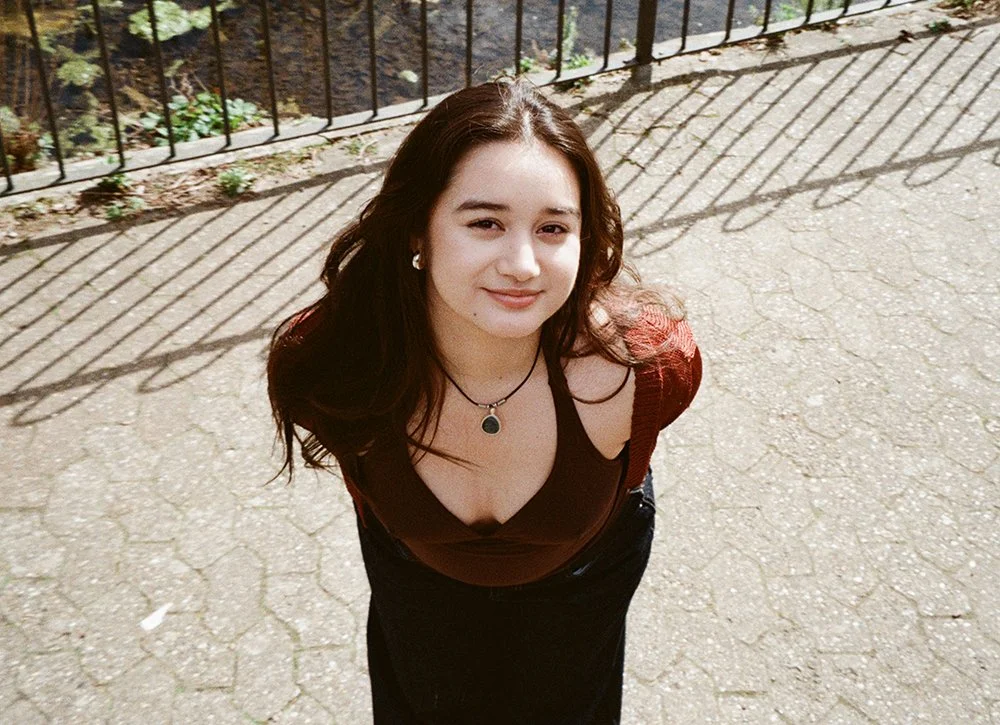
Clarissa Mae Ragrag (Photo by Origins Inconclusive)
All of this started with the most unlikely of people: Manny Pacquiao. As we all know, before his controversial political career, Pacquiao attracted international attention as a powerhouse boxer. Mae’s father, Christopher Ragrag, was a member of the band Rag Rag, which the athlete chose to play for his pre-match singer Madonna Decena.
As a child (she was born on April 12, 2003) Mae absorbed everything her dad did with the band. “That’s when I actually started singing, because I kinda got influenced by them,” she says. As Decena and the band performed Lupang Hinirang before Pacquiao’s boxing matches from 2009 to 2011, millions of viewers around the globe were itching to see the action begin. Mae, on the other hand, was far more interested in the music than the punches.
At six, she dipped her toes into musical theatre. It honed her vocal technique, especially her belting, which came in handy when she joined Gigs at 13. But her shyness was debilitating, something she candidly discusses in shy, one of the singles from her upcoming debut extended play (EP) the love songs. The alt-pop track opens with her six-year-old self’s laughter; its official visualizer also includes clips of her childhood.
She says she got “very emotional” writing shy because “it was telling my younger self, everything’s gonna be okay, and to not cage yourself up and [to not fear] the whole rejection thing, ‘cause that was a huge insecurity of mine when I was younger.” Her music teacher and loved ones had encouraged her to compete in Gigs to combat this self-doubt, but the feeling still lingers in the rest of the love songs. The EP as a whole is “lyrically insecure,” she admits, such as title track love songs (about her ex-boyfriend, and romantic anxieties in general) and its latest single anyway.
Insecurity isn’t always a bad thing, though. When I compliment her on the refinement and production quality of her music—something that artists from smaller labels often lack, even if they’re also talented like Mae—she attributes it to her insecurity about her musical output.
“I’m a bit of a diva when it comes to sound, and I think that’s just… that’s just me,” she says. “I’m a consumer myself, you know? I like listening to music.” Others always tell her to make music for herself. She asserts, “But I am making music for myself, because I’m making music for the consumer part of myself.”
She continues, “Like I know for a fact that if I were to just record a song and upload it without any thought about where the instruments are placed in the mix, how my vocals sound… personally, I wouldn’t enjoy it as much as if it was a bit more… what’s the word? Put-together.”
While she might label herself insecure, it’s evident that a lot of this insecurity is simply a young woman caring deeply for her craft. The more we talk, the clearer it becomes that Mae is immensely passionate and introspective.
She prefers to collaborate with people who share her enthusiasm. “I don’t wanna dominate the room; I’d rather it be two people working together and making something big,” she says. “I’m a huge believer of… if I’m working with a photographer, a videographer, a producer, or a band, I want them to enjoy what they’re doing.”
She points out, “I think people feel the difference between someone making something because they have to and someone who makes it because they actually like it.”
Her friend Cadyn Lewis, who has contributed to all of the EP’s songs so far, is one such person. She’d met him at a networking event. His expertise was UK dance, influencing her own drum and bass/UK garage production work in One Night Charm, which she performed at BINI’s Wembley stop. Although her friend’s influence was there, she says, “One Night Charm was purely produced by me.” Lewis added some final tweaks to Charm but allowing her to realize that she didn’t need anyone else to create a song for release was even more helpful.
“Not to sound political and stuff, but I think the music industry is still quite male-dominated,” she points out. “I always thought I needed a guy to produce music, but Cadyn kinda showed me, ‘You don’t need that. You just need your brain and your drive to produce music.’” In Lewis, Mae found a creative partner who supports her but also lets her call the shots, allowing her EP the love songs to flourish.
Although anyway is about feeling like you’re only second best to someone, the music video is more upbeat, showing Mae and Lewis hanging out on the beach. The clip was recorded on her mom Mary-Ann’s 1990s camcorder. That’s not the only connection to her family, however.The song itself is a pop track with bossa nova elements, paying tribute to her paternal grandfather, jazz instrumentalist Rudy Ragrag.
It may not be immediately recognizable, but her family’s impact upon her artistry is undeniable when she digs deeper into her songs. Mae describes her ethnicity as “75 percent Filipino, 25 percent Scottish,” with her mom from Manila and dad from Cagayan de Oro (CDO) never letting her lose touch of her Filipino heritage as she grew up in the UK. Her dad’s airline job also gave him family discounts, so Mae was able to visit the homeland pretty frequently.
She’s even aware of the differences between Tagalog and Bisaya people. Well, there’s the obvious: the languages. Big-city Manila is easier to visit than a province like CDO, so she’s picked up Tagalog over the years. She’s trying to learn Bisaya (Cebuano), but she can only understand it at the moment. “I’m jealous,” she quips when I demonstrate my own Bisaya fluency.
“I love both sides,” she says of her Filipino heritage. She adores the “collective” spirit in CDO. Manila, on the other hand, is “so populated, [so] everyone’s kinda just trying to hustle.” She loves how “very, very loud” her family is in CDO, in large part because “[Bisaya] is such an expressive language.” On the other hand, Manila offers her a sense of belonging too, where she can keep up with the local tongue. Although she finds Manileños more “reserved” on average, she notes that “I can joke around more in Tagalog. I can communicate more in Tagalog.”
In true Filipino fashion, she was a bona fide biritera (belter) as a kid. “Up until COVID, I was a huge belter. All I did was belt,” she says. Although formally released in May 2023, a few years into the pandemic, her pop-rock song why am i here? gives glimpses of her past biritera style. “I really liked doing that stuff at the time. But after COVID, I was a bit like, ‘What am I doing?’ As much as I enjoyed it, what was the reason for me actually doing it? I realized it didn’t feel like me.”
So she switched to softer tones, staying mostly in her lovely lower-mid range, which reminds me a lot of Icelandic jazz-pop singer Laufey. “I think I found my sound in terms of my voice,” Mae says. However, she’s practicing her belting these days — “not for my music,” she clarifies, “but just for me,[...] ‘cause I did really enjoy singing stuff like that.” She strives to keep the birit in her muscle memory, “but my original music, I like it where it is right now,” she affirms.
“I’ve been performing now for about ten years, which is insane.” When Mae says this, I can’t help interjecting, “And you’re so young.” With just a couple of years between us in age, I’m truly in awe of how hard she’s worked since she was a child.
“Thanks, man.” With a giggle, she says, “You’re so young too!” Hustling our entire lives almost feels mandatory for Gen Z, especially because we were born into an Internet-obsessed world. While many crash and burn, Mae considers her ten years so far as necessary training. “I’m kinda glad I started very young, ‘cause I’ve learned all the stupid mistakes,” she says.
Always bring extra guitar strings and capos, she knows now from her rookie mistakes. “It’s just really little things. Like I know now how my voice will be if I’m under air conditioning for the whole day, because the first time I was under air conditioning before a gig, I completely lost my voice.” If she can’t avoid the air-con, she keeps a bottle of hot water with her.
“You’ve been doing this for so long. Why haven’t you hit it big?” some people ask her. But she says she needed those ten years of preparation. Take the BINI concert, for instance. “I was given the opportunity [in] less than 24 hours,” she shares. “I feel like if I didn’t have ten years of experience, I would freak out on the stage.”
She corrects herself: “I was freaking out on the stage.” The gig gave her multiple firsts: first time performing without a guitar, first time performing in an arena, and first time performing with an in-ear monitor. However… “I was less freaked out than if I had no experience at all,” she concludes.
It may not be immediately recognizable, but her family’s impact upon her artistry is undeniable when she digs deeper into her songs.
“Yes, I may be singing on the streets. Yes, I may feel like no one is listening. But at the end of the day, I’m still practicing that skill of sing[ing] to people out loud.” If one of her songs gains traction or goes viral, she wants to be able to perform it properly live.
During our chat, Mae was vacationing in the Philippines, where she had been noticing an uptick in social media engagement for her new releases. Steadily taking shape is the payoff for all her years learning mic placement and other live singing essentials.
“Nothing’s fully finished when almost loving me,” Clarissa Mae wistfully sings to the aloof subject of anyway. In contrast, Mae doesn’t deal with the unfinished and the almosts. She took her time, and here she is now with an upcoming EP. Armed with a brain full of beautiful music and a voice to match, the young singer doesn’t rush. Instead, she pours her entire soul into her art.
Julienne Loreto (they/them) is a non-binary university student with roots in Bohol and Leyte. They are also a writer whose articles have been published in the prestigious music magazine The Line of Best Fit, as well as the Asian-American magazine JoySauce; their fiction stories have also been selected for publication by 8Letters and sold at the Manila International Book Fair.
More articles from Julienne Loreto
