
Behind a Top-Notch Guitar Brand, an OFW Journey
/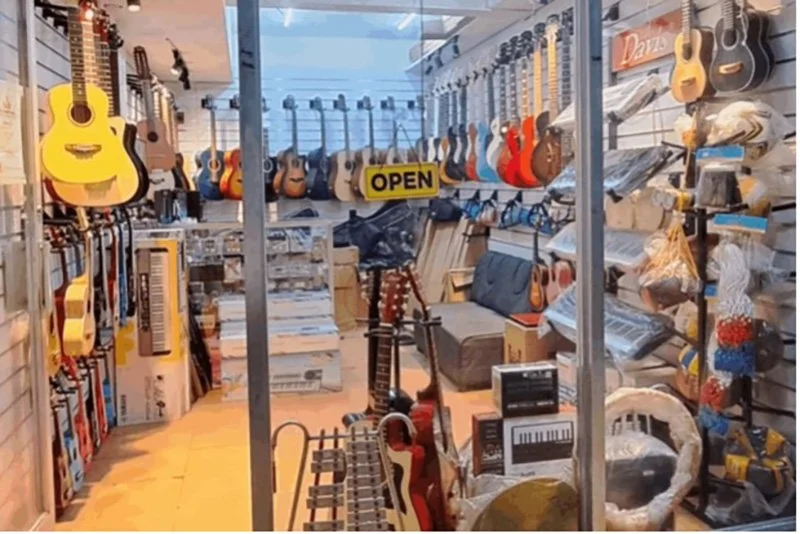
Front view of JMJ Musical Goods Trading at Nepo Mart, Angeles City, Pampanga, owned and managed by Junill Q. Lucero. (Photo courtesy of Michael Lucero)
Growing up, I was like many Filipino teenagers who found refuge and expression in music. I owned a guitar in high school, nothing special, but it carried a dream that stayed with me for years: one day, I would own a full solid-wood guitar, an instrument built with care, depth, and soul. That dream remained out of reach. Even after nearly two decades working overseas as an engineer, and even after owning two acoustic guitars from respected international brands, neither was truly all-solid wood. Instruments like that were luxuries, priced far beyond what ordinary working musicians could reasonably afford.
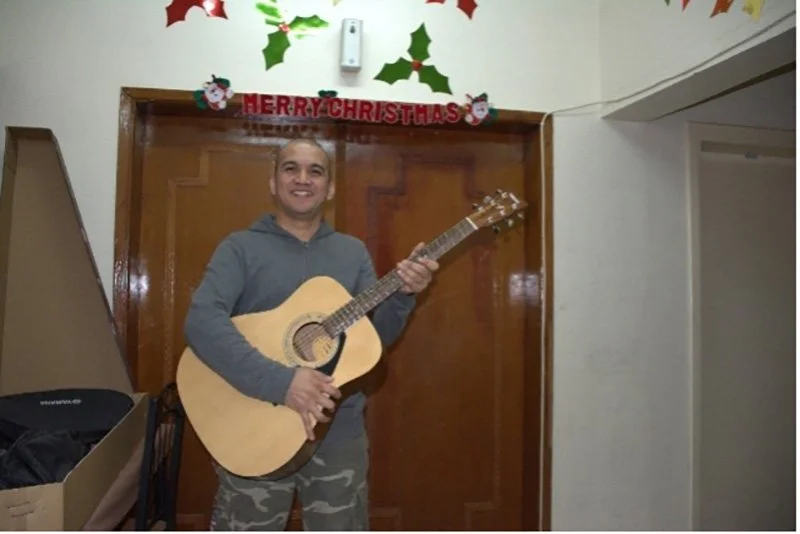
Here I am holding my newly acquired Yamaha F310 acoustic guitar in Doha, Qatar. (Photo courtesy of Michael Lucero)
That quiet frustration never disappeared. It simply waited.
My wife, Junill “Nil” Q. Lucero, came from a different but equally musical background. Her father was a professional guitarist who played in bands in Pampanga and abroad, including Japan. In their home, music was not just expression; it was livelihood. Nil later found her own relationship with music through church ministry, where songs became part of worship, service, and faith. Music, for both of us, was never a side interest. It was woven into who we were.
Life as OFWs: Work, Distance, Learning Beyond Survival
After gaining two years of construction experience in the Philippines, I left in 2006 for my first overseas assignment in the Kingdom of Saudi Arabia. Like many OFWs, I arrived hopeful and nervous, learning to navigate cultural rules, strict social boundaries, and the loneliness that comes with living far from home. Yet there was comfort in the Filipino community; simple greetings in malls or shared meals in local restaurants reminded us that we were not alone.
When Nil and I married in 2008, I knew we needed to build a life together, not just endure work contracts. Saudi Arabia was not ideal for raising a family at that time given our situation then, so I transferred to Oman in 2009, and later, in 2010, to Qatar. Qatar became the place where our family truly took shape. Its small geography allowed me to work on demanding projects while still coming home each day. Six months after I settled, Nil and our eldest son joined me. In 2014, our second son was born there. For our children, Qatar became home.

Occasionally, we celebrate the life we have built in Doha, Qatar. This photo was taken after a fine-dining meal on the 55th floor of the InterContinental Hotel Doha (Photo courtesy of Michael Lucero)
Those years shaped us deeply, not just professionally, but personally and spiritually. Like many OFWs, we learned that survival abroad is not only about income. It is about discipline, patience, and holding on to dreams quietly while fulfilling responsibilities faithfully.
Learning Business the OFW Way
Our entrepreneurial education did not come from textbooks. It came from observation and experience.
While in Qatar, Nil began a small food business rooted in her Kapampangan love for cooking and baking. She trained formally, completing commercial bread-making workshops and Wilton cake decorating courses. Through Filipino Facebook groups, she started selling customized cakes. Orders grew—birthdays, weddings, restaurant events, community gatherings. Demand became so steady that we intentionally limited production to protect quality.
At the same time, Nil balanced freelance teaching, home-schooling our children, and later working as a preschool teacher when schools reopened after the pandemic. We learned first-hand the realities OFWs face when running small businesses abroad: fluctuating demand, competition, delayed salaries in the community, and eventually, the shutdowns brought by COVID-19.
But those years taught us discipline, financial tracking, cash-flow planning, pricing responsibly, and understanding that sustainability matters more than fast profit. We were especially struck by how some Asian entrepreneurs, particularly Indian restaurateurs, operated: modest pricing, consistent quality, and a focus on keeping the business moving rather than chasing high margins. One colleague said it plainly: small profit, steady flow.
That philosophy stayed with us. We realized that if we ever built a business back home, it would not be about chasing profit. It would be about making dreams reachable.

For a five-year-old girl, this cake was designed so her new Barbie could ‘wear’ it, featuring a chocolate-flavored moist interior and an entirely edible dress made from hand-mixed fondant. (Photo Courtesy of Michael Lucero)
Coming Home: Becoming Entrepreneurs
In 2024, we made a difficult but purposeful decision. Nil and our children returned to Angeles City, Pampanga, while I transitioned from Qatar to Dubai to continue working as an engineer. Like many OFW families, we entered a season of physical separation, but with a shared vision.
Nil became the anchor on the ground. She handled business registration, government requirements, supplier meetings, and the search for the right location. She also managed daily expense tracking and financial oversight. JMJ Musical Goods Trading opened in Nepo Mart, Angeles City, as a physical music store offering guitars, keyboards, violins, ukuleles, drums, professional audio equipment, and accessories from both local and imported brands.
From abroad, I supported the business through brand development, documentation, distributor coordination, and the preparation of financial statements, along with social media management. Our business became a family-run venture built on trust, long-distance teamwork, and countless late-night calls across time zones.
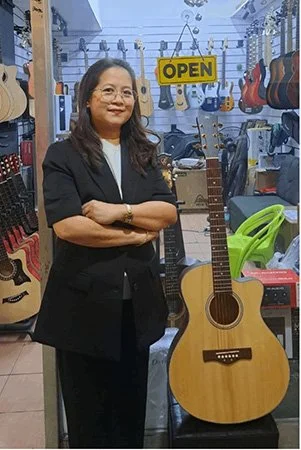
Junill Q. Lucero poses in front of the store alongside the JMJ Guitars (Photo Courtesy of Michael Lucero)
Why Pampanga and Filipino Luthiers
JMJ Guitars was born from one central conviction: Filipino craftsmanship deserves recognition equal to global brands.
Working overseas exposed me to people from many nationalities. Again and again, I observed how Filipinos were trusted for roles that demanded precision and attention to detail. When Filipinos commit to a craft, they pursue excellence quietly but relentlessly. That same quality exists in Pampanga’s luthiers, particularly in Guagua, a town long known for guitar-making.
Meeting the right master luthier was a turning point. In guitar-making, as in construction, everything depends on the person leading the craft. From there, the direction became clear: JMJ Guitars would be handcrafted, not factory-produced. We would honor traditional luthiery while thoughtfully integrating modern elements.
Nil oversees quality control personally, monitoring humidity levels in the store and checking finishes, playability, and structure. Her daily exposure to both imported and local instruments made her the ideal gatekeeper of standards.
What Sets JMJ Guitars Apart
JMJ Guitars stands apart not because it tries to compete loudly with international brands, but because it stays grounded in purpose.
All JMJ guitars are handcrafted. We do not pursue mass production. Instead, we balance tradition and innovation, time-honored Pampanga techniques paired with modern components like Fishman ISYS electronics, precision tuners, adjustable truss rods, and refined finishing.
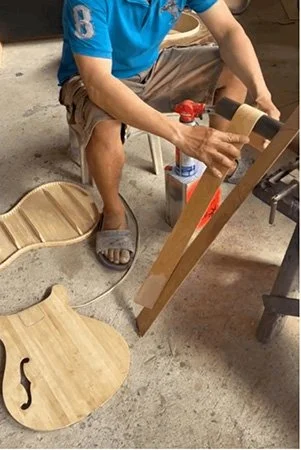
Here, one of our luthiers carefully handcrafts a custom-designed Archtop Fretless Acoustic Bass Guitar for a customer. (Photo Courtesy of Michael Lucero)
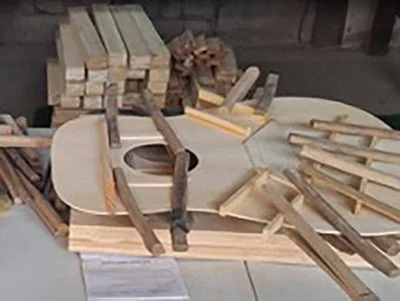
This photo captures the process of traditional guitar-making in Guagua. (Photo Courtesy of Michael Lucero)
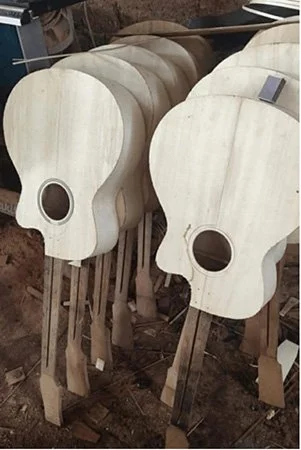
This photo shows guitar bodies prepared for application of sealer or grain filler. (Photo Courtesy of Michael Lucero)
We began with the ValuePro Line, laminated-wood guitars designed to be affordable yet fully handcrafted. Models like the Jairo Little Guitar and Massimo 41” Cutaway were named after our sons, who now play the instruments that carry their names. The Guagua GP-01 honors the town and the “pang-masa (mass-market)” guitars that sustained generations of luthiers.
The Premium Line followed, crafted from all-solid woods, designed to stand confidently beside high-end imported instruments. Finally, the Custom-Designed Line allows musicians to specify woods, dimensions, and features that suit their personal sound.
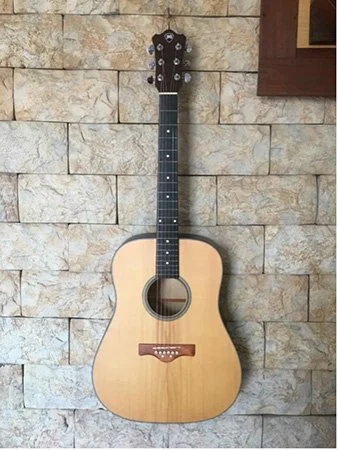
This prototype, the first under the Premium Line, was created for evaluating its appearance and sound, testing design and functionality, refining specifications, and estimating production costs. (Photo Courtesy of Michael Lucero)
Journey Comes Full Circle
Today, interest in JMJ Guitars continues to grow, not only in the Philippines, but abroad—specifically in the Middle East. Hearing from a long-time UAE-based musician who wants to visit our workshop is deeply meaningful. It reminds us that the years spent abroad were not a detour; they were preparation.
For us, Qatar will always be a second home. It shaped our family, our faith, and our understanding of work and business. Our children grew up there. Our entrepreneurial lessons were learned there. And now, they strum guitars named after them in the country we finally came home to.
Looking Ahead
Our hope for JMJ Guitars is steady, responsible growth. Not rapid expansion at the cost of quality, but a brand musicians trust, and a platform that supports Filipino luthiers and preserves Pampanga’s guitar-making heritage.
More than anything, we hope our story resonates with fellow OFWs. Coming home does not mean starting over from nothing. Sometimes, it means finally building something from everything you have learned.
JMJ Guitars exists because of distance endured, skills honed abroad, faith carried quietly, and a belief that Filipino craftsmanship, like Filipino workers, belongs on the world stage, not as a commodity, but as a legacy.

Michael Lucero is a Filipino civil engineer from Palawan who has been working as an OFW in the Middle East since 2006 and is currently based in Dubai, UAE. He writes narrative stories and blogs on Filipino life abroad, craftsmanship, and the quiet intersections of engineering, music, and everyday survival far from home, including guitar-related writing at jmjguitars.com.
