
A Century of Shared History: Filipinos and Wassamasaw Indians
/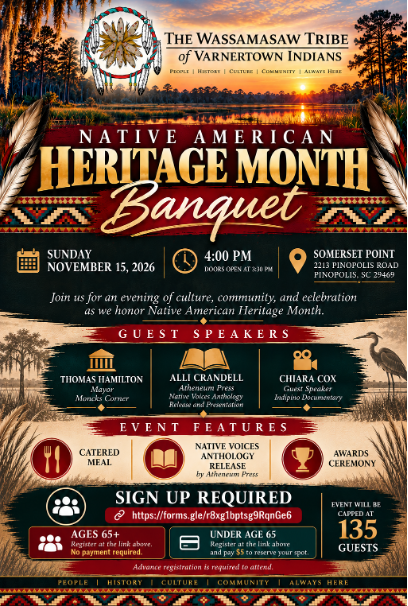
(Chiara Cox’s Speech at the Wassamasaw Tribe of Varnertown Indian’s Native American Heritage Month Celebrations.)
My name is Chiara Cox, and I am a Filipino immigrant who has proudly called South Carolina home for more than 20 years.
When I first told my family in the Philippines that I wanted to move to South Carolina, one aunt asked me, "Why not California or New York? Why South Carolina? There aren’t any Filipinos there!”
Well, Auntie was wrong!
And as it turns out, there is a remarkable Filipino history in South Carolina that I didn't even know existed.
Two years ago, I came across Vice Chief Joshua Shumak’s Facebook post in celebration of Filipino American History Month. I was stunned. I have lived in South Carolina for more than two decades, and I was only now discovering that Filipino pioneers had become part of the Wassamasaw Tribe of Varnertown Indians.
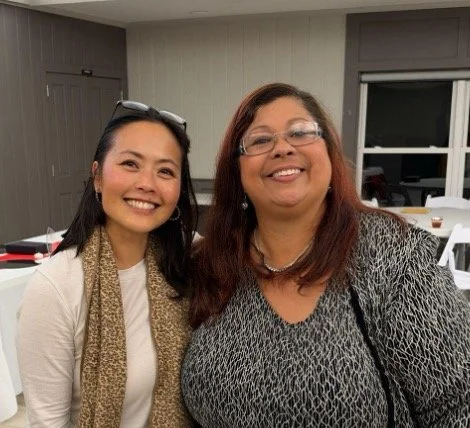
Chiara Cox with Chief Lisa Collins
A shared history spanning generations, Filipino men had married into Indigenous families right here in South Carolina. This stopped me in my tracks.
I am proud to have worked with Indigenous communities in the Philippines, so this new fact was particularly significant to me. I immediately shared the post with my friends and family. They were just as amazed and curious as I was.
Who were these Filipino men? What brought them to South Carolina? How did they become part of the Tribe? Where did they settle? What do their children look like? How about their grandchildren? Do they still eat Filipino food?
And then another aunt, who publishes an online magazine for the Filipino diaspora, asked me, "Can you write about this?"
That question sparked something in me. I wanted to learn more. I wanted to meet the families. I wanted to understand how these two communities came together. And, most importantly, I wanted to help tell this story.
Initially, I understood that the first Filipinos who married into the Tribe were World War II Navy men. But through interviews, I discovered that the first Filipino to marry into the Tribe was Eugenio Natividad. Born in 1887, he served in the United States Navy during World War I, was stationed at the Charleston Shipyard, and married Manila Arriola's aunt in the 1920s.
We are talking about a century of shared history. A century of Filipino men becoming part of the Wassamasaw Tribe of Varnertown Indians. A hundred years of marriages, children, grandchildren, shared experiences, and connections between two communities whose histories became intertwined right here in South Carolina.
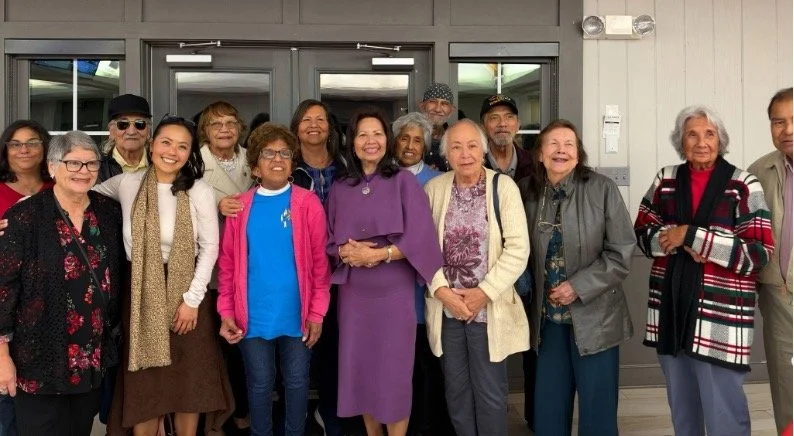
Chiara Cox with the Abdon, Arriola, Garcia, Guerzon, Maggay, and Ricafrente families.
In my interviews with the Tribe, I realized that sometimes history isn’t found in textbooks or museums or documentaries. Sometimes, it is in memories passed down from grandparents to grandchildren. Sometimes, history is just waiting for someone to ask an elder a question or for someone curious enough to ask to see old photographs. And sometimes, these stories are at risk of disappearing if we don't take the time to document them.
As a Filipino immigrant, I know what it means to leave your homeland and build a life somewhere new. I know what it means to carry your culture, traditions, food, language, and memories with you while trying to find your place in another country.
What makes your Indigenous American and Filipino American history so touching to me is that these Filipino men were not just stationed here in Charleston. They did not just find a place to live in a Jim Crow South. The Filipinos actually found belonging. They found family. These relationships began during a period when racial discrimination and segregation shaped everyday life in South Carolina. Yet, Filipino men became part of your Tribe. You opened your homes, your community, and your lives to these Filipino men. They were welcomed, embraced, and became part of a family legacy that continues today.
It is not just a Filipino American story. It is not just a Native American story. It is not even just a South Carolina story. It is a chapter of American history that deserves to be known, celebrated, and preserved. It makes me so proud of our shared humanity. It reminds me that our histories are often more connected than we realize. And it gives me hope for the generations who will inherit these stories.
It is a tremendous honor to partner with the Wassamasaw Tribe of Varnertown Indians in bringing this unique hidden history to light. Thank you to Chief Lisa, Joshua, Angie, Manila, Joyce, Marie, Cheyenne, Jordan, and Leticia for your generosity, trust, and willingness to share your family histories with me. Our time together helped shape this project.
Tonight, I am excited to share the official teaser for Fathers of Varnertown Indipinos. It will give you a glimpse into the film's direction, its approach, and the sensitivity with which I hope to honor your Tribe and your families.
I am also pleased to share that the Philippine Embassy in Washington, D.C., has shared the teaser on its platforms, recognizing the Indipino community within the Tribe. I am currently working on an article for Philippine historians to bring greater attention to this remarkable connection.
This is only the beginning.
My goal is to complete the documentary and release it by next November. But I know there are more families who want to be represented in this project. There are more stories to uncover, more family histories to document, and more photographs, letters, and treasured memorabilia that can help us piece together this extraordinary legacy.
If you have a story to share, a family photograph, an old letter, recipes or something that might help us better understand this history, I would love to hear from you. Please come talk to me after the presentation. You can also connect with me on Facebook and Instagram. I want this to be a collaborative effort, because the more voices and family histories we bring together, the richer and more meaningful this documentary will become.
We are talking about a century of shared history. A century of Filipino men becoming part of the Wassamasaw Tribe of Varnertown Indians.
Finally, to Chief Lisa and the entire Wassamasaw Tribe of Varnertown Indians: Thank you for welcoming me into your community and allowing me to share in this celebration of Native American Heritage Month. It is a privilege to stand with you to preserve your stories, honor your heritage, and ensure that future generations know the history of those who came before them. When we preserve our history, we preserve the connections, identities, and legacies that make us who we are.
There is a word in Filipino that we use to express appreciation, respect, and celebration. It is a word that carries the spirit of wishing people a long and prosperous life. That word is Mabuhay! To the Wassamasaw Tribe of Varnertown Indians, to your families, and to everyone gathered here tonight, thank you. Maraming salamat! Mabuhay!
Chiara Cox’s Speech:
Official Teaser:
Website: www.indipinos.com
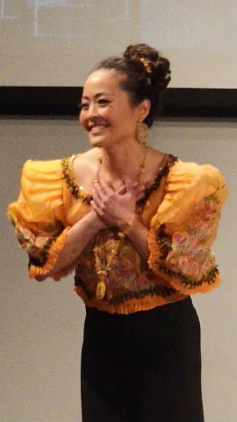
Chiara Cox combines her love of music, performing, art and travel by producing classical music videos from her home studio. She also loves to write. You can find her at www.ChiaraCox.com.
More articles from Chiara Cox
