

When the AFAM Was Me
/The moment people learn that I am married to a foreigner, many assume they already know my story. They imagine how we met, why we married, and what I gained from the relationship. The truth is that they do not—their version of my life bears little resemblance to the life I have actually lived.
Everyone in the Philippines knows what an AFAM is—or at least they think they do. The exact origin of this Filipino slang acronym remains uncertain, even though there is a widely repeated explanation that it stands for “A Foreigner Assigned in Manila.”
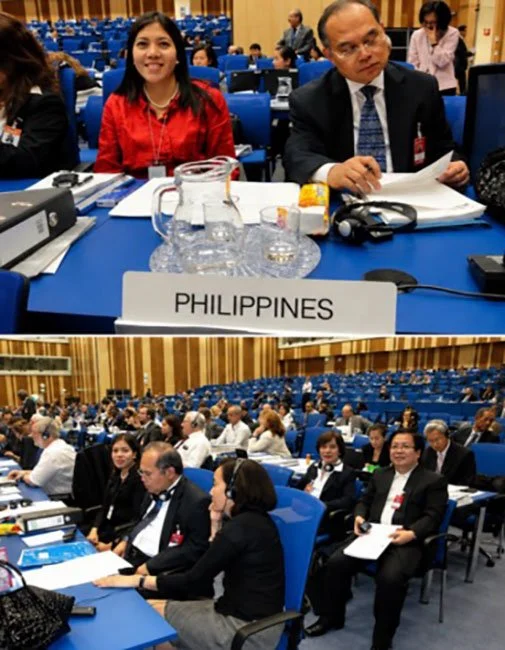
Top photo: Taken in 2009 at the United Nations Headquarters in Vienna, Austria, this photograph offers a glimpse of the author’s work life during her overseas posting. The author (left) with Ambassador Libran N. Cabactulan (right), then Philippine Permanent Representative to the United Nations in New York, during one of the many international meetings and engagements that formed part of her assignment.
Lower photo: Front row (from left): the author; Ambassador Libran N. Cabactulan, former Philippine Permanent Representative to the United Nations in New York; and Ambassador Linglingay F. Lacanlale, former Philippine Permanent Representative to the United Nations and International Organizations in Vienna. Back row, two members of the Philippine delegation. (Photos courtesy of Maria Antonia Bosa Van Espen-Boonen)
According to this interpretation, the term originally referred to foreign men, particularly Western men, living in or spending time in the Philippines during the era of American military bases, such as Clark Air Base and Subic Naval Base, where a large number of foreign servicemen were stationed.
Over time, AFAM evolved into a backronym and expanded to refer to almost any foreigner, including members of expatriate communities, the entertainment industry, and social media circles. It has been variously interpreted as “A Foreigner Around Manila” or “A Foreigner Arriving with Money.” The term has become so embedded in contemporary Filipino culture that it has evolved into a social phenomenon, generating essays, academic research, and cultural commentary.
What is interesting is that popular stereotypes, particularly on social media platforms such as Tiktok and Facebook, often frame AFAM relationships in purely economic terms: a Filipina or Filipino seeking a wealthier foreign partner. As the common remark goes “Meron na namang isang pamilya na nakaahon sa kahirapan”—another family has been lifted from poverty.
My reality never fit the usual AFAM narrative.
Preconceived Stories
I experienced firsthand how people often impose preconceived stories on interracial or international marriages without knowing the actual circumstances. Beneath the warmth of every homecoming was a familiar refrain: “AFAM na naman...” Some looked at me with curiosity, others with subtle judgment, as though they could reconstruct my life simply by seeing the foreign man beside me.
Yet my story turns those assumptions on their head. I did not meet my husband while seeking opportunities abroad or hoping for a different life overseas. By the time our paths crossed, I was already serving overseas in the foreign service. We met through our shared social circles during my diplomatic posting, and what began as a chance encounter gradually developed into a relationship founded on mutual respect, shared values, and a genuine appreciation of each other’s cultures.
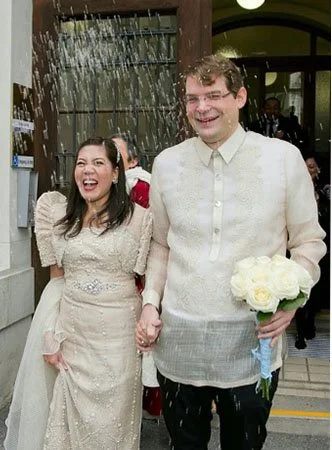
The author and her husband on their wedding day in Vienna, Austria, wearing traditional Filipino wedding attire woven from piña and banana fibers. As they leave the ceremony, family and friends shower them with rice—a cherished tradition in both the Philippines and Belgium, symbolizing blessings for a prosperous and enduring marriage. (Photo courtesy of Maria Antonia Bosa Van Espen-Boonen)
Years ago, while my husband and I were living in Manila during one of my regular foreign service rotations, he decided to enroll in the Ateneo-Regis Executive MBA Program in Rockwell. As part of the admission process, he was interviewed by a panel of three professors. One question stood out: “As a foreigner from a developed country, why did you choose to join your wife here in the Philippines, instead of having her immigrate to your country—the more common path for many Filipinos?”
I never doubted that my husband would do well in the interview. He was admitted to the program and later graduated with distinction, shortly before we left for my next overseas posting in the United States.
But what is striking is the question itself.
Deeply Entrenched
The professors’ inquiry reflected a deeply entrenched, systemic assumption: that a marriage between a Filipino and a citizen of a wealthier nation must inherently serve as an escape hatch or a one-way ticket out of the Philippines. It exposed a societal blind spot that often fails to see our country as a place of destination, opportunity, and professional growth for outsiders, rather than just a point of departure.
While modern globalization has shifted how we view international marriages and relationships, personal experiences often provide the clearest lens through which to understand these dynamics. There is nothing inherently wrong with marrying a foreigner; on the contrary, when built on mutual respect, such unions can be profoundly enriching experience, beautifully bridging different cultures and perspectives.
This reality is reflected in my own family, where two of my sisters are also happily married to foreign nationals. Their journeys illustrate how these relationships can flourish alongside professional accomplishment and shared ambition. One sister met her husband while working for a publishing company in Hong Kong in the 1990s, while the other met her spouse while serving as a bank officer in Manila.
These stories, together with those of numerous friends, relatives, and notable Filipinos who have married foreigners across government, entertainment, fashion, sports, and other fields, demonstrate that many international relationships are rooted in professional equality, emotional maturity, and deep, reciprocal love. They blend the warmth, adaptability, and strong family orientation of Filipino culture with broader global perspectives, creating an environment in which both partners can thrive.
Several prominent Filipinos, including historical figures, have found love across cultures and nationalities. Among the best known is statesman General Carlos P. Romulo, who married American author and journalist Beth Day. Former Department of Foreign Affairs Secretary and Director-General of the United Nations Industrial Development Organization (UNIDO), Domingo L. Siazon, married Japanese national Kazuko Siazon, who worked closely with him on several international cultural initiatives. Lawyer Loida Nicolas-Lewis married African-American businessman and lawyer Reginald Lewis, while businessman Virgilio Hilario married Finnish beauty queen and first Miss Universe Armi Kuusela.
Multicultural marriages are also common in the Philippine entertainment industry. Examples include model Solenn Heussaff, who is married to Argentine entrepreneur Nico Bolzico; actress and model Isabelle Daza, who is married to French businessman Adrien Semblat; and internationally acclaimed theater actress Rachelle Ann Go, who is married to American businessman Martin Spies, to name a few. In many of these unions, the foreign spouse chose to live with their Filipino partner in the Philippines for a period of time.

The author’s husband on his graduation day in 2018 after earning his Master of Business Administration (MBA) from Ateneo de Manila University in the Philippines through its partnership with Regis University in Colorado, USA. (Photo courtesy of Maria Antonia Bosa Van Espen-Boonen)
Celebrated Multicultural Marriages
While high-profile multicultural marriages are often celebrated as unions of intellectual equals and symbols of global sophistication, modern “AFAM hunting” is frequently portrayed in local popular culture as a survival strategy—a means of securing foreign citizenship or improving one’s economic prospects, including the ability to support family members back home through remittances. These negative connotations stem from deep-seated cultural biases and assumptions about economic survival, social mobility, and societal judgment.
A holistic view of the AFAM phenomenon requires acknowledging that marriage to a foreigner may also be influenced by socioeconomic realities. For some individuals, such marriages represent a practical path toward financial stability and a better future for themselves and their extended families. This reality should neither be dismissed nor judged harshly. Economic aspirations do not diminish a person’s capacity for genuine affection, loyalty, or commitment. Ultimately, whether formed through professional networks, shared interests, or aspirations for upward mobility, cross-cultural marriages demonstrate the resilience, adaptability, and openness of Filipinos in building meaningful and enduring partnerships across borders. Recognizing these diverse motivations moves the conversation beyond simplistic stereotypes and toward a deeper appreciation of the many ways human relationships are formed and sustained.
Flipping the perspective from foreigners assigned in Manila to Filipinos assigned by Manila, my foreign husband is not an AFAM. Rather, I was the AFAM— A Filipino Assigned by Manila—while on an overseas posting with the Department of Foreign Affairs. In fact, I would say that the Department has its own pool of AFAMs. Quite a few of my former DFA colleagues are also married to foreigners and, at different points in their careers, have lived in Manila during the regular diplomatic rotation. The same could be said of Filipinos assigned overseas by the Philippine government, Philippine companies, or other Philippine-based organizations for work, projects, or official duties.
A Playful Twist
My use of the acronym is, of course, a playful twist on its usual meaning. It is not intended to turn the usual meaning of AFAM into a measure of financial status or social standing. Rather, it reflects the perspective of Filipinos whose work has taken them across borders, where they, too, in the unfamiliar position of being the foreigner, become the ones adapting to a different culture, building relationships, and creating a home far from the Philippines.
In short, while many Filipinos understand AFAM to mean “A Foreigner Assigned in Manila,” its origins matter less to me than the perspective it came to represent. Not all AFAMs are foreigners. Some, in a broader and more reflective sense, are Filipinos—assigned by Manila rather than assigned in Manila.
In the end, whatever meaning is attached to AFAM, I hope it never overshadows the reality of multicultural families. They are living examples of cultural openness, mutual respect, and the increasingly interconnected world we share. Their stories remind us that the strongest relationships are built not on nationality or stereotypes, but on trust, respect, and a shared commitment to building a life together.
Over the years, I came to realize that AFAM was never just about nationality; it was about perspective. Depending on where life takes us, anyone of us can become the outsider, the newcomer, or the one learning to adapt. My years abroad taught me that what begins as “foreign” often becomes familiar through friendship, work, and love.
Looking back, I no longer think of AFAM as an acronym that defines people. Instead, I think of the friendships, the family, and the life my husband and I built together across cultures. Those, more than any label, are what truly matter.

The author and her husband
Maria Antonia Bosa Van Espen-Boonen is a retired Philippine foreign service staff officer and diplomat based in Brussels, Belgium. Her writing draws on both personal and professional experiences, spanning more than two decades of government service and diplomatic assignments in the United States and in Europe. She is a recipient of the Department of Foreign Affairs 2014 Outstanding Employee Award.
More from Maria Antonia Bosa Van Espen-Boonen
