
To You, ‘These Yet to Be United States’
/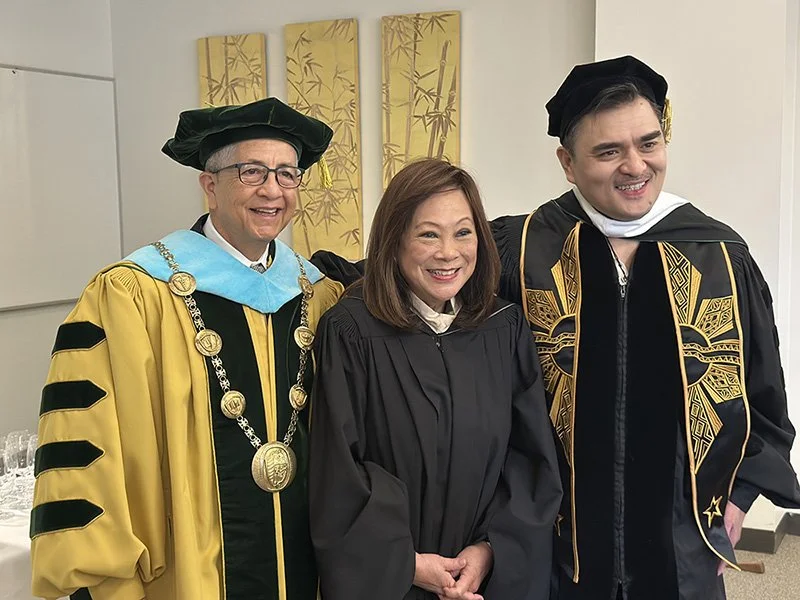
(L-R) University of San Francisco President Salvador D. Aceves Ed.D., Mona Lisa Yuchengco, Jose Antonio Vargas (Photo courtesy of Mona Lisa Yuchengco)
This is the author's commencement address to the 2026 graduating graduate students of the University of San Francisco (USF) College of Arts and Sciences, delivered on May 23, 2026.
USF also conferred on Jose Antonio Vargas the degree of Doctor of Humane Studies (honoris causa). Read the citation delivered by PF Publisher Mona Lisa Yuchengco below.
In what feels like a post-literate era, you all have “Master’d” something. Not content-created, not social media-influenced, but mastery. Of Applied Economics, Data Science and Artificial Intelligence, Urban and Public Affairs, Migration Studies, et cetera. So, let’s take a moment for you all to congratulate each other.
And speaking of Migration Studies, much like America is now a country of countries, this graduating class of graduate students represents 6 continents, 43 countries, and 25 states. You all embody the very diversity that powers not only the San Francisco Bay Area—not only California, the fourth largest economy in the world—but the rest of what James Baldwin called “these yet to be United States.”
As we gather here today, immigrant students across our country are under unprecedented attack. Completing college, earning a degree, securing employment––all of that is difficult enough. Now add the constant threat of arrest and detention and deportation. Last year 260 immigrant students were arrested by ICE, and 174 of them were removed from the country they call home.
International students who seek to continue their lives here face tougher barriers than ever. Just yesterday, U.S. Citizenship and Immigration Services radically changed long-standing immigration policy, now forcing anyone applying for a green card to leave America indefinitely and apply in their home country, disrupting lives being built, or already built, here. The impact of these changes is immense. Without immigrants, international students, and children of immigrants, U.S. colleges and universities would lose up to one-third of undergraduate enrollment and almost two-fifths of graduate enrollment between 2025 and 2037.
For the past 15 years, I’ve traveled all around the country, engaging with people who want me arrested and deported. Among the realities I’ve grappled with is that government officials, from ICE agents to Stephen Miller, are hiding from basic facts about undocumented life––that we don’t commit more crimes than native-born citizens; that we contribute more than we take from government agencies––that undocumented people pay taxes to the same government that is arresting and detaining us.
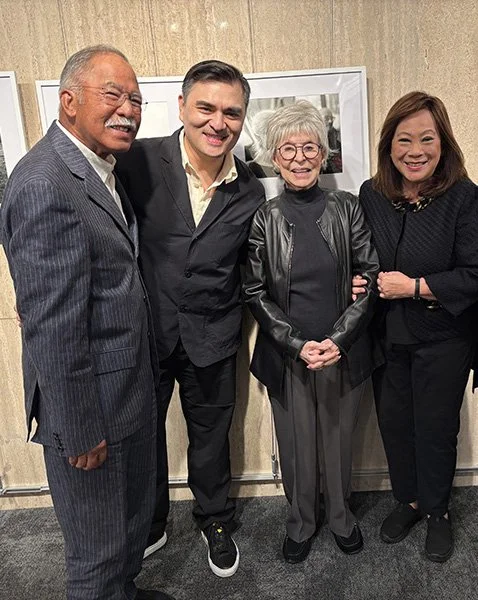
(L-R) Lloyd LaCuesta, Jose Antonio Vargas, Rita Moreno, Mona Lisa Yuchengco. Moreno was also one of the commencement speakers. (Photo courtesy of Mona Lisa Yuchengco)
This government is hiding from the full force of our history, from the fact that, unless you’re Native American (who were already here) or a Black American who’s a descendant of enslaved peoples (who were kidnapped and forced to come here against their will), you emigrated from someplace else, and your legality, such as it is, is a product of time, circumstances, and whatever laws happened to be in place.
History is cracking before us. Rights hard fought for and earned by the Civil Rights Movement, led by Black Americans and joined by white allies, are crumbling in a country that, because of immigration, is no longer Black or white, in a country that’s always been more complex and nuanced than its history has often allowed. Immigrants must practice our own version of patriotism. Even though we cannot vote––though I’ve called America my home for almost 33 years, because of my immigration status, I’ve never been able to vote––we must ensure that those who can vote, including our own family members, exercise that right and never take it for granted. I define “American” as Americans who are willing to fight for an America that includes all of us.
What’s become abundantly and painfully clear is that what is happening all across the country is not a question of legality. It’s a question of humanity––our shared humanity. All this talk about artificial intelligence, about the promises and perils of AI, demands that we focus, now and more than ever, on human intelligence, on what connects us to each other, human being to human being.
And we, as human beings, are a collection of every single human being who’s ever touched our lives.
The University of San Francisco holds a very special place in my heart. This is the professional home of Teresa Moore, a professor of journalism and media studies. I met Teresa when she was an editor mentoring young journalists and I was a high school student hungry for a byline––you know, that name you see under the headline of a news article: by Jose Antonio Vargas. I was obsessed with bylines because they were proof that I, an undocumented student with no valid green card, no driver’s license, no U.S. passport, existed. Teresa was the first editor who demanded excellence in me. Not just competence, not just get it done on deadline––aim, as much as you can, for excellence. A few years ago, Teresa told me: “You wanted to write your way into America.” I’m proud to be able to say that I would have never written my way into America without Teresa’s mentorship which has turned into a friendship.
On behalf of immigrant families and the risks they continue to take––on behalf of the risks that immigrant students continue to take to get educated and build lives bigger than themselves––it is my honor to receive this honorary degree.
The University of San Francisco is also the home of Law Professor Bill Hing, who founded USF’s Immigration and Deportation Defense Clinic. Every immigration lawyer I spoke to warned me about the dangers of publicly revealing my undocumented status, especially not in the pages of the New York Times. Every lawyer but Bill. Bill was the only one who said, go for it, take the risk. I dug up an email he sent me 15 years ago, days before my life would forever be changed by telling my story. He wrote: “Did I tell you I teach a class named Rebellious Lawyering? Most people think it's about rebelling against the ‘man’ or various standard institutions; but actually, it's more about rebelling against conventional lawyering.” To this day, rebellious lawyering informs my work and the work of Define American, a non-profit I founded with a group of friends.
I stand here today as one, and I carry with me those friends, along with anyone I’ve ever met and every kindness I’ve ever encountered and received. As I say that, please take a moment to think of and be grateful for every kindness you’ve experienced in your time here.
I stand here today as one, and I carry with me the story of my Lola, my grandmother, who left the province of Zambales, in the Philippines, and arrived in Mountain View, California in 1984; and the story of my Mama. 31 years after I left Manila, after decades of waiting for her green card to be approved, Mama is finally here in the Bay Area. Lola, Mama and me now all live together in Berkeley, three generations of immigrants finally reunited after decades of separation.
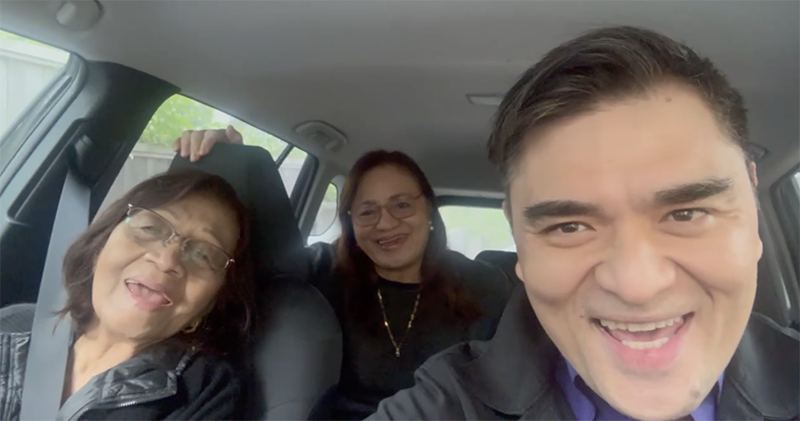
Vargas with his lola (left) and mom (Photo courtesy of Jose Antonio Vargas)
When you honor me, you honor the risks that Lola and Mama took to come to America.
On behalf of immigrant families and the risks they continue to take––on behalf of the risks that immigrant students continue to take to get educated and build lives bigger than themselves––it is my honor to receive this honorary degree. It is my deepest honor to congratulate this Class of 2026!
Sidebar
The citation delivered by PF Publisher Mona Lisa Yuchengco for the conferment of the Doctor of Humane Letters (honoris causa) to Jose Antonio Vargas:
Award-winning journalist and creator.
Tireless activist for the human rights of all immigrants.
Compassionate and compelling voice for the voiceless.
Masterful multimedia storyteller who illuminates the inconvenient truths and dire consequences that define the perilous journey to citizenship and what it means to be a citizen.
For decades, you have chronicled the harrowing stories of immigration—in print, on camera, online, and in person—captivating audiences across the nation. As a celebrated journalist at The Washington Post, you earned a Pulitzer Prize for your team’s coverage of the tragic 2007 Virginia Tech shooting. Your work as a filmmaker and producer has garnered Emmy and Tony nominations. In 2011, you founded Define American, a nonprofit organization that empowers diverse and nuanced storytelling about immigrant experiences across media through research, partnerships, and storyteller engagement. Define American was twice named one of the World's Most Innovative Companies by Fast Company, and its Immigrants Belong campaign recently won a Webby Award. With unwavering dedication, you have broadened the attention of news media, policymakers, and the public, urging all to witness the full humanity of our nation’s immigrants, one story at a time. Yet, behind your relentless pursuit of truth, you harbored a secret: you, too, were undocumented.
At the age of twelve, you left your home in the Philippines to join your grandparents in Mountain View, California. Welcomed with warmth, you were presented with a green card and Social Security number by your Lolo. A visit to the DMV to apply for a driver’s license revealed a life-altering truth: your green card was fake. Suddenly, your college plans, internships, and dreams of becoming a journalist seemed out of reach. Yet many rallied around you, devising creative solutions that enabled you to attend college and graduate.
While in college, you launched your journalism career at The San Francisco Chronicle, later contributing to The Philadelphia Daily News, Rolling Stone, and The New Yorker. From The Washington Post, you went on to become a senior contributing editor at The Huffington Post. The tension of living the American dream in hiding grew unbearable. Having once come out as gay in high school, you now chose to reveal your undocumented status.
In 2011, you published the groundbreaking essay “My Life as an Undocumented Immigrant” in The New York Times Magazine. By sharing your truth, you ignited a national conversation about America’s broken immigration system and advocated for the DREAM Act. You became a beacon for others awaiting legal status, sharing your story in solidarity. Your memoir, Dear America: Notes of an Undocumented Citizen, became an instant bestseller. This year, the Brooklyn Public Library named it one of the 250 most notable books in U.S. history. In a bittersweet turn, you were legally admitted in 2024 with a nonimmigrant temporary worker O visa, renewable every three years, yet still without a pathway to citizenship.
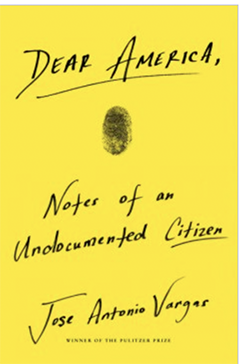
Jose Antonio Vargas’ Dear America: Notes of an Undocumented Citizen
Your work has been honored with a litany of awards, including the Sidney Award for your New York Times Magazine essay, lauded as an outstanding piece of socially conscious journalism. And the Mountain View school district you once attended named an elementary school in your honor. That all may know of our great esteem for you, and our strong support for your vital work as a powerful voice for the voiceless and passionate advocate for immigrants’ full humanity, the University of San Francisco does confer upon Jose Antonio Vargas the degree of Doctor of Humane Letters, honoris causa, with all the rights and privileges pertaining thereunto.
Given this twenty-third day of May, in the year of our Lord two thousand twenty-six, and of the University, the hundred and seventy-first, in San Francisco, California.
