
The Terno: Living Silhouette of the Filipino Soul
/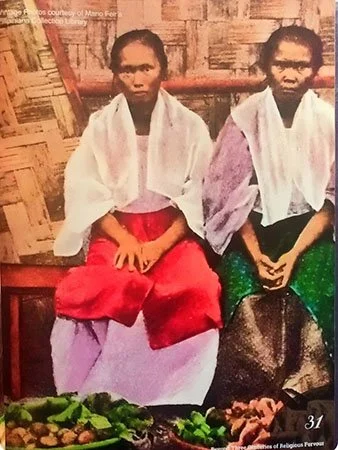
Likely taken in the early 1900s, the photograph shows two women dressed in the classic Filipiniana ensemble — the baro’t saya — composed of the baro (blouse), the pañuelo draped over the shoulders, the saya (skirt), and the tapis worn as an overskirt. (Photo courtesy of Mario Feir and Lito Perez)
From the layered elegance of the Maria Clara ensemble to the sculptural butterfly sleeves of the modern terno, each transformation reflects the cultural, political, and economic currents of its time.
From Baro’t Saya to the Maria Clara
The roots of the terno lie in precolonial attire, when Filipino women wore the baro (blouse) and saya (skirt), often accompanied by a tapis (overskirt). These garments were woven from indigenous fibers such as cotton and abaca and designed for comfort in the tropical climate.
Spanish colonization in the 16th century reshaped clothing traditions. European ideals of modesty and rigid social hierarchy influenced Filipino attire, ushering in a refined aesthetic that mirrored colonial sensibilities. From this cultural convergence emerged a hybridized form of the baro’t saya, a four-piece ensemble composed of the blouse, skirt, pañuelo (shoulder scarf), and tapis (the single rectangular piece of cloth wrapped around the waist or chest as a skirt).
By the 19th century, this attire had become synonymous with the refined Filipina of the ilustrado class, that is, the educated, middle-to-upper class Filipino intelligentsia during the late 19th century Spanish colonial period. Delicate textiles such as piña and jusi, embellished with intricate embroidery, demonstrated the extraordinary craftsmanship of Filipino artisans.
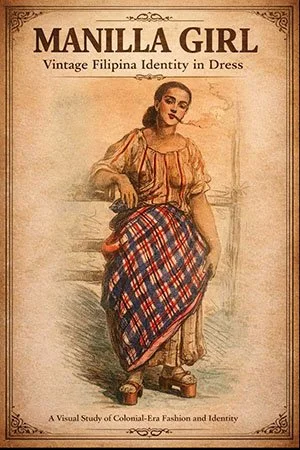
First printed in The Illustrated London News in 1857, this hand‑tinted wood engraving—Manilla Girl: Vintage Filipina Identity Dress by English artist Charles Wirgman—captures a gentle domestic ritual of the era. Known for sketching everyday life across the Philippines, China, and Japan, Wirgman depicts a “postprandial” pause: a young Filipina wearing an indoor dress, composed and unhurried, enjoying a cigar in the calm that follows a meal. (Photo courtesy of Mario Feir and Lito Perez)
The ensemble was immortalized in literature through the character Maria Clara in Noli Me Tangere, giving the attire its enduring name—the Maria Clara dress. Though often associated with colonial gentility, it also became a subtle expression of Filipino cultural identity within Spanish colonial society.
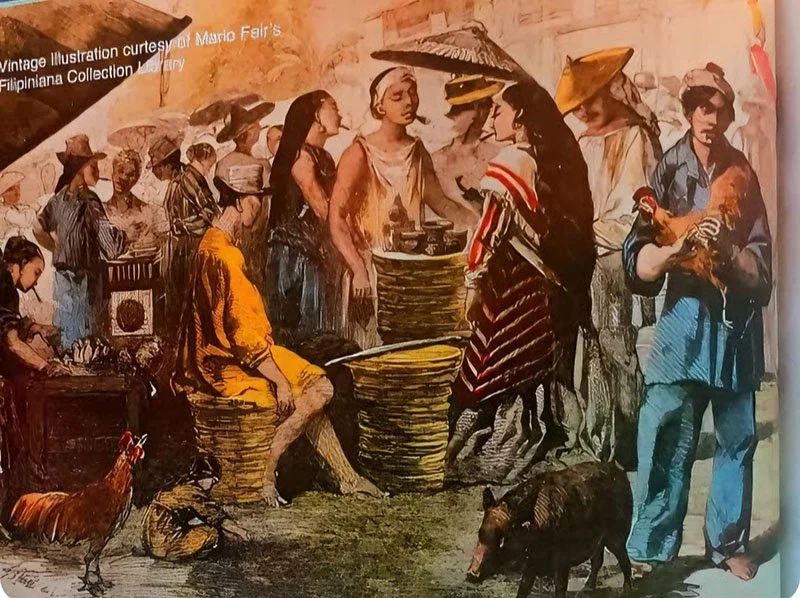
Based on Charles Wirgman’s 1857 sketches for The Illustrated London News, the scene captures the lively rhythm of 19th‑century street life. In the Manila busy marketplace, a young Filipina in her elegant Maria Clara quietly draws the eye. (Photo courtesy of Mario Feir and Lito Perez)
The Traje de Mestiza and Cosmopolitan Manila
At the dawn of the 20th century, the Philippines entered a new era under American rule. Western education, urban modernization, and global entertainment began reshaping Filipino lifestyles.
During this period, the Maria Clara ensemble evolved into the traje de mestiza, a transitional form that retained its elegance while introducing a more streamlined silhouette. The pañuelo gradually disappeared, sleeves grew larger and more sculptural, and skirts became sleeker.
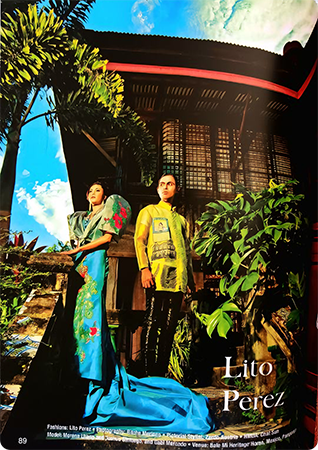
A modern reinterpretation of the traje de mestiza by 2024 Obra Maestra Awardee for Philippine Fashion Design, Lito Perez of Camp Suki—celebrated for restoring the grace and grandeur of the terno and other garments of Filipino heritage. (Photo courtesy of Mario Feir and Lito Perez)
This transformation reflected the changing role of the Filipina, who was becoming increasingly visible in public life as an educator, civic leader, and professional.
The glamour of the Manila Carnival accelerated this evolution. Carnival queens appeared in dazzling gowns that blended Filipino textiles with Western haute couture aesthetics. Inspired by Hollywood films and international fashion magazines, designers incorporated Art Deco motifs, dramatic trains, and shimmering beadwork. The result was a striking fusion—Filipino tradition infused with cosmopolitan sophistication.
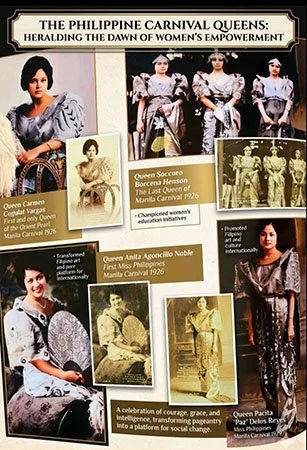
The Carnival Queens stood at the front of a new era, signaling the rise of women’s power and public voice. (Photo courtesy of Mario Feir and Lito Perez)
The Era of the Modistes
The golden age of the traje de mestiza and early terno during the 1920s and 1930s was shaped largely by women designers known as modistes. Though modestly titled, these women were the true architects of modern Filipino fashion.
Among the most celebrated was Pacita Longos, widely credited with refining the dramatic butterfly sleeve that would later define the terno. Her designs became synonymous with Manila elegance.
Equally influential was Juanita Mina Roa, considered Longos’s greatest rival. Roa dressed members of the political elite, including First Ladies Aurora Quezon and Esperanza Osmeña, and is credited with introducing the pañuelo-less terno in 1936—simplifying the silhouette and paving the way for the modern one-piece gown.
Other prominent modistes included Pura Escurdia, whose atelier catered to Manila’s high society during the peacetime, and Marina Antonio, admired for her meticulous craftsmanship in creating elaborate ternos before the war.
Another legendary establishment was the Vanity Dress Shop, run by the Lo sisters—Tita Chayong and Tita Ling—whose dress studio produced elegant gowns for Manila’s most fashionable women. Closely associated with this pioneering generation was the historic House of RT Paras, regarded as the oldest continuously operating fashion atelier in the Philippines.
Founded in 1902 in Angeles, Pampanga, by self-taught seamstress Roberta Tablante Paras, the atelier began as a modest dressmaking enterprise that would evolve into a multigenerational institution in Philippine fashion. Known as Aling Belta, Paras was renowned for her discipline in precision tailoring and mastery of fine materials. She later established the RT Paras School of Dressmaking in Manila, training generations of dressmakers in couture craftsmanship.
Her daughter Josefina Tayag Gonzales, often called the “Chanel of the Philippines,” continued the legacy, elevating the house through technical perfection and refined design. In 1957 the atelier moved to Quezon Avenue, becoming a favored fashion house among Manila’s elite circle.
The third generation was led by Froilan Gonzales, internationally known as Roy Gonzales, who later achieved recognition in Parisian haute couture before returning to continue the family tradition. Across more than a century, the House of RT Paras has dressed presidents (President Cory Aquino and President Gloria Macapagal-Arroyo), first ladies, and cultural luminaries—including Imelda Marcos and Imelda Cojuangco—remaining a symbol of enduring craftsmanship in Philippine fashion.
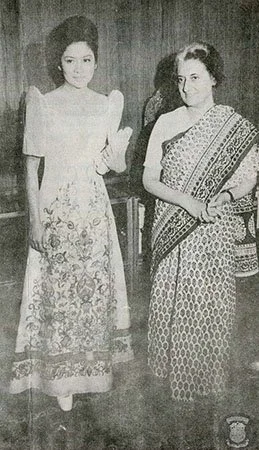
First Lady Imelda Marcos with Indian Prime Minister Indira Gandhi (Source: Picryl)
Building on the legacy of pre-war Manila’s modistes, post-war designers introduced key innovations that would define the national dress: the sculptural butterfly sleeve, Art Deco embellishment, and unified silhouettes made possible by the use of zippers, allowing garments to evolve from multi-piece ensembles into the sleek one-piece terno.
War, Liberation, and the Male Couturier
World War II disrupted the Philippine fashion scene, yet the years that followed brought profound cultural change. As society emerged from wartime austerity, social attitudes became more relaxed, and traditional gender roles began to shift. This period saw the rise of male couturiers, most notably Ramon Valera.
Valera revolutionized Filipino fashion by perfecting the one-piece terno, eliminating the separate blouse and skirt to create the sleek, continuous silhouette recognized today. His mastery of proportion and architectural sleeve construction elevated the terno to the level of haute couture, eventually earning him recognition as the first National Artist for Fashion Design.
As the Philippines moved toward independence in 1946, the terno emerged as a powerful visual symbol of national identity—distinct from both European and American fashions. However, in the decades following the war, global fashion trends began influencing everyday apparel. Western dresses and casual attire became more common, and the elaborate terno gradually receded from daily use.
Politics, Power, and Reinvention
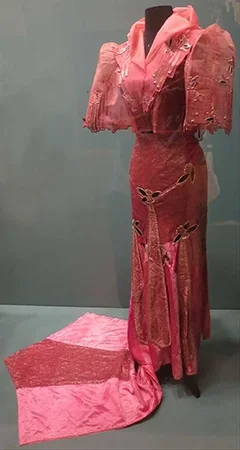
The Terno at the Honolulu Museum of Art (Source: Picryl)
During the presidency of Ferdinand Marcos, the terno returned to global prominence through the dramatic gowns worn by first lady Imelda Marcos at international events. Her wardrobe projected an image of Filipino elegance and cultural sophistication abroad.
Yet the symbolism of the terno became complex during the years of Martial Law, when it was sometimes associated with political extravagance. During the People Power Revolution, however, simplified versions of traditional attire appeared in civic gatherings, symbolizing dignity and moral resolve within the democratic movement.
A Contemporary Renaissance
In recent decades, the terno has experienced a powerful revival. Contemporary Filipino designers reinterpret the iconic butterfly sleeve through modern silhouettes—from minimalist gowns to avant-garde couture. They incorporate both innovative materials and heritage textiles such as inaul, abel Iloko, and t’nalak, reconnecting fashion with traditional weaving communities.
Today the terno appears on international runways, museum exhibitions, and diplomatic occasions, serving as a cultural ambassador for the Philippines.
Today the terno appears on international runways, museum exhibitions, and diplomatic occasions, serving as a cultural ambassador for the Philippines. It has also become a symbol of modern Filipina leadership. Public figures such as Leni Robredo have worn it at official events, affirming national identity while projecting strength and dignity.
A Living Masterpiece
Across centuries, the terno has mirrored the evolving realities of Filipino society—from colonial hierarchy and nationalist awakening to modern empowerment and artistic reinvention. Influenced by indigenous craftsmanship, Spanish elegance, American modernity, Hollywood glamour, and global couture, it remains one of the most distinctive garments in the world.
More than fashion, the terno is a living masterpiece—a wearable chronicle of the Filipino soul, where history, culture, and artistry merge in a single unforgettable silhouette.
The author warmly thanks Dexjordi Lyle Sison for his generous help with the photographs.

Zardo A. Austria is an award‑winning cultural impresario, writer, and publisher best known for creating Obra Maestra, the landmark series celebrating Philippine fashion, culture, and the arts. A two‑time Aliw Award honoree, he received the 2020 Aliw Award for Artistic Excellence and the 2022 Best Special Event Production Award for Obra Maestra in Taal, distinctions granted by the Aliw Awards Foundation, the country’s foremost institution recognizing excellence in live entertainment and cultural presentation.
He launched his professional writing career at 17, while a sophomore at the University of the Philippines Diliman, beginning a distinguished five‑decade journey in publishing. Since then, he has served as editor and creative director of five lifestyle and travel magazines and has authored and published four acclaimed coffee‑table books on Philippine heritage and history.
He currently writes the online column “Epiphanies of the Soul” and is preparing to release his fifth book, The Premium Collector’s Edition of Obra Maestra: Threads of Power, Silhouettes of Heritage, Weaves of Filipino Soul.
