

Rizal Navigated the Troubled Water of Diaspora Identity Politics
/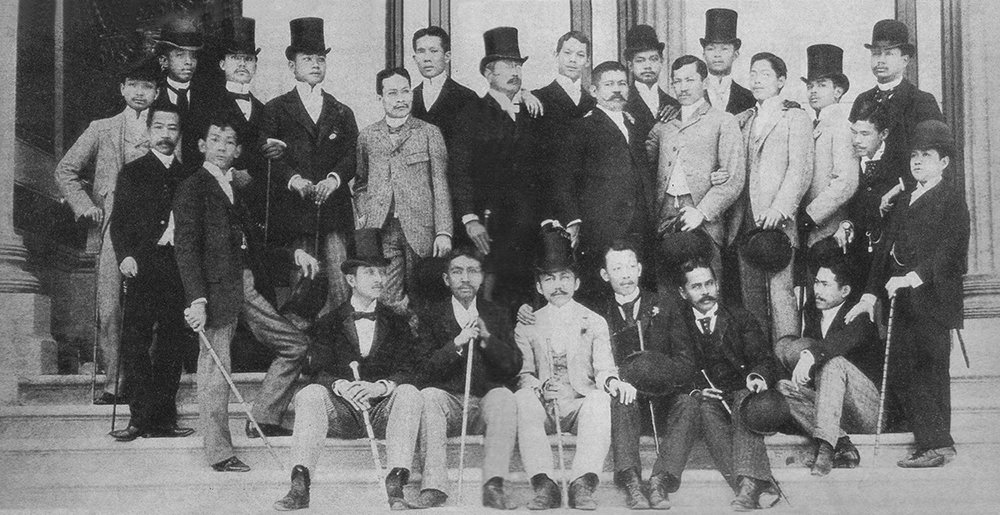
Filipino diaspora intellectuals in 1880s’ Madrid. Rizal stands to the right of Marcelo del Pilar’s glorious mustache. Image from Wikipedia.
1)
I'll admit it: I was annoyed.
For a few years now, I've been watching online Fil-Am identity spaces—the Instagram posts about decolonizing the mind, the threads about reclaiming pre-colonial identity, the debates about who counts as "really" Filipino. As a Cebuano living in Davao, surrounded by migrant families from across the country as well as the Lumad and the Moros and Tsinoys and fresh-off-the-boat Chinese, something about the discourse rubbed me the wrong way.
Plurality is just the texture of daily life here. But in those online spaces, the desire to make the Filipino unique and different from the West seemed to lead to a kind of romanticization—of the indigenous, of victimhood, of a pre-colonial golden age that never quite existed as advertised.
The hyperawareness of race, the insistence on trauma as identity, the earnest reclamation of baybayin and babaylan—it all felt like projection. American anxieties mapped onto a Philippines that's messier and more plural than their discourse allows.
Then I read Filomeno Aguilar's Jose Rizal, Nationhood, and the Anticolonial Imagination, and my annoyance dissolved into recognition. There it was, the template: Madrid in the 1880s, in the letters and essays of José Rizal and his fellow ilustrados: young people from the Philippines living abroad, code-switching between identities, hyperaware of race, caught between pride and embarrassment about their homeland. Today’s diaspora Filipinos are navigating the same structural bind the ilustrados faced 140 years ago. Once I understood that, I couldn't unsee it.
This essay is my attempt to make sense of that recognition. It's also an introduction to Aguilar's book, which I think anyone interested in Filipino identity—whether in the Philippines or the diaspora—should read.
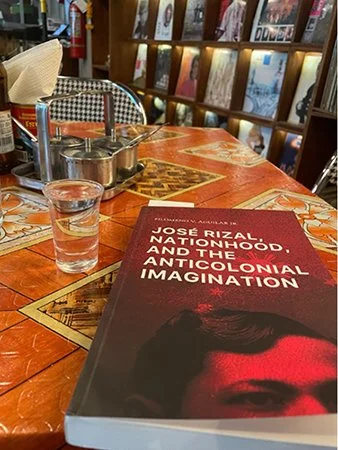
Performative Filipino starter kit. (Photo by the author)
2.
Let me start with a scene that turns out to be more complex than how it is usually presented.
In 1887, Spain organized the Exposición de las Islas Filipinas in Madrid. The colonial government brought 55 individuals from the Philippine colony to display in the capital—including Igorots from the Cordillera highlands, Moros from Mindanao, Negritos, and manual laborers from the Hispanized lowlands.
The young ilustrados in Madrid—Rizal, Antonio Luna, Graciano López Jaena, and others—were mortified. Before the exposition even opened, Rizal wrote to his Austrian friend Ferdinand Blumentritt: "According to the newspapers and the information I have, it will not be an Exposition of the Philippines but, rather, an exposition of Igorottes, who will play music, cook, sing, and dance." López Jaena complained that "the Exposition does not represent those Islands with dignity or, at least, with decency; it shows nothing but the backwardness of the Philippines."
The sting was personal. Antonio Luna, writing under the pen name Taga-Ilog, recalled his humiliation when young Madrileñas stared at him on the street and muttered, "¡Jesús que horroroso! Es un igorrote!" (Jesus! What a hideous sight! It's an Igorot!) Aguilar writes, “The ilustrados were enraged.”
And yet. There were also moments of unexpected solidarity. López Jaena referred to the people on display as "nuestros hermanos"—our brothers. He was surprised to discover that some Igorots spoke perfect Spanish. He observed that "Igorots are neither savage nor irrational" and "are susceptible to modern civilization." Evaristo Aguirre, a creole who considered himself "purely Filipino," also called the exhibited persons "our brothers." Rizal himself referred to them as "my compatriots."
Aguilar captures the contradiction: "In their humanism, the ilustrados felt a fraternal bond with the individuals they believed were demeaned and exploited by the exposition."
Embarrassment and solidarity. Distance and kinship. The desire to differentiate themselves from the "backward" elements of their homeland, combined with the instinct to defend those same elements against Spanish condescension.
Reading this, I thought of Antonio Luna on the streets of Madrid, marked by his face, mistaken for Igorot. And I thought of myself in corporate Makati, speaking the same language and accent as my colleagues' maids and laborers, marked as Bisaya. I hate to admit that I also felt the same inner contradiction. A defiance rose in me then—a defiance that eventually made the Cebuano language situation a recurring theme in my writing.
A century had to pass, Aguilar notes, "before identification with the Igorot became cool." The ilustrados felt the sting of being marked as "less than" before the immigrant experience became a literary genre. I understood. I’d been there too.
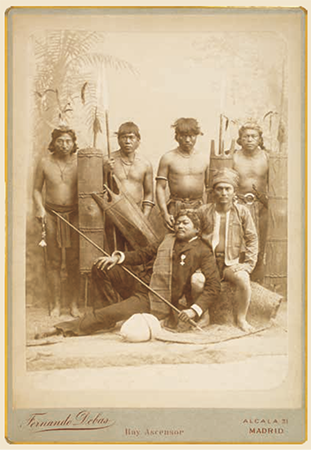
The cocky fellow manspreading in the front of this studio picture is Don Ismael Alsate, an Igorot notable who was put in charge of all the men of the delegation. The one beside him is Purganan, 38, from Abra, a schoolteacher. The men behind them are other Igorot notables, and would likely be four of the following: Cal-libag, 28, from Abra, a wealthy property owner; Asang, 33, from Abra, head of a tribe; Lav-lav, 55, from Lepanto, military guide; Gumadant, 28, from Lepanto, gobernadorcillo; Oit-tavit, 34, from Bontoc, gobernadorcillo; Sumad-en, 50, from Bontoc, head of a tribe. Lepanto refers to what are now some Kankanaey-speaking areas, like Sagada. While it is easy to find the names of the ilustrados in the first photo above, the first time I saw the names of the participants of the Madrid Exposition was in the appendix of Aguilar’s book. I could not find them on the internet. Let’s remember and spread their names. Photo from the document whose cover is below.
3.
Filomeno Aguilar is a sociologist and historian, and Jose Rizal, Nationhood, and the Anticolonial Imagination is a major scholarly work—but written accessibly, with an eye toward readers who aren't specialists.
The book's central motive is to read Rizal's contradictions seriously. Aguilar shows how Rizal was brilliant but also trapped—by European racial science, by the political needs of the moment, by his own blind spots. The contradictions within Rizal's writings isn't a failure of thought, but evidence of a fierce internal struggle between his rational intellect and his emotional loyalty to the homeland.
The ilustrados were trying to answer the question, "Who are we?" And their answers—beautiful, flawed, sometimes racist—became the foundations of Filipino nationalism: the "golden age" before Spain; the blood compact as founding betrayal; the idea that the Philippines was "always already there," a primordial nation waiting to be awakened. These were political moves, not historical facts. And we've been living inside them ever since.
Aguilar's aspiration is that we might finally move beyond them—not by rejecting the ilustrados, but by understanding what they were up against.
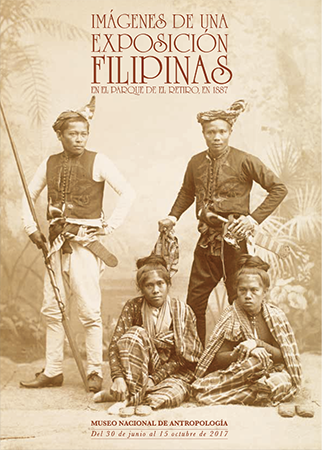
This is the cover of the official document of the 2017 exhibition on the 1887 exposition by Spain’s Museo Nacional de Anthropología. The pictured are most likely the four Moros from Jolo in the group: Buton-Bason, male, 29; Basalia, female, 30, wife of Buton-Bason; Oto Jadcaqui, male, 25; and Juda, female, 22.
4.
Once I started looking, the parallels between the ilustrados and contemporary Filipinos in the diaspora doing identity work became apparent.
Living abroad, navigating between identities. The ilustrados were diaspora intellectuals. They wrote in Spanish, studied in European universities, absorbed European ideas. They were shaped by the experience of being from the Philippines while living elsewhere.
As Rizal observed on his first trip to Europe in 1882, "What a revolution takes place in the ideas of the man who for the first time leaves his native land and travels around through different countries!" The journeys to Europe, Rizal noted, "contribute much to strengthen the bonds, for abroad the inhabitants of the most widely separated provinces are drawn together in patriotic sentiment."
Filipino Americans today seem to be shaped by the same dynamic. The experience of being Filipino in America—navigating between cultures, explaining yourself to outsiders, discovering kinship with other Filipinos you'd never have met back home—produces a particular kind of consciousness. Rizal’s and Benedict Anderson's "specter of comparisons" works on them too.
Romanticizing the indigenous and pre-colonial. Rizal constructed a golden age in his annotations to De Morga’s Sucesos de las Islas Filipinas: a pre-Hispanic Philippines with advanced civilization, literacy, trade networks, gentle customs. This was partly true, partly exaggerated, and entirely strategic.
As Aguilar puts it, "Rizal's glorification of the patria was the outgrowth of the feeling of repugnance at being denigrated and humiliated by the colonial master." Against Spanish ridicule and taunting, Rizal reversed the discourse: we are better than Europeans. Our ancestors had a moral civilization that Spain destroyed.
Diaspora Filipinos today perform a similar move—reclaiming baybayin, celebrating babaylan priestesses, insisting on a Philippines before Spanish contamination. The emotional logic is identical: asserting dignity against erasure.
Hyperawareness of race, within imposed frameworks. The ilustrados didn't invent the racial categories they used. They inherited "Malay," "indio," "mestizo," "Negrito" from Spanish and European racial science. Aguilar writes: "Products of European thought, Rizal and other ilustrados were too deeply immersed in racial thinking—colonial oppression was voiced and experienced explicitly as the indio's racial degradation—for them to transcend a race-based discourse. Notwithstanding some questions, they had no alternative to the racial paradigm."
The bind: to assert equality with Spaniards, they had to use the language of race. They couldn't step outside the framework. They could only work within it.
Filipino Americans navigating identity face a structurally identical situation. They operate within American racial categories—"Asian American," "BIPOC," "person of color." These categories are imposed by the structure of American life, by policies and institutions and everyday interactions. You can critique them, but you can't escape them if you want to be politically legible. The framework shapes what you can say and do.
The victimhood narrative. Andrés Bonifacio's manifesto, Ang Dapat Mabatid ng mga Tagalog (What the Tagalog Should Know), told a story: the Spaniards deceived Sikatuna, seduced him with sweet words, and betrayed the blood compact. The Philippines was Edenic before Spain; colonialism was the Fall. Filipinos were using "Make X Great Again" long before Trump.
Aguilar's analysis: this narrative "represented the Katipunan parable of Spanish evildoing and the resulting victimhood of the colonized." It was politically powerful—it helped launch a revolution—but historically dubious. The blood compact, as Aguilar shows in painstaking detail, was an invention, retroactively imposed on indigenous rituals—both by the colonists and the nationalists—that meant something quite different to the participants.
Contemporary identity discourse often centers victimhood in similar ways—colonization as ongoing trauma, the Filipino as perpetually wounded by history. This framing has real power. But Aguilar shows it's also a very old choice, with its own costs. The victimhood narrative, he argues, has "bequeathed to later generations an ineffable sense of colonial trauma that has been embedded deeply in national consciousness. Thus has lingered the sense of being betrayed, as though the islanders had no agency at all."
The question of who counts. The ilustrados drew boundaries. Igorots were "mountain tribes" outside civilization. Muslims were ambivalently included. Chinese were explicitly alien—Rizal himself placed "Chinese and savages" on the same level. Aguilar doesn't flinch: "Racism was embedded in the cradle of Filipino nationalism."
Identity discourse always has its inclusions and exclusions. Who counts as "really" Filipino? The boundaries have shifted since the 1880s—we eventually let the Igorots in, uneasily included the Moros, absorbed the Chinese mestizos—but the impulse to draw them persists.
None of this is meant as critique of the diaspora identity discourse. Once I understood the structural bind the ilustrados faced, my annoyance dissolved. I try to imagine their situation: growing up as de facto representatives of a country they may never have lived in, inheriting their parents' complicated feelings about the homeland—the embarrassments, the insecurities, the guilt of having left. When political awareness inevitably sprouts, perhaps the romanticization is a kind of repair. A way of resolving inherited shame by asserting inherited greatness. The ilustrados did the same thing, for similar reasons.
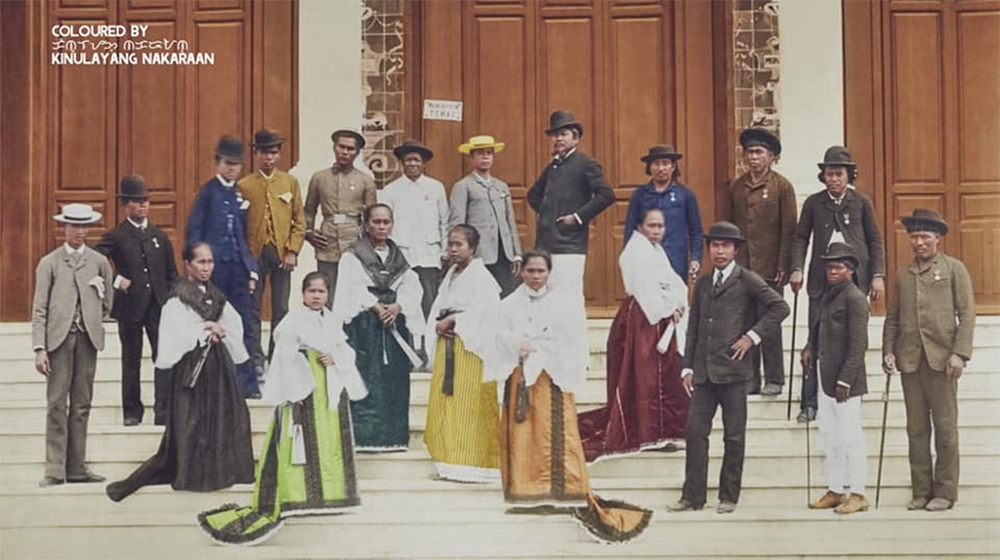
Here are the names and backgrounds of the rest of the forty three members of the group who went to Madrid. From Antique: Raimundo Picio, a rich man and gobernadorcillo; Ambrosio Talan, 60, seaman; Feliciano Ibut, 27, seaman; Vicenta Rico Toling, 17, weaver; Petra Talam, 25, weaver. From Iloilo: Eleuterio Samudio, loom master; Bonifacio Guimera, 31, draftsman; Matea Bada, weaver; Saturnina Llana, 33, draftswoman; Emilia Gimera, weaver; Francisca Urmas, weaver; Romana Ramos, weaver; Margarita Gordoncillo, weaver; Fabian Lloporal, 16, seaman. From Bulacan: Bonifacio Cruz, 27; Martin Espiritu, 30; Andres Espiritu, 30; Felipe Torres, 28; Simon Garcia, 28; Monaco Rojas, 28, in charge of the botanical section; Custodio de los Santos, 29. Chamorros from the Marianas: Jose Flores, 20; Antonia de los Santos, 22. From the Carolines: Pearipio, 30, musician; Dolores Neisern, 22, speaks English. From Zambales: Antonio Mabituen, 22, cook (probably the Negrito). From Manila: Juan Legaspi, 57; Vicente Francisco, 22, sculptor. From Camarines Sur: Antonio Pavilin, 27. From Negros: Tek, 19. Photo from Kinulayang Nakaraan Facebook page. Names are known, but individual identifications within the photograph remain uncertain.
5.
I should clarify my own situation, because it's different from both the ilustrados and the diaspora.
I recently wrote a historical novel called Rajah Versus Conquistador, about the power game between Rajah Humabon and Ferdinand Magellan in 1521—the encounter that ended with Magellan's death on the beach at Mactan. My goal was different from theirs.
Many Philippine historical novels use the past to deliver moral lessons for the present. The past becomes a mirror, reflecting contemporary concerns. I wanted to do the opposite. I wanted to use the present to fill the gaps of the historical and anthropological record, the way modern DNA is used to complete dinosaur genomes in Jurassic Park. Magellan's chronicler, Antonio Pigafetta, recorded 160 Cebuano words in 1521, and surprisingly, I could understand most of them. If there's any truth to the Sapir-Whorf hypothesis—that language is an expression and frame of culture—then I share a lot of the cultural DNA of Humabon and Lapulapu.
I didn't want to make Humabon a proto-nationalist hero or a victim of European treachery. I wanted to encounter him as he might have seen himself—an orang besar, a big man of maritime Southeast Asia, navigating a world of tributary networks and competitive feasting. Not a "Filipino," because that word didn't exist yet. Definitely not a victim. He was playing his own game, using the Castilians for his own purposes.
What Aguilar explains through scholarship, I lived as creative practice. Writing the novel, I felt the pull of the inherited narratives—the victimhood, Spain as the primordial enemy, the betrayal that began our Fall. These specters wanted to colonize my imagination, to turn the story into nationalist propaganda. To be faithful to what the novel wanted to be, I had to exorcise my mind of the ilustrado ghosts—the very ghosts Rizal himself, in his final years, began to question.
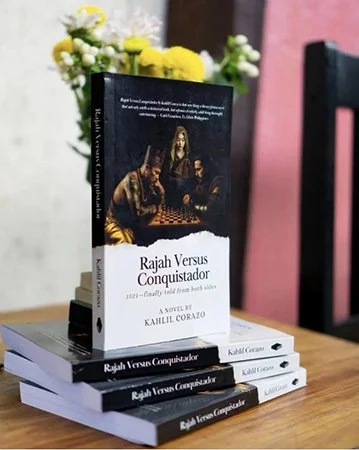
Rajah Versus Conquistador is available in ebook format via Kindle, Apple Books, Kobo, and Nook. In the Philippines, the paperback is available in Lazada and various bookstores. Abroad, the paperback is available in Amazon sites for the USA, Canada, Australia, Germany, Spain, France, Italy, and the UK.
6.
Rizal was exiled to Dapitan, in Zamboanga, from 1892 to 1896. There, for the first time in his life, he had sustained contact with the Subanen—one of the "mountain tribes" he'd theorized about, the people he'd implicitly excluded from his vision of Filipino civilization.
And he was surprised.
"I have known them here," he wrote, "and really they are a peaceful people, very honest, industrious, and faithful in their transactions, not reneging on their word." He wanted to live among them and the Moros for some weeks to learn more. Aguilar notes, with a poignancy that's hard to miss: "martyrdom prevented him from expounding what might possibly have been an alternative vision of nationhood based on firsthand knowledge, a patria adorada that went beyond a mere inversion of colonial racism."
What might have been. Rizal finally met the people he'd theorized about, and it changed his mind. Encounter over projection. Curiosity over utility. He was doing, in those final years, what anthropology would later try to systematize—approaching others on their own terms, suspending the frameworks you brought with you. It's what I attempted with Humabon: to let him be an orang besar playing his own game, not a figure in a nationalist moral drama.
But the revolution came, and then the execution, and whatever alternative vision Rizal might have developed died with him.
7.
We did eventually broaden "Filipino." The Lumad are in—in fact, they have become the official “Indigenous Peoples” of the country. After a long peace process, the Bangsamoro is also in. The Chinese mestizos, once a separate tribute category that paid double the taxes of indios naturales, vanished into plain Filipino just a few years after taxation shifted from heredity to income—proof that identity is shaped by power, not nature.
But Aguilar's deeper point is that we still carry the emotional and epistemic baggage of the ilustrados. The victimhood. The primordialism. The lingering sense that we were betrayed, "as though the islanders had no agency at all." The inability to accept that the Philippines was, in Nick Joaquin's words, "begotten of Spain"—that the very entity we are asked to love was created through the colonizer we are taught to resent.
None of this is meant as critique of the diaspora identity discourse. Once I understood the structural bind the ilustrados faced, my annoyance dissolved.
Aguilar ends with an aspiration:
"Memories of past colonial injuries, which have their own histories, need to be finally uncovered, mapped, confronted, accepted, and forgiven. With the healing of historical trauma and the acknowledgment of historical truths, it will be possible for the twenty-first century to produce a new Filipino narrative of the Spanish conquest, one not reliant on primordialism."
I think the same aspiration applies to diaspora Filipinos navigating American racial frameworks. Maybe the goal isn't to escape the framework—that may be impossible. Maybe it's to hold it lightly. To use it strategically while knowing it's a construct. To remain open, like Rizal in Dapitan, to encounters that change your mind.
Rizal never got to finish his journey. But maybe we can finish it for him. Not by rejecting the ilustrado inheritance—it's too deep in us for that—but by understanding where it came from, what it cost, and what it made possible. By staying open to the people and perspectives that don't fit our frameworks. By being willing to say, as Rizal did of the Subanen: I have known them here, and I was wrong about them.

Kahlil Corazo is a writer and scholar based in the southern Philippines. If you liked this essay, you might also like his novel, Rajah Versus Conquistador, or his essays on the Filipino experience, The Invisible Philippine War.
