
My Grandfather, Leader and Pioneer
/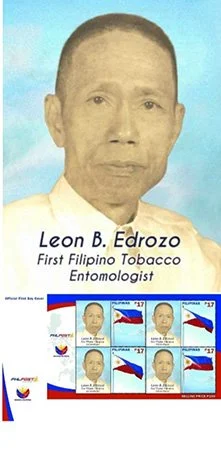
The Philippine Post Office issued a limited-edition stamp on Leon B. Edrozo in November 2024 to commemorate his distinction as the first Filipino tobacco entomologist (Photo by Dominic Agsaway)
My siblings, cousins, and I affectionately referred to him as “Lolo Papang.” Since I would only see him during family vacations in Luna, Apayao, I did not have the chance to get to know him well, especially because he passed away while I was in college. However, I am grateful that he left behind his biography, which my late aunt, Lydia Edrozo Reyes, preserved for decades. The three single-spaced, typewritten pages on legal-sized paper appear to be an autobiography, written in a style that suggests he was the author. Interestingly, the narrative is written in the third person, which may have been a stylistic choice to avoid an egocentric tone. Another clue is the numerous dates on the calendar that only Lolo Papang would have known.
The Philippinensian (1917), the University of the Philippines’ yearbook, is also a valuable resource, and it has been made available online by the University of Michigan. I remember reading the yearbook one summer vacation in Luna, Apayao. Being a theater enthusiast, I enjoyed looking at the photos of the play The Miser, which was staged during that school year. It also shows that Lolo Papang was dubbed the “First Filipino Tobacco Entomologist” early on for his notable thesis, A Study of Tobacco Insects.
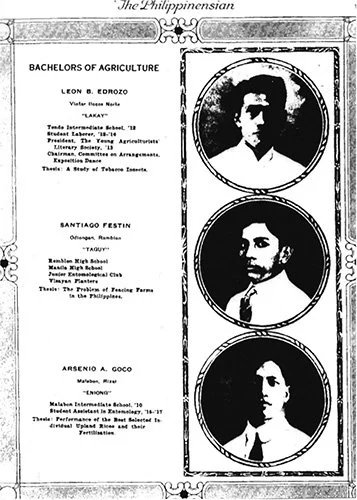
The Philippinensian (2017) (Photo courtesy of the University of Michigan)
Lolo Papang was born in Vintar, Ilocos Norte, on June 26, 1890. He completed his primary education in Vintar and two years of intermediate classes in Laoag, Ilocos Norte. With only 150 pesos in his pocket, he traveled to Manila with his cousin, who had a job opportunity, enabling Lolo Papang to complete his elementary education at the Tondo Intermediate School in 1912.
When he entered the University of the Philippines’ College of Agriculture in Los Baños, Laguna, he must have been 21 or 22, which was considered old for a first-year college student at the time. Accordingly, his nickname in the Philippinensian was “Lakay” (“Old Man”).
Lolo Papang was a working student employed on campus, earning an hourly rate of 10 centavos. With his earnings plus the monthly allowance of five pesos from his cousin, he was able to continue his studies. At the end of five years, he was one of thirteen who graduated in April 1917 with the degree Bachelor of Agriculture.
As a creative writer, I have always wondered if my love for writing and literature is in my genes. Lo and behold, I found the answer in the unlikeliest of places! In the Philippinensian, Lolo Papang was listed as the president of the Young Agriculturists’ Literary Society in 1913. There — my love for literature seems to run in my blood!
After his graduation, Lolo Papang was appointed superintendent and acting cashier of the rice colony in Colonia (now Libertad), Abulug, Cagayan, under the Department of Agriculture and Natural Resources in 1917. (Footnote: My mother, Purificacion Edrozo de la Cruz, the eldest in her family, was born in Colonia on November 20, 1919.) He held the position of superintendent for four years. Under his leadership, the rice colony flourished, yielding abundant rice, corn, and other farm products.
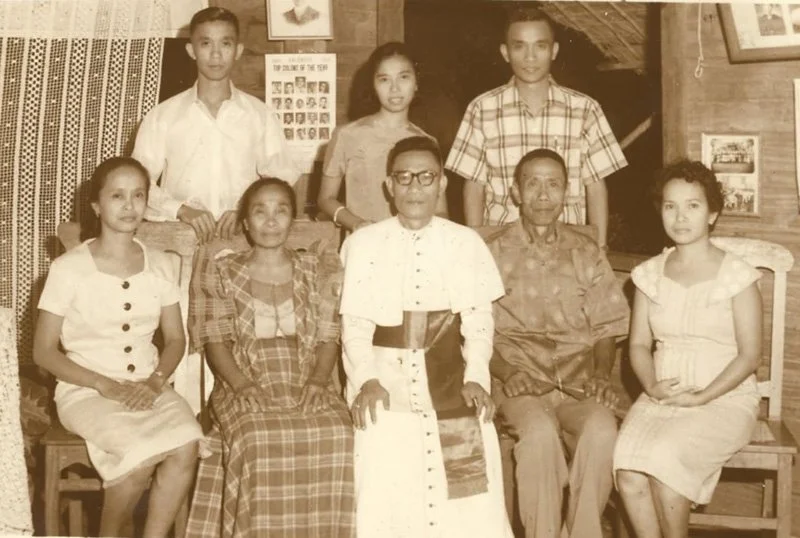
The Edrozo Family in 1959. Seated, left to right: Purificacion Edrozo de la Cruz, Simeona Fernandez Edrozo, Father Onofre Edrozo, Leon Edrozo, and Salvacion Edrozo Bautista. Standing: Francisco Edrozo, Lydia Edrozo, and Mariano Edrozo. Not in the photo: Paulo Edrozo. (Photo courtesy of Purificacion E. de la Cruz)
In 1919, he met and married Simeona Fernandez of Ballesteros, Cagayan. In 1921, he resigned from his job as superintendent of the rice colony.
Lolo Papang set his sights on the fertile lands originally inhabited by Pugots, also known as Aetas. Armed with a bolo and an axe, he cleared his way into this land, becoming the second Ilocano settler after Antonino Barroga. The “promised land” was initially known as Macatael, or “Itchy,” due to the irritating water from its streams and rivers. According to the Luna, Apayao government website, Lolo Papang later renamed it Luna in honor of the Ilocano hero General Antonio Luna. Historically, Luna was part of three successive provinces: Mountain Province, Kalinga-Apayao, and later Apayao, and it is now the capital of Apayao.
Luna was a new frontier, and Lolo Papang encouraged settlement by providing shelter to newcomers, assisting with homestead applications, and helping to develop the newly opened lands. He was an adviser, a peacemaker, and even a matchmaker to help Luna’s population grow.
He held various leadership positions in Luna, culminating in his election as municipal-district president from December 16, 1935, to October 15, 1937. During his term, he worked on the approval and opening of the road from the Luna municipal building to Cagayan’s national highway, a distance of 6.7 kilometers. It is now known as the Luna-Cagayan Junction, a burgeoning area in Libertad, Abulug, Cagayan, where Lolo Papang worked as a rice-colony superintendent.
As a community leader, he played diverse roles, including horticulturist, food-production campaigner for civilians and soldiers in the aftermath of World War II, and agronomist.
On September 16, 1951, Lolo Papang began working at the Bureau of Plant Industry’s Tobacco Division at the Luna Tobacco Experimental Station in Tumog, Luna, as an agronomist. His last position was Assistant Tobacco Entomologist, beginning on January 1, 1955, until his retirement on June 27, 1955.
At the experimental station, he conducted tobacco research, experimenting with Turkish tobacco, White Burley tobacco, and Ring Gauge wrapper tobacco in upland and lowland cultivation. The results were published in the Bureau of Plant Industry Digest. Additionally, a Google search revealed that he co-authored the following article with Ulpiano V. Madamba: “A Progress Report,” in The Philippine Journal of Agriculture, volumes 19–20 (1954), pages 141–158.
Armed with a bolo and an axe, he cleared his way into this land, becoming the second Ilocano settler after Antonino Barroga.
Lolo Papang was a pioneer and community leader in Luna, Apayao, while raising his family of seven in Ballesteros, Cagayan, where he served as treasurer of the Northern Cagayan Academy, now known as Northern Cagayan Colleges Foundation, Inc. Later, most of his children relocated to Luna.
He passed away in Luna, the town he helped to found and build, on March 14, 1974, at the age of 83.
Leon “Lolo Papang” B. Edrozo’s accomplishments show his community leadership and pioneering endeavors in research and community development. Whatever he did, he approached it with heart, a clear goal, and a compelling vision. And I am forever thankful that he was my grandfather.
The author would like to extend his sincere gratitude to Dexjordi Lyle Sison for his assistance with the photos, and to Arjan Edrozo and Glenn Edrozo for their contributions to the research.
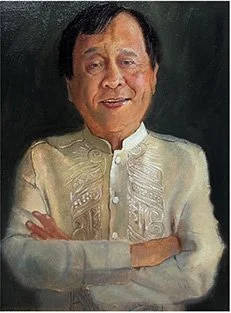
Rey E. de la Cruz, Ed.D., a Positively Filipino correspondent, writes from Chicagoland when he is not immersed in the arts and yearning for his hometown in the Philippines: Ballesteros, Cagayan, known as “The Gakka Capital of the World.” He made groundbreaking contributions to film education, being the Philippines’ first documented film student (University of the Philippines) and high-school film teacher (San Beda University). As an educationalist, he originated and disseminated the use of the ancient Philippine board game sungka as a teaching strategy. He was awarded the Gawad Balagtas for Drama in Filipino by UMPIL, the Philippines’ largest organization of writers, “for his pioneering creative spirit that imagined and expanded what can be possible for today’s modern theater.” His plays, marked by far-out dreams, visionary storytelling, and bold theatricality, have left a lasting impact. Notably, Cardinal Luis “Chito” Tagle played the role of the Second Doll in Tatlong Manyika (Three Dolls), a tragic farce on Philippine class warfare, when he was a teenager. De la Cruz penned the enduring masterpiece at the age of 16.