

Love and Hard Times
/Book Review: Taxi Dancer by Marivi Soliven. Red Hen Press, 2026.
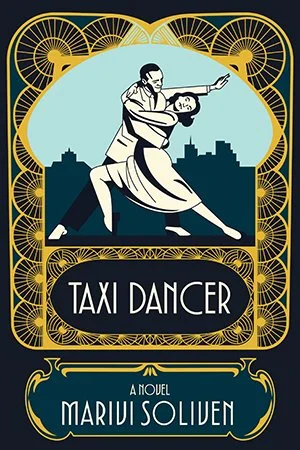
Taxi Dancer is more than a romance. It is also a portrait of the lives of the manongs, Filipino men who traveled to the United States in the early 1900s in search of a better life. Many settled on the West Coast, working as agricultural laborers in California and Washington, while others traveled farther north to work in Alaska’s fish canneries.
More Americans are learning about the manongs and their lives, thanks in part to the growing recognition of their role in U.S. history. Filipino American labor leaders Larry Itliong, Philip Vera Cruz, and Peter Gines Velasco were featured in Marissa Aroy’s Delano Manongs: Forgotten Heroes of the United Farm Workers and the PBS docuseries Asian Americans. More recently, they were honored for their contributions by the Department of Labor, which included them in its Wall of Honor in 2024. Itliong’s life has also been the subject of several books, including Journey for Justice: The Life of Larry Itliong, by Dr. Dawn Mabalon and Gayle Romasanta, which became the basis for Larry the Musical: An American Journey.
Those who have visited the Smithsonian’s How Can You Forget Me exhibit, which shares the stories of early Filipino immigrants in Stockton, California, will find that many of the artifacts displayed there come to life in Soliven’s carefully crafted novel. It is easy to imagine Eli, a recent transplant from the Philippines, transforming from a Filipino agricultural worker, carrying his treasured set of tools, into a dashing and sophisticated gentleman dressed in the highly coveted and iconic Macintosh suit, ready to spend his hard-earned money on a few minutes of ballroom dancing with the lovely taxi dancers employed at the Rizal Dance Hall.
Soliven is no stranger to writing about the immigrant experience. Her novel, Mango Bride tells the story of two Filipino women from opposite sides of the social spectrum who moved to the United States. Pandemic Bread, one of her essays from Suddenly Stateside: Funny Essays on Pinoy Life in America was turned into a short film by Zeinabu Davis with Princess Punzalan leading the cast.

Marivi Soliven
Soliven describes Filipino American history as “grim,” noting the indignities and discrimination experienced by early Filipino immigrants. In 1935, Eli and Lucinda, like the rest of the country, were living through the Great Depression. The Dust Bowl migration—when white families from Oklahoma, Texas, Arkansas, and Missouri migrated to California—displaced Filipino and Mexican agricultural workers. Just a year earlier, the status of Filipinos had changed from U.S. nationals to aliens after the Tydings-McDuffie Act was passed. The act promised Philippine independence but also limited the number of Filipinos allowed to immigrate to the United States. Since Filipinos were classified as aliens, this also prevented them from owning property or businesses in states that enforced the Alien land law.
Mixed-race marriages were illegal in California, where anti-miscegenation laws remained in place, forcing Eli and Lucinda to hide their relationship from everyone who knew them. The Filipino Repatriation Act of 1935 offered free one-way passage to the Philippines for Filipinos who did not have the financial means to return home. Though unintentional, the parallels between the experiences of immigrants in the 1930s and the present-day situation in the United States can feel eerily familiar—and disturbing.
Soliven first found the newspaper article that inspired the novel in 2001, while she was working in the archives of the San Diego History Center. The writing, however, began years later, when Soliven won the Writer-in-Residence Hedgebrook Fellowship, which gave her the time and space to begin Taxi Dancer.
For a work of fiction, Soliven conducted an enormous amount of research to recreate 1930s San Diego. She unearthed newspaper articles in the San Diego library, reviewed court trial papers, consulted with lawyers, and read academic papers about taxi dance halls and the history of Filipino Americans in California. Among the books she consulted was the late Dr. Dawn Mabalon’s Little Manila Is in the Heart.
After completing the novel in 2016, Soliven spent another ten years searching for a publisher for Taxi Dancer. Despite the success of her earlier award-winning novel, Mango Bride, the rejections were plentiful. She documented them all in a color-coded spreadsheet. The process was discouraging, but “I had to keep going until I found a home for it,” Soliven explained.
She was determined that Taxi Dancer was a story that needed to be told. So many Filipino stories, she pointed out, have been forgotten, including the role of Filipino soldiers during World War II and the struggles of the manongs. “This is a history that people don’t know about,” she said. There was more to these men than their identities as laborers: they also wore suits like movie stars, frequented dance halls, and hoped to fall in love.
Finding the right publisher took time. Soliven submitted her manuscript to Red Hen Press after reading Monica Hernandez’s blog post calling for more Filipino American writing. Hernandez, Red Hen’s media director, is always on the lookout for Filipino voices as part of the press’s “quest for representing marginalized communities.”
Soliven joins several Filipino American writers published by Red Hen Press, including E.P. Tuazon, whose collection of essays, A Professional Lola, was published in 1994. That fall, two more Filipino American writers are scheduled to join the press: Nita Noveno, whose hybrid memoir Mud on the Moon explores growing up in Alaska, and Aimee Suzara, whose poetry collection birth language is also slated for publication.
After reading the manuscript, Kate Gale, co-founder and publisher of Red Hen Press, immediately knew they wanted to publish Taxi Dancer. Hernandez was equally effusive, citing the “beautiful writing and the story,” as well as the combination of elements—“historical fiction, interracial and forbidden romance, murder”—that would appeal to different audiences.
Perhaps more importantly, Hernandez sees tremendous hope in Taxi Dancer. She points to characters who, “despite society and its unjust laws,” continue to act out of love, even when they themselves are flawed. Their actions, she says, are “always led with love.”
Readers are drawn into a world that stretches from dusty asparagus fields to the steamy dance halls where men paid for the company—and dances—of taxi dancers.
Soliven insists that all she wants to do with Taxi Dancer is tell a story. She has written a poignant love story set during a difficult period for Filipinos, when they were unwanted, misunderstood, and mistreated. She writes about love and hate, and in doing so, reminds us of the power of fiction to make history personal.
As John Hersey, the author who revolutionized journalism with his landmark New Yorker article about Hiroshima, said in the recent Netflix The New Yorker at 100 documentary, “I think fiction is much more powerful for readers in looking at grand and terrible events because the reader can identify with a character.”
Taxi Dancer does exactly that: it invites us to see, feel, and experience a largely forgotten chapter of Filipino American history through the lives of two people who dared to fall in love.
Taxi Dancer by Marivi Soliven
Published by Red Hen Press
Launch: September 29, 2026
Book Events here.

Titchie Carandang is a freelance writer. Her articles have been published in the White House Quarterly, Northern Virginia Magazine, Metro Style, Connection Newspapers and other publications. She is the co-founder and was co-director of the Philippines on the Potomac Project (POPDC), where she researched Philippine American history in Washington, D.C. She has received awards from the Philippine American Press Club, the Mama Sita Foundation, and the Doreen Gamboa Fernandez Food Writing Award for her writing.
More articles from Titchie Carandang
