
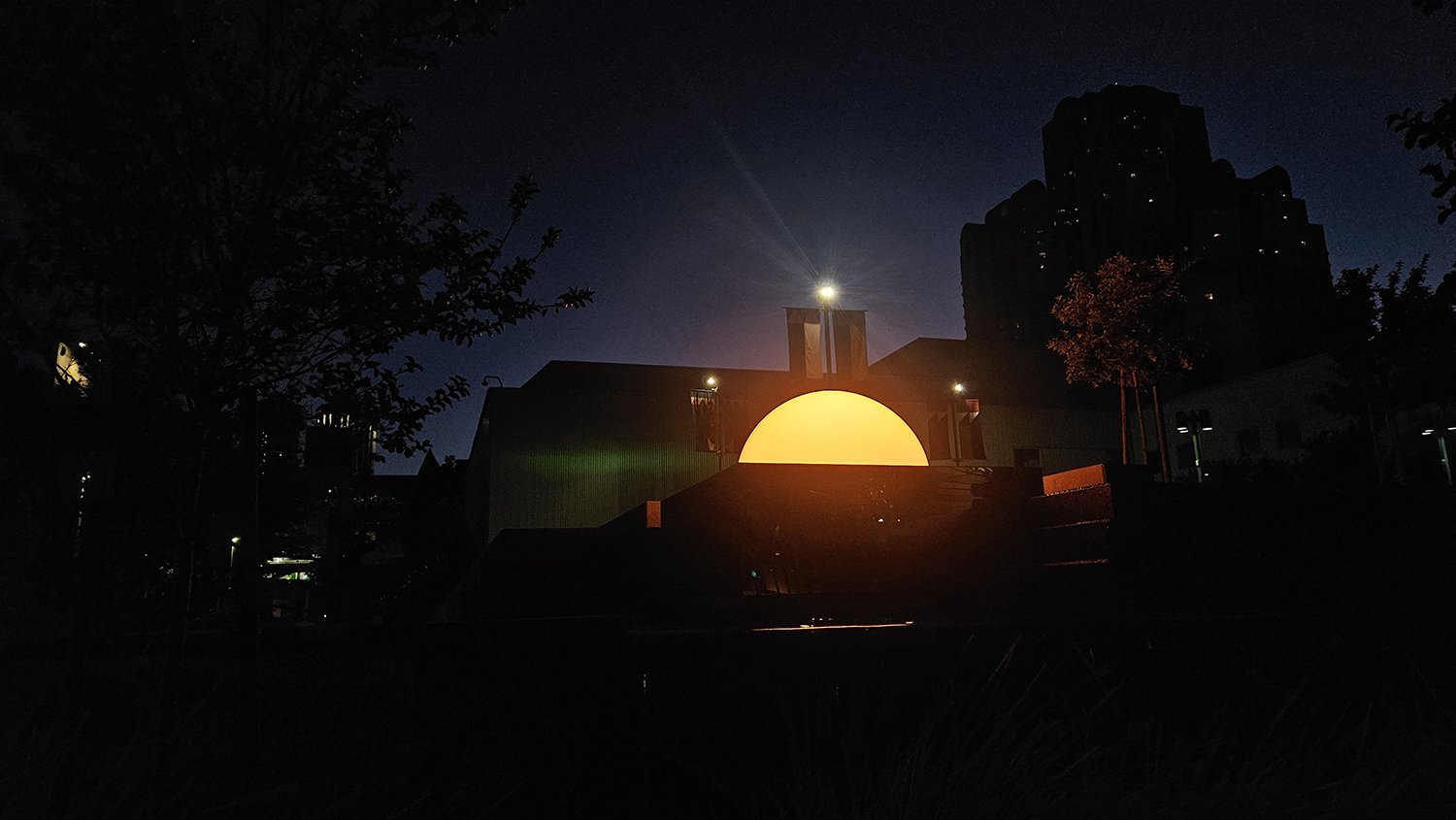
How Can You Forget Me: Filipino American Stories
/
“The exhibit, like the trunks, we can view from the outside and conjure many perspectives. But it is only when you lift the lid and look inside will you appreciate its meaning, embrace its presence, and allow the spirit of the Manongs to speak to you.” - Elena Mangahas, Board Member, Little Manila Rising
Within this modest 1,200-square-foot space unfolds the story of Filipino Americans who migrated to the United States in the early 1900s, when the Philippines was a U.S. colony. The exhibit’s placement—between galleries devoted to immigration and democracy—feels intentional. Filipino American history embodies both themes: they arrived as U.S. nationals, not immigrants, yet were denied the full rights of citizenship. They labored in West Coast fields and canneries while navigating exclusion, racism, and legal discrimination.
Unpacking the Trunks
How Can You Forget Me: Filipino American Stories tells a familiar yet deeply personal story of a people seeking a better life thousands of miles from home—an experience shared by immigrants from all over the world. It begins with three beautifully restored steamer trunks that once held the personal effects of Filipino men who traversed Hawaii, California, Oregon, Washington, and Alaska, harvesting asparagus in dusty fields and canning salmon in frigid coastal factories.
These men, mostly from Ilocos, were called manongs, the Ilocano term for “big brother.” The lives of the manongs, among the earliest overseas Filipino workers (OFWs), are emblematic of the immigrant experience; they reflect both hardship and hope.
It shows the lives of Filipino migrants who lived in Stockton, California from the 1910s to 1970s. Most of the items in the exhibit belong to the Filipino Agricultural Workers Collection - which sprung from the discovery of 26 trunks, suitcases, and toolboxes made by Antonio Somera in 2005 in the basement of the Daguhoy Lodge, owned and operated by the Legionarios del Trabajo, a Filipino American fraternal society modeled after Masonic lodges. These trunks were brought to Dr. Dawn Mabalon (who later passed away in 2018) and Dillon Delvo, founders of Little Manila Rising. They made it their goal to preserve the trunks and find a home in the Smithsonian, working with Center for Folklife and Cultural Heritage Curator, Dr. Sojin Kim, who later introduced them to Dr. Sam Vong, Curator of Asian Pacific American History. Vong worked on the collection of the one trunk and several items for the museum’s Archives Center.
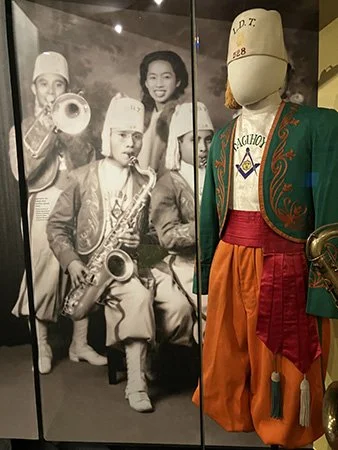
Legionarios del Trabajo vestments (Photo by Titchie Carandang)
Vong also wrote an article, republished by Positively Filipino, highlighting five items from the more than 50 objects currently on display: a steamer trunk, an asparagus knife, three-piece suits, a pageant dress, and a hand-embroidered pillowcase stitched with flowers and the words “How Can You Forget Me.”
These items and other artifacts provide a fascinating glimpse into the complex lives of Filipino Americans as U.S. nationals who could live and work in America but were denied citizenship—only to lose their status after the Philippines gained independence from the United States.
Collaborative Curation
Vong’s curatorial approach was deeply collaborative. He traveled to Stockton several times. He interviewed the members of organizations like Little Manila Rising, San Joaquin County Historical Society & Museum, and the Filipino American National Historical Society (FAHNS), and also enlisted their help to lend artifacts. Families and individuals shared their memories and loaned treasured family heirlooms including labor leader Larry Itliong’s emblematic jacket, passport and his United Farm Workers Organizing Committee flag that were provided by his children. For Elena Mangahas, board member of Little Manila Rising, Vong’s curatorial work is “beyond research.” She described him as a kind of medium, allowing “the spirits of the Filipino ancestors to speak to him,” weaving personal stories of the manongs and manangs to the broader fabric of American immigration history.
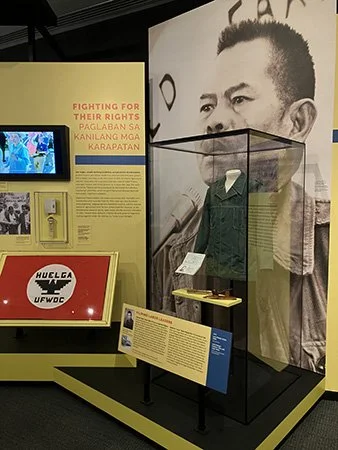
Larry Itliong’s jacket (Photo by Titchie Carandang)
The exhibition also included an advisory committee of Filipino Americans from the Washington, D.C., area. Vong hopes the show “does justice not only to Filipino American communities and the Filipino diaspora, but also to AAPI communities,” and inspires further donations to preserve these histories.
Pivotal Turn
Originally conceived as a five-part video series, the project took a pivotal turn when Dr. Yao-Fen You, Acting Director of APAC, recognized the symbolic power of the trunks, seeing them as “both literal and metaphorical carriers of hope and aspiration—belongings of men who traveled thousands of miles across the Pacific Ocean in search of work and a new life.”
The result is APAC’s first exhibition at the National Museum of American History, dedicated entirely to Filipino American stories. It also serves as a test case for a permanent gallery dedicated to Asian American, Native Hawaiian, and Pacific Islander (AANHPI) histories on the National Mall, where they hope to identify their “various audiences—what resonates with them, what excites them, and what they hope to learn and experience about AANHPI history and culture.”
While Filipino Americans have appeared in previous Smithsonian projects—including Sightlines: Chinatown and Beyond and the traveling exhibition I Want the Wide American Earth, inspired by Carlos Bulosan’s poetry—this is the first exhibition devoted entirely to their lived experiences in the United States. Last year, Sightlines: Chinatown and Beyond, an exhibit also by APAC, showed the presence of Asian Americans in DC neighborhoods. Even though the exhibit ended, a fun online exhibit, Sightlines Atlas, presents Filipino Americans in DC that includes the Manila House, a historical landmark that was a popular gathering place for Filipinos in the Foggy Bottom neighborhood, and Filipino restaurants, Joia Burger and the now closed Hiraya. At the Museum of American History, popular Filipino American rapper Ruby Ibarra’s jacket was on display until October of last year. In 2024, at the Smithsonian’s Portrait Gallery, historian Ambeth Ocampo was part of the Advisory Committee of Scholars of the 1898: U.S. Imperial Visions and Revisions exhibit, providing a richer and more nuanced understanding of the acquisition of the Philippines as a colony.
The exhibit has two entrances that provide an unrestricted view of the entire exhibit. There are eight thematic sections – titles in English and Tagalog – guide visitors through the narrative. I visited the exhibit with my children and these are the items that we found the most interesting.
The trunks in Workers Needed. These are the first things you notice coming from the South entrance (for the directionally challenged it is the left side facing the exhibit). The trunks owned by Enrique Andales, Eusebio Maglinte, and Anastacio Omandam are lovingly restored, with pretty floral lining, and look almost brand new, evoking romance and adventure. Large scale portraits of Andale and Omandam smartly dressed in suits are riveting, inviting you to look closer. Seeing Andales’s signature on one of the hangers makes it feel very personal, and it feels like an invitation to look closer and to unpack the rest of the stories in the trunks.
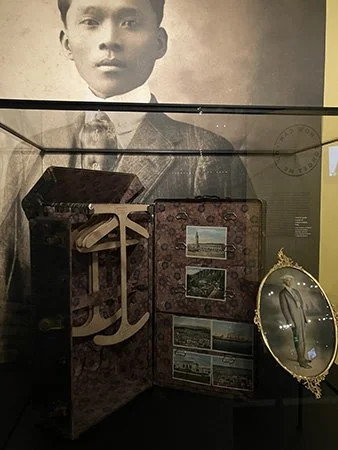
Enrique Andales (Photo by Titchie Carandang)
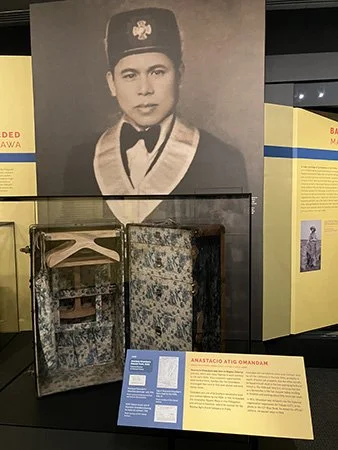
Anastacio Omandam (Photo by Titchie Carandang)
The asparagus knives in Backbreaking Labor. Mahirap Na Paggawa. The displayed tools are lined up like surgical tools. The accompanying photo of Filipino farmworkers bent over the field gives renewed respect for the term “backbreaking labor.” The quote from Erwin Mina, “Every Filipino farmworker owns one of these hoes. They broke the backs of generations of farmworkers,” tell a harsher story: bent backs under punishing sun, repetitive labor, and racial hostility. This is in direct contrast with the startlingly large photographs (nine feet in height) of the manongs dressed in elegant suits and sexy swimwear projecting dignity, masculinity, and aspiration.
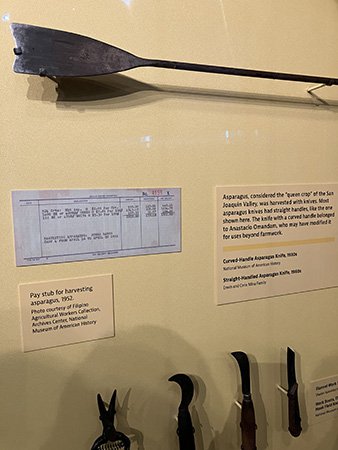
Asparagus Knives (Photo by Titchie Carandang)
The presence of women. Pillars of Litle Manila broadens the narrative beyond male laborers, the exhibition highlights the role of women in sustaining community life, even though fewer objects survive to tell their stories. Barbara Nambatac, whose photographs and intricate white lace gown are on display, joined the contest to raise money for the Stockton Legionarios del Trabajo. There is also an interesting photograph of a woman laborer wearing high heels that makes one wonder how she survived the day picking produce. Mangahas also points out that a photo of Concepcion Ruiz Sepe Lagura, a female member of Legionarios del Trabajo was used to explain the significance of the lodge.
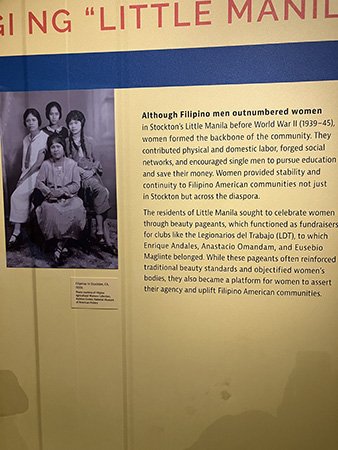
Pillars of Little Manila (Photo by Titchie Carandang)
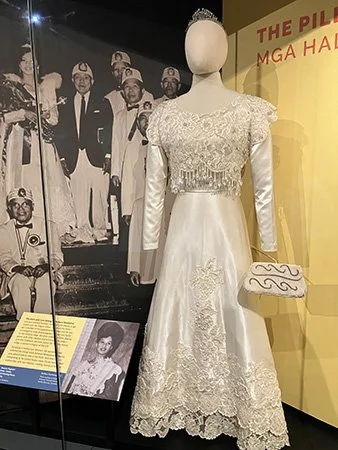
Barbara Nambatac’s wedding dress (Photo by Titchie Carandang)
Leisure and community life. Glimpses of the community enjoying leisure pursuits such as - swimming, boxing, social dances and fraternal gatherings that are highlighted throughout the gallery. This shows that these men were not merely laborers; they were brothers, dreamers, intellectuals, and romantics.
Fighting for their Rights. Personal effects of labor leader Larry Itliong anchor this section. Alongside fellow organizers Philip Vera Cruz and Peter Velasco, Itliong helped lead the Delano grape strike in 1965, and were inducted to the U.S. Department of Labor’s Hall of Honor in 2024. Together with Cesar Chavez, they fought for farmworkers’ rights, challenging exploitative wages and unsafe conditions. Their presence underscores how Filipino Americans were central to the labor movement, not peripheral to it.
The wall of distance and longing. The map illustrates the physical distance between the United States and the Philippines, and the travel paths of Pablo Solomon, Enrique Andales and Eusebio Maglinte. The embroidered pillowcase with the exhibition’s title, How Can You Forget Me. The interactive panels invite a closer look, my teenager lingered at the interactive displays, lifting panels to uncover hidden stories.
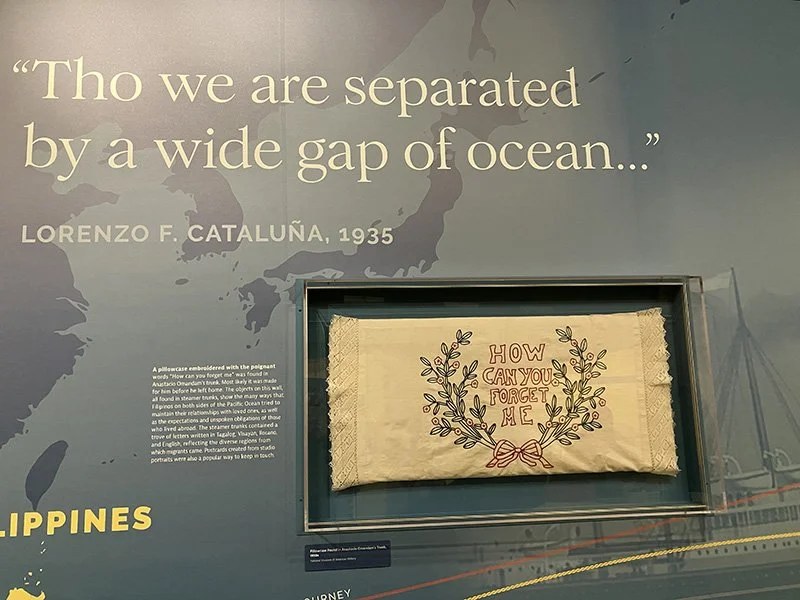
The “How Can You Forget Me” embroidered pillow case (Photo by Titchie Carandang)
Interactive Media Kiosk
We also enjoyed exploring the different stories from the interactive media kiosk. We hope that this will be included in the online experience of the exhibit in the future.
Breaking Stereotypes
When Vong examined the artifacts, he discovered that it dismantles the stereotype of the uneducated migrant laborer. Letters written in elegant cursive, college enrollment materials, and even books on palmistry reveal intellectual curiosity and ambition. Though not part of the exhibit, Filipino war heroine Maria Orosa worked in Alaska and picked fruit while she was a student at the University of Washington. Writer Carlos Bulosan was a laborer and was active in the labor movement.
How Can You Forget Me: Filipino American Stories tells a familiar yet deeply personal story of a people seeking a better life thousands of miles from home.
These artifacts situate Filipino Americans within major moments of U.S. history—World War I, the 1918 influenza pandemic, the Great Depression, and the fight for women’s suffrage and the Philippines’ campaign for independence.
A Question
At the opening reception of the exhibit, Little Manila Rising chair and co-founder Dillon Delvo posed a question about the title of the exhibit, drawn from the embroidered pillowcase: What does How Can You Forget Me mean? Delvo listed the possible answers—a question, a statement, an indictment, a responsibility, a debt, or a goal—and probed deeper, asking whether it is directed at a loved one, a generation, a museum official, or a legislator. The romantic in us imagines a sweetheart left behind, translating the heartrending Tagalog words between separated lovers: Paano mo ako malilimutan?
Perhaps it is all of these.
The exhibition reminds us that the manongs were never merely statistics in immigration records or footnotes in labor history. They lived full, complicated lives. They endured discrimination yet built a community. They bent beneath fieldwork yet stood tall in tailored suits.
“How can you forget me?” is not only a romantic refrain—it is a challenge to remember the lives of each immigrant who left their home to build a better life here in the United States..
Postscript
Dr. James Sobredo wrote an in-depth article about the exhibit in an article he wrote for Rappler. He is also working with the Commission on Filipinos Overseas (CFO) to trace the living relatives of the owners of the trunks. In his Bridges on Air interview, he mentioned that he has found leads to the living relatives of the following men: Pablo Solomon (Bataan), Eusebio Maglinte (Bohol), Enrique Andales (Cebu), Anastasia Omandam (Negros Oriental). He is also documenting opening two trunks that are with FAHNS Stockton.
The writer is grateful to Yao-Fen You, Sam Vong, Rick Lee, Ethan Johanson, and Elena Mangahas for their help with the article.
Exhibition Details
How Can You Forget Me: Filipino American Stories
Smithsonian’s National Museum of History|2 West| Nicholas F. and EugeniaTaubman Gallery | Open Daily 10:00 a.m. - 5:30 p.m. |Free admission |Ends November 28, 2027|Email APAC-Eucation@si.edu to book a tour for students/community members/professional group
Exhibition Overview here.
Visual Description here.
Selected Resources
Learn about the owners of the steamer trunks and more in the Filipino Agricultural Workers Collection, Archives Center, National Museum of American History
How Can You Forget Me: Artifacts of Early Immigrant Life by Sam Vong
Landmark Filipino American exhibit opens at Smithsonian Museum by James Sobredo
Filipino men's fashion: Farmworkers in three-piece suits by Ethan Johanson

Titchie Carandang is a freelance writer. Her articles have been published in the White House Quarterly, Northern Virginia Magazine, Metro Style, Connection Newspapers and other publications. She is the co-founder and was co-director of the Philippines on the Potomac Project (POPDC), where she researched Philippine American history in Washington, D.C. She has received awards from the Philippine American Press Club, the Mama Sita Foundation, and the Doreen Gamboa Fernandez Food Writing Award for her writing.
More articles from Titchie Carandang
