
House of Stone Keeps Past Alive in Modern Iloilo
/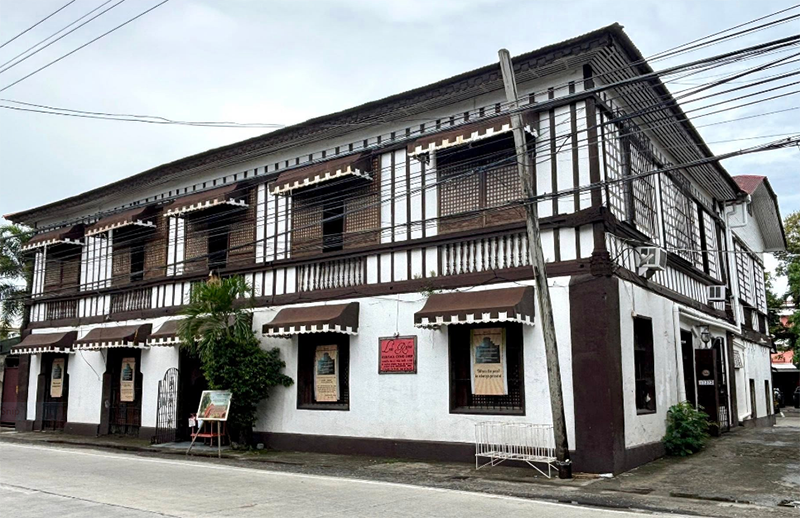
Arevalo's Balay nga Bato.
On that journey Rizal was just a traveler, noticing things a traveler does. Thus on August 4, when his ship docked for a stopover at Loney Wharf (Muelle Loney) in Iloilo, he wrote in his journal: “The entrance to Iloilo is beautiful; it looks like a white city on the water.” He went on to describe Iloilo as “(a) nymph of galvanized iron, a modern creation.”
A ‘White City Set on Water’
Flying over Iloilo City these days, one will see, like Rizal, a “white city set on water” and a “modern creation,” yes, but instead of galvanized iron, a city of concrete-and-glass buildings–from gleaming corporate hubs and high-rise residences to shopping malls and a convention center whose roof design mimics dancing warriors and flowing waves. Wide avenues link different parts of the city, from the older Calle Real to the SM City and Plazuela complexes, and the spanking new Megaworld. The Esplanade, a nine-kilometer walkway, cuts a white swath along a river that has been cleaned and revitalized, and the brand new Sunset Boulevard is four kilometers of a scenic riverside drive to the north.
Visitors to Iloilo are invariably impressed, and Ilonggos are justifiably proud. But among longtime residents there is the persistent and often unspoken thought: “How long before our city becomes totally unrecognizable?”
Happily for anxious Cassandras, there are parts of Iloilo that hold on, stubbornly, to its past. One place holding on carefully and lovingly to Iloilo’s bygone days is found in Arevalo, a district known as the city’s flower capital because of its many gardens and a plaza with flowers in abundance. Only about 5 to 10 minutes from the plaza, the Camina family’s Balay nga Bato, or Stone House, on 20 Osmena Street, stands as a 161-year old witness to the changing times and fortunes of Iloilo.
A Witness to History
Father Anselmo Avanceña designed the Balay nga Bato for his brother Fernando and Fernando’s wife, Eulalia Abaja, in 1860. Construction was completed in 1865. The house was built in the twilight years of the Spanish Empire in the Philippines, but at a time of rapid expansion for Iloilo with the opening of its port to international shipping in 1855. The city’s prosperity and its coastal location made it vulnerable to raids and plunder by sea pirates, and so the wealthy families of the city fortified themselves in houses made of plaster and stone. Hence, Balay nga Bato.
The house’s shining narra floors and the 24 hardwood pillars supporting the structure are from a time when wood was abundant and the preferred material for the interiors of houses. Wide windows at the front of the house with capiz shell panels were ideal not just for ventilation, but also allowed occupants to watch, during the Lenten season, elaborate carrozas passing by, bearing religious statues commemorating the passion of Jesus Christ. A deep Catholic faith is also seen in the oratorio, an area with prie dieu, statues of saints, crucifixes, and other religious objects. An azotea, or balcony, at the back of the house, was for courtship practices far different from today’s.
Most of the objects and furniture in the house are from the Spanish times, but porcelain plates and jars of different sizes are remnants of trade with Chinese merchants in the 1800s. Clay bowls and pots date back to pre-Hispanic times. A gramophone in one corner and an antique Singer sewing machine in another bring us to the American period in the early 1900s. Foot-powered wooden hand looms in the almacen, the ground floor storage area common to all balay nga bato, are a testament to Iloilo’s flourishing weaving industry that collapsed with the opening of the port and the introduction of cheap factory-made fabrics brought in by European merchants.
Repurposing a Historic Structure
Gerard and Luth Camina– the former Ma. Luisa Miniviluz Saludes of Jaro–are the fourth generation of the Avanceña-Camina family to be stewards of the house. Where some members of the family saw the house and its contents as a burden to be managed, Luth and Gerard saw only opportunity. Luth, especially, envisioned inviting the public to see and admire the contents and history of the house. Which is precisely what they did in 2010.
Ma.Luisa Saludes Camina (Luth), owner of Balay with husband Gerard.
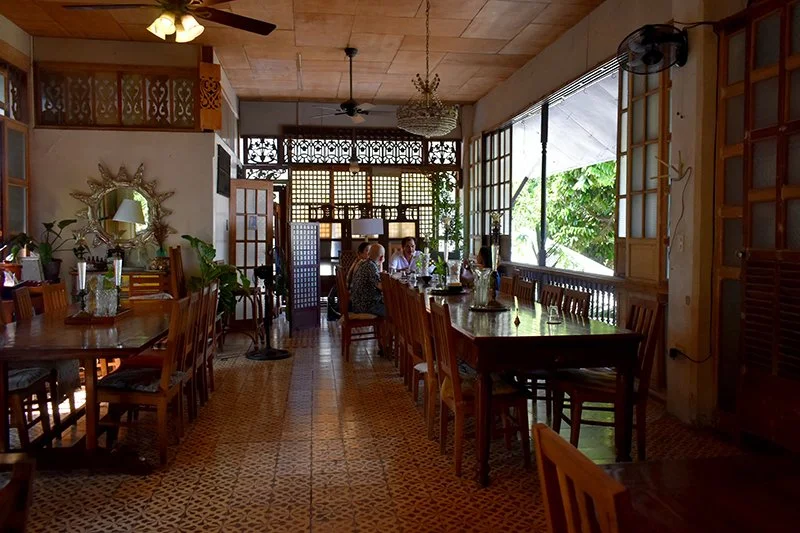
Since then, diverse groups of people have streamed into the house, enjoying its antiques collection and furniture from bygone days, soaking in the ambience of times past. Visitors are welcomed with a cup of tablea (chocolate made from pastilles that the Spaniards introduced to the Filipino diet, papaya juice, and on occasion, Spanish-inspired feasts laid out on long tables overlooking the azotea. A serving of pancit molo, a savory soup with pork-filled dumplings that is a beloved Iloilo specialty, is a nod to the Chinese.
Gourmands come to Balay nga Bato wanting to savor its by now well-known food offerings, dishes made using local products and traditional recipes. Students come for lessons in Iloilo’s–and indeed, the Philippines’– past. Researchers come to examine the house’s treasures. It is a popular venue for weddings and anniversaries and even conferences. Visitors from other provinces come to get lessons in cultural preservation. In 2015, recognizing its value to the community and its popularity, the National Museum of the Philippines declared the house an important cultural property.
Preserving Traditional Crafts
Today, craftsmen and women from the community keep alive the weaving tradition, making hablon and patadyong, textiles with designs unique to Iloilo. In spotlessly clean and well-ventilated rooms, workers make tablea using traditional methods. The tablea has won several awards from the Philippine Department of Trade and Industry. Wooden shelves in the almacen display slippers and bags made from abaca fiber, and the artisan tultul salt from Guimaras is found alongside rich, dark muscovado sugar from other parts of Panay. Bottles of sinamak–coconut vinegar infused with garlic, chilies, ginger, and other aromatics– make the mouth water. The stainless steel pitchers used for mixing tablea are on offer, together with the batidor, a stirring rod made from guava wood that is said to improve the taste of the drink. There are jams made from fruits not typically used for this purpose: banana chips, cashews, and other agricultural products.
Most of the objects and furniture in the house are from the Spanish times, but porcelain plates and jars of different sizes are remnants of trade with Chinese merchants in the 1800s.
Many of the products come from the Caminas’ farmland in Guimaras. Instead of detracting from the care of the house, Luth and Gerard’s venture into agriculture feels like a natural offshoot of their work in cultural preservation. Where they protect a house and a city’s history at the Balay, their Spring Bloom Agrifarm in Sibunag protects native tree species like calamansi, cashew, pomelo, camagong, banaba, and batuan, apart from coffee and cacao. The Balay nga Bato is a way of showcasing the abundant yields of the farm.
Keeping Iloilo’s Past Alive
Both Caminas have degrees in business and have had stints in the banking industry, but the work they do at the farm and the Balay is driven not just by a business sense but by passion and a love for their native city. “We have only just awakened to the fact that we are a heritage city, a city with a unique history that is work preserving,” notes Luth. They will eventually pass stewardship of the property to their children, whom they hope will continue the work of keeping Iloilo’s past alive. In the meantime, they continue to explore new ways of making the house even more relevant and accessible.
It was also Rizal who said: "In order to read the destiny of a people, it is necessary to open the book that tells of her past." With Iloilo marching forward briskly on the path of progress, city planners would do well to glean lessons the house has to give. The house illustrates how a city integrated new tools, customs, and industries into daily life during a period of profound political and economic change—retaining what was most essential, pleasing, and functional while celebrating the skills and artistry of its people.
Gourmands come to Balay nga Bato wanting to savor its by now well-known food offerings, dishes made using local products and traditional recipes.
There is much to learn from the values, designs, and craftsmanship embodied in the house, as well as from the sensibilities, aspirations, and strengths of earlier generations, which embraced the shiny new toys and materials of a new era without losing sight of enduring principles.
Stretched out on one of the wicker chairs in the living room of Balay nga Bato, one can almost imagine the clip-clop of calesas along the street outside, carrying people to church or on leisurely afternoon strolls to the plaza. One can almost hear the shouts of boatmen docking at the rear of the house, bearing news of the latest arrivals at the port and unloading textiles destined for nearby storehouses. In the kitchen, housemaids in flowing sayas prepare a meal, using chopping boards hewn from tree trunks. The rhythmic clack of rosary beads and the murmur of voices drift from the oratorio after the church bells toll the Angelus at six o'clock. And on the grand staircase at the entrance, the swish of gowns and the tap of canes announce the arrival of guests, come to partake of the hospitality of Balay nga Bato.
The Balay nga Bato is located at 20 Osmena St., Arevalo, Iloilo and Luth Camina may be reached at saintteresa20@yahoo.com.

Marilynn (Meyen) Quigley is a poet and writer based in Victoria, British Columbia, Canada. She is a graduate of the University of the Philippines in Iloilo City (now the University of the Philippines in the Visayas) and was one of the editors of “Graciano’s Dirty Fingers,” together with Maria Luisa Mabunay and Francisco G. Villanueva.
More articles from Meyen Quigley
