

Fil-Ams and the NFL: From Roman Gabriel to Super Bowl-Winning Jason Myers
/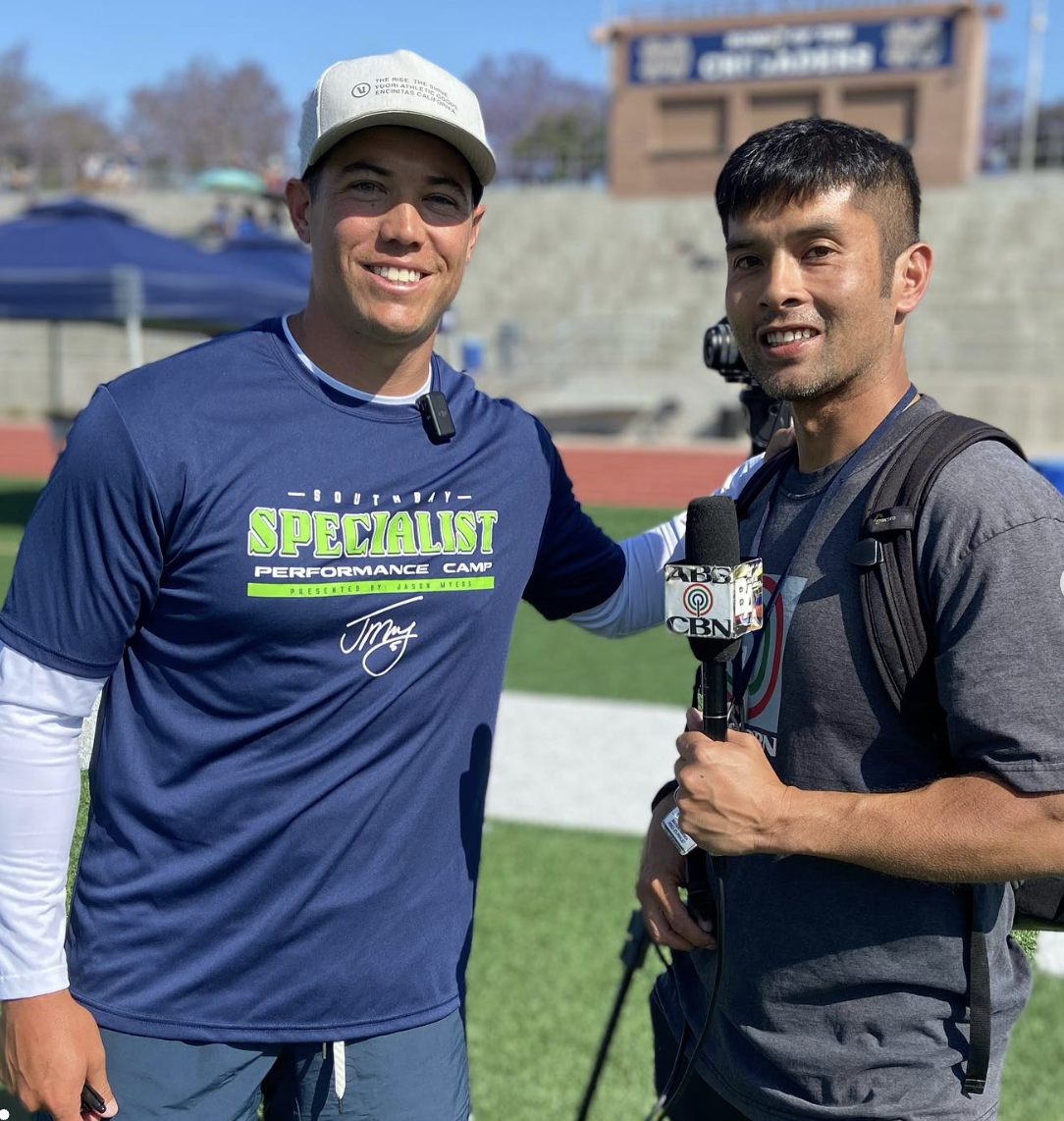
Seattle Seahawks kicker Jason Myers with reporter Steve Angeles in 2023 (Photo courtesy of Steve Angeles)
In a contest dominated by defense and field position, Myers’ accuracy from multiple distances stabilized Seattle’s offense and created insurmountable pressure for New England. Though Seahawks running back Kenneth Walker III was named Super Bowl Most Valuable Player for his rushing performance, Myers’ contribution was central to the outcome and represents one of the rare instances in which a kicker decisively shaped a Super Bowl result.
Myers’ Filipino heritage is traced through his paternal lineage; his great-grandfather was Filipino, a fact Myers has acknowledged publicly when discussing his family background. While his ancestry is more distant than that of some earlier players, the historical weight of his achievement lies in the visibility and decisiveness of his role. In a league where Filipino American representation has remained numerically small, Myers’ Super Bowl performance stands as a contemporary milestone, linking modern success to a longer lineage of Filipino American participation in professional football.
That lineage begins most prominently with Roman Ildonzo Gabriel Jr., whose career remains the foundational narrative for Filipino American identity in the NFL. Born on August 5, 1940, in Wilmington, North Carolina, Gabriel was the son of Roman Ildonzo Gabriel Sr., a Filipino immigrant, and Edna Mae Wyatt, his Irish American mother. Growing up in the segregated South, Gabriel faced both racial and cultural marginalization, experiences that shaped his resolve and public demeanor. Despite childhood asthma and modest means, he developed into a dominant quarterback, excelling at North Carolina State University, where he earned All-American honors and established school records that stood for decades.
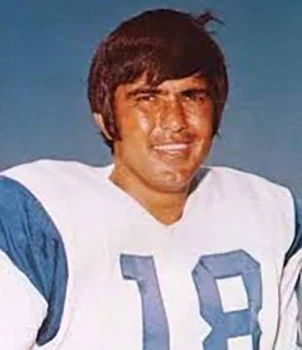
LA Rams’ Roman Gabriel (Source: Facebook)
Gabriel was selected second overall in the 1962 NFL Draft by the Los Angeles Rams, entering a league in which quarterbacks were overwhelmingly white and Asian American visibility was virtually nonexistent. Over eleven seasons with the Rams and five additional seasons with the Philadelphia Eagles, Gabriel became one of the NFL’s premier passers of the late 1960s and early 1970s. His strongest season came in 1969, when he led the league in passing yards and touchdowns and was voted NFL Most Valuable Player. That award made Gabriel the first Filipino American—and remains the only Asian American quarterback—to receive the league’s highest individual honor. His success at the game’s most scrutinized leadership position challenged prevailing assumptions about race, authority, and athletic intelligence in professional football.
For Filipino Americans, Gabriel’s significance extended far beyond statistics. At a time when Asian Americans were often rendered invisible or stereotyped in American popular culture, Gabriel’s prominence offered a rare and powerful counterexample. He did not publicly foreground his Filipino identity during his playing years, a reflection of the era’s pressures toward assimilation, yet his heritage has since been embraced as a cornerstone of Filipino American sports history. In retrospect, Gabriel’s career established the possibility of Filipino American excellence in a sport that would remain resistant to Asian representation for decades.
The next major Filipino American figure to leave a sustained mark on the NFL was Tedy Bruschi, born June 9, 1973, in San Francisco, California, to a Filipino mother and an Italian American father. Bruschi starred collegiately at the University of Arizona, where he was recognized for both athletic performance and academic achievement. Drafted by the New England Patriots in the third round of the 1996 NFL Draft, Bruschi became the intellectual and emotional anchor of one of the most successful defensive units in league history.
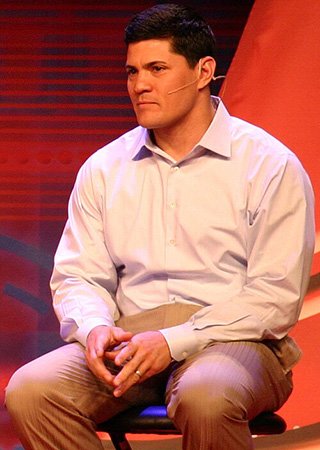
New England Patriots’ Tedi Bruschi (Source: Wikipedia)
Over a 12-year career spent entirely with the Patriots, Bruschi won three Super Bowl championships and earned Pro Bowl honors in 2004. His reputation rested not on speed or size alone but on preparation, positioning, and leadership—qualities that made him a prototype for the modern inside linebacker. In 2005, Bruschi suffered a stroke that threatened to end his career, yet he returned to play the following season, reinforcing his standing as one of the league’s most respected veterans. For Filipino American fans, Bruschi’s visibility as a defensive leader on a dynasty team represented a continuation of Gabriel’s legacy, translated into a new era and a different positional role.
Doug Baldwin, Jr. represents another significant chapter in this narrative. Born on September 21, 1988, Baldwin is of Filipino descent through his maternal grandmother. Undrafted out of Stanford University in 2011, Baldwin signed with the Seattle Seahawks and steadily developed into one of the league’s most reliable wide receivers. Between 2011 and 2018, he recorded multiple 1,000-yard seasons, earned two Pro Bowl selections, and played a central role in Seattle’s Super Bowl XLVIII championship. Baldwin’s career exemplified the capacity of Filipino-heritage athletes to excel at skill positions traditionally dominated by other demographic groups, further expanding the representational landscape.
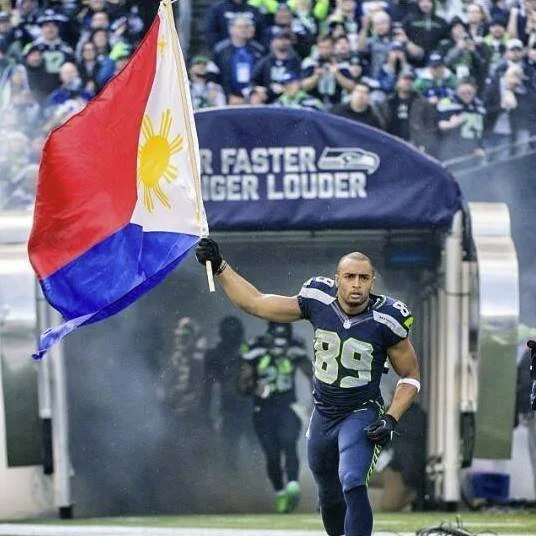
Seattle Seahawks’ Doug Baldwin, Jr. (Source: Facebook)
Eugene Philip Amano’s career stands apart for both its durability and its origins. Born on March 1, 1982, in Manila, Philippines, Amano immigrated to the United States as an infant and grew up in California. After playing college football at Southeast Missouri State University, he was selected by the Tennessee Titans in the seventh round of the 2004 NFL Draft. Amano spent nine seasons in the league, appearing in 124 games and starting 68 as both guard and center. He is widely regarded as the only Filipino-born player to have enjoyed a sustained NFL career, and his longevity at one of football’s most physically demanding positions carries particular symbolic weight for Filipino American narratives of labor, endurance, and professional legitimacy.
Myers’s contribution was central to the outcome and represents one of the rare instances in which a kicker decisively shaped a Super Bowl result.
In the contemporary NFL, Camryn Bynum represents the most visible continuation of this tradition. Born on July 19, 1998, in Corona, California, Bynum traces his Filipino heritage through his mother’s family, with ancestral roots in the Philippines. Drafted in the fourth round of the 2021 NFL Draft, Bynum has developed into a consistent starting safety and defensive leader, compiling significant tackle and interception totals while anchoring secondaries in the modern pass-heavy NFL. Unlike earlier generations, Bynum has publicly embraced and promoted his Filipino identity, engaging in outreach efforts that connect American football with Filipino youth communities both in the United States and abroad.
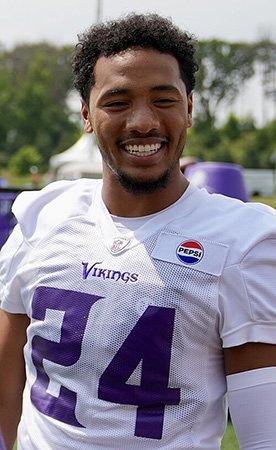
Minnesota Vikings’ Camryn Bynum (Source: Wikipedia)
Taken together, these careers form a coherent historical arc. From Roman Gabriel’s breakthrough at quarterback, through Bruschi’s leadership on defense, Baldwin’s excellence at wide receiver, Amano’s endurance in the trenches, and Myers’ record-setting Super Bowl performance, Filipino American athletes have contributed meaningfully at every level of professional football. Their stories reflect both continuity and change: continuity in the persistence required to succeed within a historically exclusionary sport, and change in the growing visibility and acknowledgment of Filipino heritage in American athletic culture. Jason Myers’ performance in Super Bowl LX thus stands not merely as an isolated achievement but as the latest affirmation of a lineage that began more than sixty years earlier and continues to redefine the boundaries of representation in the National Football League.
Other Key Filipino American NFL Players (Current & Recent)
Zaire Barnes (Linebacker, NY Jets/Giants)
Tariq Castro-Fields (Cornerback, Philadelphia Eagles/Carolina Panthers)
Dillon Gabriel (Quarterback, Cleveland Browns)
Andrei Iosivas (Wide Receiver, Cincinnati Bengals)
Josh Jacobs (Running Back, Green Bay Packers)
Jordan Norwood (Wide Receiver, Denver Broncos/Cleveland Browns)
Nikko Remigio (Wide Receiver, Kansas City Chiefs)
Johnny Wilson (Wide Receiver, Philadelphia Eagles)
See Lloyd LaCuesta’s video on: Jordan Norwood carrying the ball for Filipinos at the Superbowl.

Alex S. Fabros, Jr. is a retired Philippine American Military History professor.
More articles from Alex Fabros, Jr.
