
Dado Banatao, an Inspiration for Filipinos
/Boyish Charm, Humble Spirit
Regina Manzana Sawhney
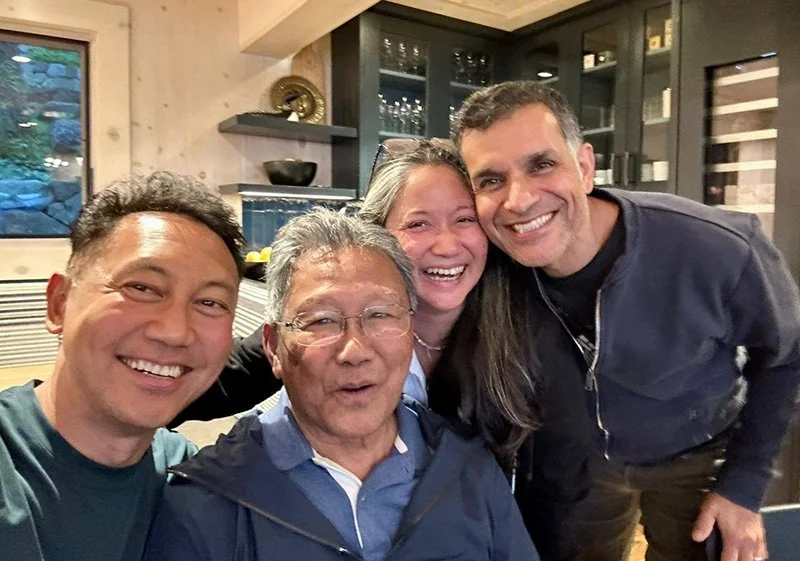
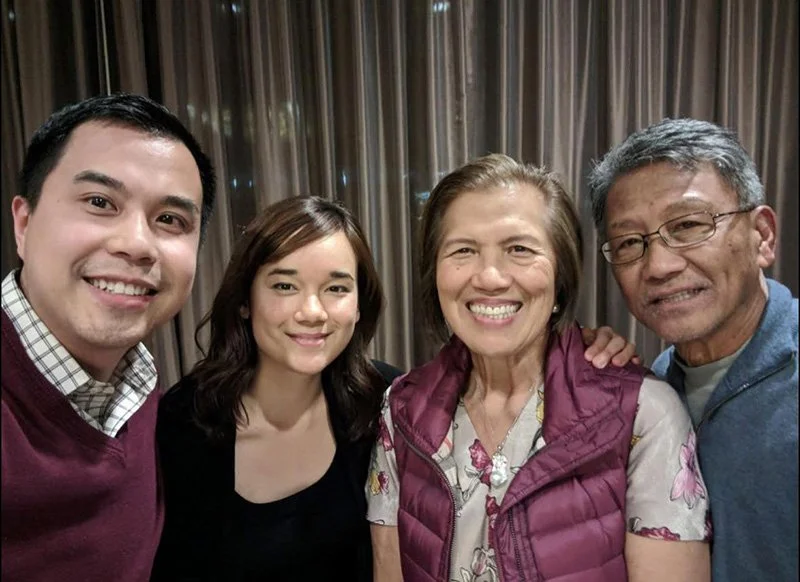
(L-R) Michael Baloing, Dado Banatao, Regina Manzana-Sawhney, and Rohit Sawhney (Source: Facebook)
Years ago, as the sun set in Cloverdale and we sipped an exceptional, well-aged glass of Silver Oak, we exchanged stories of how we met our life partners. Suddenly, with an almost boyish charm, we were transported back to the days of him courting the love of his life as he glanced lovingly at Maria, enthusiastically sharing the tale of how she came to be cherished family. As I revisit pictures, I’m reminded of that story when I see that same “damn, I’m so lucky” look in Dado’s eyes—the way he looked at Maria. Seeing him speak of his kids and grandkids, recalling milestones and family trips, there was always that spark of immense pride, joy, and love.
I’m grateful for having been invited over several years to volunteer at the Banatao Scholars Retreat. During one retreat, as college students and guests gathered, I looked for Dado, only to find he was nowhere to be found. He was out back, breaking down boxes and hauling out the trash. When I offered to take over and encouraged him to return to the group, he insisted—somehow—that the kids would rather have time with me and that I let him finish. Immense success can change someone’s values, make them feel entitled, and cause them to forget where they came from. Not Dado. His character and humility persisted through prosperity. At times, he spoke of the struggle: working tirelessly through school and later sacrificing countless hours to bring innovation to life. I recently revisited a video from a scholars’ retreat where he shared lessons learned with the college students. There, he spoke with a quiet conviction that drew me in—about how, while he was in school, the Jesuits instilled a pursuit of academics and grit, but always with soul—something he hoped the scholars would carry forward, as he did, well beyond their college years.
Year after year, when students, mentors, and alumni gathered for the Banatao Scholar weekend retreats, we experienced a taste of Dado’s journey. Many students shared how they were the first in their families to go to college or to pursue STEM. How they felt alone—being the first, the only, or misunderstood in their chosen paths. How they may not have been able to pursue STEM without what the family scholarship enabled. Their culture, academic excellence, and shared ideas brought them together. Over a single weekend, scholar alumni created experiences that fostered teamwork, and groups worked tirelessly to master the pitch. Dado listened intently to their presentations. Mentors and volunteers often remarked on how we took away so much more than we gave. At the end of the weekend, graduating seniors reflected on how the scholarship program gave them the priceless gift of connection to their culture, a supportive, family-like community, and the ability to pursue their academic—and later professional—dreams. In their stories, you could feel the power of Dado’s legacy. From the Banatao Family Scholarship to PhilDev, he brought mentors, scholars, and alumni together—and through their work and the collective impact made, his story continues to be our story.
Beyond these moments, I’ll never forget the look he gave me last year at a family celebration when he saw me and flashed that “I’m so happy you’re here” smile. He surprised Rohit and me by literally lifting me up and giving me the biggest hug. Today, through tears, as I remember a dear friend I’ll never forget, I hold on to the memory of that hug and know that the many influenced by Dado’s magic will uplift generations to come.
From the author’s Facebook page
Never Too Big for Little Things
Apl.de.Ap
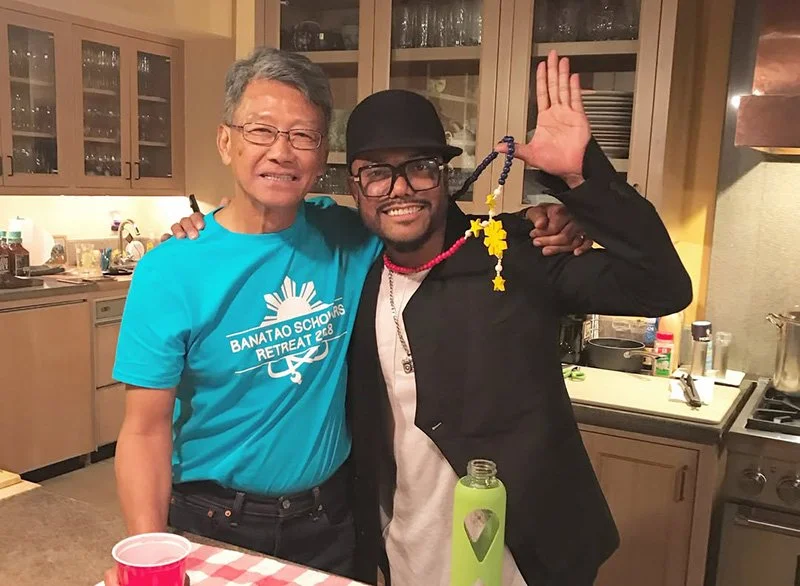
Dado Banatao and Apl.de.Ap (Source: facebook)
I was fortunate to meet Dado many times over the years. He was always generous with his time and wisdom, willing to answer whatever random question I had. Through him, I learned the power of building community as a way to shape the future we want.
Dado co-founded S3. He helped launch countless Filipino startups and entrepreneurs, contributing to the growth of our nation in ways we may never fully be able to measure.
But the moment I’ll remember most comes from the weekend this photo was taken. He was hosting scholars at his home in Sonoma and invited my team and me to observe and judge. There was incredible food, great wine, and even better conversation. It was a perfect weekend.
We got so caught up in the judging that we nearly missed our flight home. In the rush to say goodbye, I looked everywhere for Dado but couldn’t find him. As I walked toward the car, I finally saw him—standing quietly beside the recycling bins, breaking down boxes.
No matter how big you become, never be too big to do the little things.
Rest in power.
From the author’s social media post
A Generous Icon
Mona Lisa Yuchengco
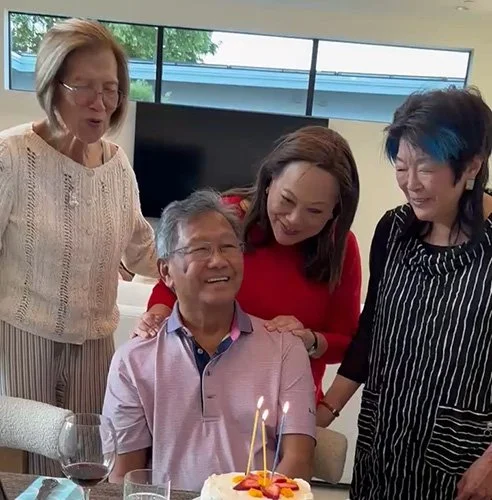
(L-R) Maria Banatao, Dado Banatao, Lisa Yuchengco, and Gail Kong
In 1996, the Manilatown Heritage Foundation was formed to build a community center on the ground floor of the former I-Hotel site, where Filipinos could gather to keep the legacy alive and where the community could come together for artistic, educational, and other events. Halfway through construction, the project ran out of money. I approached Dado and Maria Banatao for assistance and introduced them to Emil de Guzman, who was the executive director at the time. Dado asked to meet with the architect and contractor to review the plans. A week later, the Banataos approved funding of $150,000, to be matched by community donations. We quickly worked to raise the other half, and the center was completed. Without the Banataos’ initial boost, it would have taken us much longer to raise the money.
In another instance in the 1990s, while serving as a board member of the Asian Pacific Fund, I asked Dado and Maria if they would be willing to start a scholarship program for Filipino American youth entering college, as none existed at the time. Without hesitation, they agreed to provide four-year scholarships for students pursuing degrees in science, technology, engineering, and medicine. It is the largest scholarship program for Filipino Americans in the United States, and many of its students are not only gainfully employed but also serve as mentors to incoming scholars. Hundreds of Filipino American students have benefited from the program, which continues to this day. To date, PhilDev, the foundation they started, has supported 320 scholars, 100 innovators, and 220 start-ups.
I was in such awe of the man that I nominated him for every award I could, beginning with the Filipinas Magazine Achievement Award and continuing through other organizations with which I was involved—the Asian Pacific Fund, Asian Business League, Leadership for Asian Pacifics, Inc. (LEAP), and the Center for the Pacific Rim at the University of San Francisco. Of course, he also received recognition from mainstream institutions, including the Ernst & Young Entrepreneur of the Year Award and the Ellis Island Medal of Honor, to name a few—but he never bragged about any of it. The last award he received was the Manong Tribute earlier this year from Positively Filipino, in celebration of those whose lifelong work continues to enhance the Filipino American community and other communities at large, and who are leaving legacies for us to learn from, value, and treasure during our lifetimes. Although Dado had been suffering from Alzheimer’s for several years, he attended the event and willingly posed for photos.
For the past twenty-some years, I have treated Dado and Maria on their birthdays. During these moments, we shared stories about our children and grandchildren, our concerns and apprehensions, and our victories and successes. Dado believed that every Filipino could rise to their true potential, and he provided the boost to make that journey easier—just as he did for us at the Manilatown center. From the son of a rice farmer in Cagayan to the boardrooms of Silicon Valley, Dado touched and changed lives, including mine, through generosity and kindness passed forward.
I will miss you, my friend. Thank you for being an icon for so many of us to emulate.
Without hesitation, they agreed to provide four-year scholarships for students pursuing degrees in science, technology, engineering, and medicine.
Thanks, Dado, We Got It from Here
Oliver Segovia
Oliver Segovia (left), Maria Banatao (second from RIght), Dado Banatao (right) (Source: Facebook)
Though national conversations in the Philippines this season revolve around flood-control scandals and the 2026 budget, I wish we could pause to reflect not just on Dado Banatao’s life, but also on his ideas and beliefs.
I first read about Dado as a management engineering junior at Ateneo. The dot-com bust was in the rearview mirror, and a new generation of products like the iPod, PayPal, and Friendster was taking the field. But there was no clear entry point into a technology career in the Philippines.
The top hirers were banks, consumer goods companies, and a trickle of consulting firms. The BPO industry was—and still probably is—relegated to the outer edges of the low-margin back-office and customer-support supply chain.
More than two decades ago, Dado was already sounding the alarm: the Philippines was far behind in R&D and engineering, and this gap would only widen.
Dado’s belief in research-led development helped inspire the Ateneo Student Business Review, a publication I co-founded in college. Our mission was to shape a culture of research and innovation in the Ateneo community. I fondly remember the articles we assembled for that maiden issue: how to make Jollibee a global brand, using the internet for education, and the role of private technologies in defense. More than twenty years later, the ASBR is still around, and the themes from those early articles continue to resonate.
I finally met Dado at PhilDev’s entrepreneurship bootcamp in Cebu in the early 2010s. I was struggling with the pressures of founder life back then, having gone almost broke twice. I felt an enormous rush of impostor syndrome. Here I was, meeting the man I admired—who had inspired me to walk this path—yet never feeling truly worthy of even having a conversation with him.
But that week in Cebu was exactly what I needed. It was a refreshing break from my bubble, and a fulfilling week spent mentoring university students on getting started in tech. It was an honor to see Dado and his wife, Maria, work their magic.
In those sessions, Dado emphasized the importance of complete mastery of the inner mechanics of the problem you wish to solve.
His anecdotes about “reading the code” to drive chip performance at lower cost using software—while pioneering the fabless semiconductor business model in the 1980s—were masterclasses in themselves, and well worth revisiting if you want to learn more.
What was remarkable about Dado and Maria’s philanthropic work was how strong their personal ties remained to the Philippines. They visited regularly, stayed for extended periods, and met people from so many walks of life. They remained deeply involved with the homeland.
This may seem ordinary to Filipinos, but when was the last time we saw Sergey Brin, Peter Thiel, or Patrick Collison actively supporting and mentoring young scholars in Russia, West Africa, or Ireland? If we define this as a connectedness-to-your-roots metric, Dado stands apart.
Through Dado and Maria, I met the amazing members of the broader PhilDev community—Paco, Michael, Regina, Sheila, Eric, Olivia, and many more. When Jordana and I moved to Silicon Valley, Dado and Maria warmly welcomed us into their home. In a delightful coincidence, it turned out that Maria had been my mother-in-law’s teacher at St. Paul many decades ago. Some of our son’s first books were gifts from Maria.
Dado once joked that of all his investments, real estate had the best risk-adjusted return. I told him he didn’t need to convince me—my developer father had been drilling that into my head since I was young. He appreciated that my father, like him, had also started out in a province. It was a joy seeing Maria reconnect with my mother-in-law, and watching Dado meet my father and father-in-law during my son’s baptism celebration.
When I decided to step back from full-time work earlier this year to invest in and research startup ideas, one opportunity that emerged was helping deepen people-to-people ties between the Philippines and Silicon Valley. Jordana and I wanted to blend our experiences as students in exchange programs with the cross-pollination of ideas that happens in tech.
Maria, Olivia, and Regina were immediately supportive, and together we organized the Philippine AI Retreat and the US–Philippines AI Summit at Stanford. Dado and Maria welcomed a new generation of Filipino AI builders and researchers into their home for dinner on a pleasant summer night in June.
One of the most memorable highlights of the year was when Tita Lisa Yuchengco invited me to introduce Dado at this year’s Manong and Manangs Tribute at the San Francisco Public Library. It was a touching tribute to a lifetime of service, and it was wonderful to see Dado and Maria receive the appreciation and gratitude of the Filipino American community.
Dado strongly believed that the only way to lift Filipinos out of poverty is by building innovative, engineering-led products that are sold in global markets. To do this, education must focus on science and engineering.
The answer to the Philippine economic conundrum is STEM-led innovation that raises productivity and competes in free and open markets. It’s not the government, not the billions in remittances, not the BPO industry, and not more real estate companies. It’s only through technology-driven products the world wants to buy. This is Y Combinator meeting the developmental state.
Dado never wavered in this belief. It is perhaps the tragedy of our times that this remains an alien—heretical—idea among the Filipino economic and political elite. So maybe it was fate that Dado passed away on Christmas Day at the dawn of the AI age, so that Filipino families can always remember him.
Dado would want us to keep building and spreading the word. The most enduring way to honor him is to persist in this mission—to prove him right, one breakthrough at a time.
Thank you, Dado. We got it from here.
From the author’s Facebook post
