
Artists Novy Bereber and Ignatius Jones: Not Like Everybody Else
/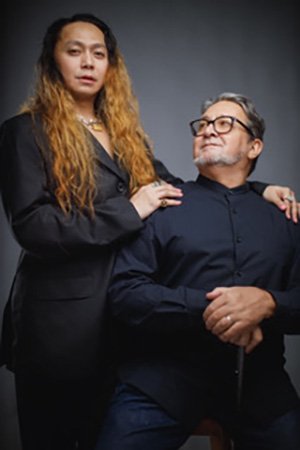
Novy Bereber and Ignatius Jones (Photo courtesy of Maria Carmen Sarmiento)
Jones’ health problems had slowed him down. Although he was 20 years younger than his “Gâ,” short for the Ilonggo palangga, or darling, which was his term of endearment for Nacho Jones, Novy had already stopped dancing on stage. When they decided to make Iloilo their home in 2022, they both wanted to share with Filipinos what they had learned and practiced for world-class audiences.
Jones believed that Iloilo arts and culture could be world-class. As the Sinulog is to Cebu, and the Ati-Atihan is to Aklan, so is the Dinagyang to Iloilo. Toward the end of every January, Iloilo’s Dinagyang Festival draws over a million visitors from all over the Philippines and abroad. Hundreds of thousands of merrymakers throng the streets to watch the varied cultural performances. Jones conceptualized the “Dinagyang ILOmination” (a pun on illumination), the artfully lighted and choreographed Friday evening procession of Ati tribes and floats that marks the start of the culminating Dinagyang weekend. Novy was more often a judge for the performances and served as a creative director and consultant for the Miss Iloilo Pageant, another of the Dinagyang highlights. When it comes to spectacle, more is always more. The Dinagyang has been called the “Queen of Philippine Festivals” and has received numerous awards.
Homecoming of Sorts
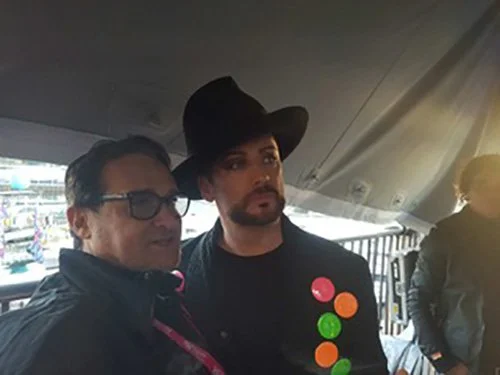
Ignatius Jones and Boy George (Photo courtesy of Maria Carmen Sarmiento)
Coincidentally, returning to the Philippines was also a homecoming of sorts for Ignatius “Nacho” Jones, a.k.a. Juan Ignacio Rafaelo Lorenzo Trapaga y Esteban. Long before he transformed into Ignatius Jones, AM (Order of Australia), which Queen Elizabeth II had awarded him for his contributions to entertainment and literature, he was born in Singalong, Manila, in the late 1950s and had spent his early childhood there. The Trapagas had Basque roots, while on his mother’s Esteban side, Jones was Catalan. Creativity and musicality ran on both sides of the family. The Trapaga grandfather was an orchestra conductor, and his son, the patriarch Nestor Juan, played the violin, conga, and bongo drums. Nacho Jones and his younger sister, Monica Trapaga, would later manifest this musical talent. Their Esteban maternal grandfather was a professional cartoonist and an erstwhile actor, while the grandmother, Mary Case Esteban, had a clothing atelier showcasing her own designs and ran a catering service for state events. Imelda Romualdez Marcos was among her clients.
In 1963, Nestor Trapaga and Margot Esteban left their comfortable life in Manila behind to migrate to Australia with their three young children: Juan Ignacio, Luis Miguel, and Rocio Maria. Nacho grew up in the Sydney suburb of Wahroonga and adopted dual Australian-Spanish citizenship. He excelled in the Classics at his prep school, even competing for top honors with Tony Abbott, who later became the 28th Prime Minister of Australia. Despite his academic proficiency, Jones did not proceed to university but founded Australia’s first “shock rock” band, Jimmy and the Boys, where he was the lead singer and contortionist.
The Australian rock journalist Jenny Hunter-Brown gleefully called them “a high voltage package of filth, glorious filth.” Their songs on Spotify bear the E warning for explicit content, but they were also great fun. The rock music historian Ian McFarlane describes their popular performances as having “mixed S&M trappings, sex shop props, mock rape, and other depravities with sub-Zappaesque humor, hard rock, jazz, reggae and disco.” Jones performed his hit song, Not Like Everybody Else, in a white dinner jacket, which he hilariously stripped away to reveal a studded leather-and-chains BDSM harness. The release of their album of the same title was delayed for being too obscene. On the Donnie Sutherland talk show Sounds After Dark, Jones and the band’s transvestite keyboardist Joylene Thornbird Hairmouth (Billy O’Riordan in real life) deadpanned about forming a political party known as “The Cocktail Party.”
Unstoppable

(L-R) Novy Bereber, director Baz Luhrmann and Ignatius Jones (Photo courtesy of Maria Carmen Sarmiento)
After Jimmy and the Boys disbanded, Jones was unstoppable. He was versatile, to say the least. In a 180-degree turn from the band, he formed a straight vintage jazz trio, Pardon Me Boys, with his younger sister Monica Trapaga (who sang the theme song for the Bananas in Pyjamas children’s show) and directed her children’s music videos. He also acted on stage and screen and co-authored the tongue-in-cheek bestsellers True Hip and The True Hip Manual with Pat Sheill. In the late 1990s, Jones staged The Olympic Journey Begins, featuring roadshows in 27 Australian cities as a lead-up to the 2000 Sydney Olympics. He would go on to direct the Vancouver Winter Olympics and other high-profile events for Sydney. As the director of the 2002 Gay Games Opening Ceremony, Jones declared that “Australia and the gay and lesbian community is not so much a melting pot… We are more of a mixed salad, where every part remains separate, yet adds to the wonder of the whole… I have been lucky; I have never had to come out. I was never in.”
Meanwhile, back in the Philippines, young Noviembre “Novy” Bereber (thus christened because he had been born on November 11) was off to a much rockier start. At the tender age of three, his parents had separated. Little Novy, their only child, was removed from his familiar home in Roxas, Capiz, to be shuttled among his grandparents and his mother’s several sisters in Iloilo City, while his mother became an OFW in the Middle East. His father had left them for his other family. As dearly as his grandmother and his aunts loved him, the sensitive young child acutely felt the loss of the only home he had ever known and the absence of his parents. Sometimes, he would stay with his grandmother in Molo, or with an aunt in Hippodromo, Delgado, or Jaro. He made light of his peripatetic lifestyle, saying, “I was an NPA when I was very young: No Permanent Address.”
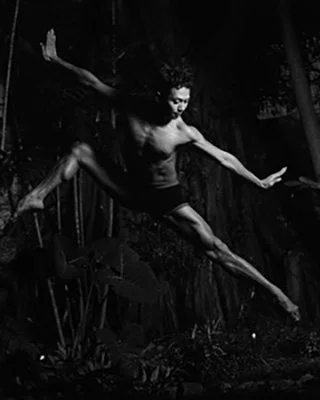
Novy dances (Photo by Jojo Mamangun)
Their family was of modest means, yet they did not begrudge him what they could share. For one of his birthdays, his maternal grandmother, Fay Yap Pacheo, long retired as a public-school teacher, made him a layer cake out of paper because she could not afford to buy him a real one with her meager pension. An aunt who worked in the administration office of SM took him along with her on weekends. She would plunk the fair-skinned, fine-featured little boy on top of her desk, and he would regale her office mates by vivaciously dancing to pop tunes on the radio. He would be rewarded with cash, which he would then use to buy treats in the school canteen to augment his baon. Another aunt made yema candies, which Novy would sell to his classmates. He was well-liked, but it was his gift for dance that would distinguish him even as a child.
Dance Beginnings
In 1989, when Novy was in the third grade, a sympathetic teacher recognized his talent and arranged for him to dance solo before the entire Iloilo Central Elementary School to his own upbeat choreography of Jamie Baby’s Kasi Bata. That was his first taste of performing publicly before a large audience. Novy was with the first batch of the Iloilo National High School Class of Performing Arts, where he joined the Dagyaw Theater Dance Company, founded by Mr. Edwin C. Duero, who was also instrumental in shaping the Dinagyang Festival. It was Duero who added pageantry and distinctive theater to what had previously been perfunctory and repetitive performances by drably authentic Ati tribes, who had descended to Iloilo City upon the City Tourism Office’s invitation. The Dagyaw Theater Dance Company was invited to perform in Europe and the USA for the 1998 World Expo, giving Novy his first exposure on an international stage.
Sadly, his own mother was not proud of his achievements. Instead of appreciating his physical grace and talent, she was shrilly homophobic and would cruelly criticize and deride his effeminacy. Since she had been absent for most of his formative years, she blamed her mother and sisters for making him an agî or baklâ (gay). If not for the mentorship of his teacher Edwin Duero and the steadying influence of his high school bestie, Madeleine Sia Ang, whose stable family welcomed and accepted him, Novy might have succumbed to adolescent angst—or worse.
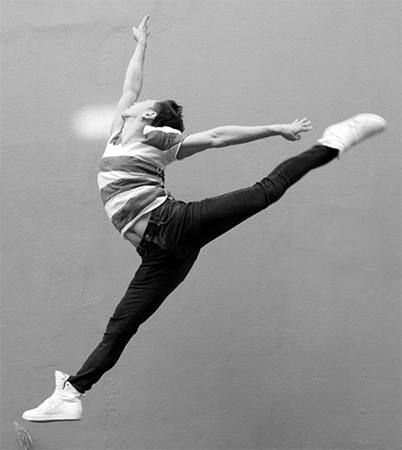
Novy taught a class in sydney back in 2012 (SOurce; Facebook)
After high school, Novy realized that a conventional college degree was not for him. His negligent father had coldly rebuffed all his appeals for support. Boldly, he went to Manila, hoping he might travel to Japan as a “cultural performer.” It was a difficult time, with Novy sharing a tiny room in Pasay with five other struggling young provincianos, one of whom was his cousin. There was no furniture, so they slept side by side on a banig (mat) on the floor and shared a bathroom with others living in similarly cramped quarters in the same decrepit house. Although he had not had any formal dance classes, the recruitment agency he applied with recognized that he was exceptional and hired him to train other “cultural performers.” For each student who passed as a “cultural dancer” for work abroad, he was paid the then-princely sum of P5,000. Being enterprising, he used part of this to buy leotards and dancewear in Divisoria, and Iloilo delicacies, which he would then sell to his students and fellow dancers.
At each stage in his life, Novy believes he has been guided by mentors whom he calls his angels. After Edwin Duero came Osias Barroso, the associate director of Lisa Macuja’s Ballet Manila. Barroso was conducting a workshop for the recruitment agency that Novy was working for. He remembered Novy from Duero’s Dagyaw Theater Dance Troupe. Although Novy had no classical training, Barroso believed he had a place in Ballet Philippines, where the choreographer Agnes Locsin had a modern Filipino dance repertoire. Barroso was right, and Novy became a full scholar of Ballet Philippines in 2000 and was a soloist during workshop recitals.
Another angel, in the form of Ballet Philippines choreographer-director Alden Lugnasin, was then part of Novy’s journey as a dancer. He became a regular member of the dance troupe and was the soloist for the ballet Buhay. Novy’s own choreography, To Whom It May Concern, became part of Ballet Philippines’ repertoire and was one of Margie Moran’s favorites. By 2004, Novy felt confident enough to resign from Ballet Philippines to become a freelance choreographer, doing corporate events. For the opening and closing ceremonies of Cinemalaya in 2005, Chris Millado had Novy do the choreography. It has been this way ever since.
Making It
The year 2005 was also when Novy made it to the international scene in a big way as a principal dancer for the Asian Games in Doha, Qatar. And who would be the event director? Ignatius Jones. During the after-party, Nacho gave Novy his personal card. In the succeeding days, Jones’ chauffeur and car would come calling for Novy. There would be intimate dinners for two in the privacy of Jones’ Doha villa. And so the seeds of romance were planted.
The following year, Novy was back in Manila. He auditioned for the Broadway Asia production of The King and I and was cast as an alternate in the role of Simon Legree. When the production went to Shanghai, Nacho Jones surprised Novy by being in the audience. Afterwards, he came backstage with flowers and invited all the Filipino cast members to a party in his hotel room. That was when Novy realized that Nacho was serious.
Although Ignatius Jones was one of the top event directors in the world, Novy still had to audition just like everyone else for a part in the 2008 Vancouver Winter Olympics. Bereber and Jones may have been romantically involved by then, but their personal lives were separate from their professional careers. To get a permit as a working student in Canada, Novy enrolled in English and Culture at Simon Fraser University in Vancouver, British Columbia.
Novy still paid his own way even when he moved into Jones’ well-appointed apartment in a Sydney heritage building. He did not take part in the vibrant Sydney drag and pageant queen scene but enjoyed hosting dinner parties for their close friends as Poquesia Jones, the glamorous lady of the Jones household.
Novy continued to upgrade his skills. He got certified as a Stott Pilates instructor and taught contemporary dance and modern ballet at the Sydney Dance Company. Despite being a couple with Jones, he maintained his financial independence and even worked part-time as a receptionist at an aesthetics clinic. A high point in his professional career was the reprise of his role as Simon in Sydney’s The King and I, with Lou Diamond Phillips and Jason Scott Lee alternating as the king. Dancing at the Sydney Opera House was a dream come true, and after this, he was ready to stop performing as a solo dancer.
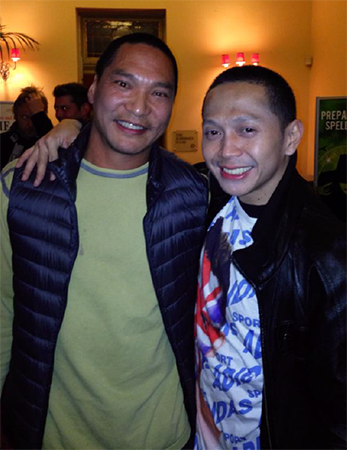
Novy and Jason Scott Lee (Source: Facebook)
Taking the Big Leap
When Australia legalized gay marriage, Novy and Nacho took the big leap on Octobr 12, 2018. They had been living together for over ten years by then. Like any Filipino, Novy wanted to celebrate with his loved ones in Iloilo, so on his 40th birthday in 2019, he and his Gâ affirmed their vows at the Nelly Garden, a neo-colonial mansion built by a member of the Lopez clan in Jaro, Iloilo City. Five years later, Nelly Garden would also be the venue for a rebirth-day party Novy held for his Gâ, who had passed away in 2024 from complications of kidney and liver disease.
Living together had its own highs and lows. With his advancing age and deteriorating health, Gâ became increasingly needy and demanding. Then one day, Novy saw a sign on the Sydney Opera House bulletin board looking for teachers willing to work with Parkinson’s disease (PD) patients. He was intrigued. A paternal aunt had died of this cruel, incurable disease. He signed on, and it changed his entire perspective on his life and career. In an epiphany, he realized how lucky he was to still have the gift of movement and bodily control. He became more patient with his Gâ. He went for further training with Mark Morris’s Dance for Parkinson’s in New York. Dancing helps to slow the progression of the disease and improves PD patients’ posture, coordination, mood, and core strength.
Then came COVID-19, when Novy and Nacho could not travel because of lockdowns. That period became a test for many relationships, but for them, it was more of a second honeymoon. With only each other for company, 24/7, through those pandemic years, their relationship mellowed and matured. Every day was precious. They realized how truly blessed they were.
Novy made it to the international scene in a big way as a principal dancer for the Asian Games in Doha, Qatar. And who would be the event director? Ignatius Jones.
When COVID travel restrictions were lifted, Novy returned to Iloilo with Sayaw PD (Parkinson’s Disease). Holding these free classes of guided movements for the mobility-impaired has become his way of paying it forward and sharing the gift of dance with those who least expect it. Sayaw PD is Novy’s gift not just to Iloilo, but to anyone with an internet connection who cares to join the free classes online. He or a senior teacher leads classes face to face every Wednesday at 11 a.m., Philippine time, at various venues such as the Asilo de Molo, Museo Iloilo, and even LGU multipurpose halls. There are no wrong movements, as the classes aim to bring joy to those living with Parkinson’s disease through chair-based dance sessions. Seniors who also have balance and mobility issues, or patients with other kinds of movement disorders, are likewise welcome to join. Sayaw PD has become his major advocacy, with the taglines: “May sayá sa bawat galaw—may kasama sa bawat sayaw” (There’s joy in every movement—there’s someone with you in every dance).

Love from Novy and Nacho (Photo courtesy of Maria Carmen Sarmiento)
Ignatius Jones returned to Iloilo too; it turned out to be for good. Realizing his end was near, Nacho first made sure that Novy -- the little boy who had once been an NPA (No Permanent Address)—would be home safe. Their portrait hangs in the Bereber Pilates Studio in North Grove, Molo, Iloilo City, which, sadly, Nacho did not live long enough to see. He did get to see the larger Pilates Studio in Anaros Subdivision, Mandurriao, Iloilo City. In his final weeks, tired of suffering while prolonging his life, Nacho defiantly refused to take his meds or undergo drastic medical procedures. “You can fuck me dead,” he had flippantly replied to his nurses’ pleas.
He also made Novy promise to scatter some of his ashes in the Spanish village of Trapaga, where his father’s Basque forbears had come from. This had been on Nacho’s bucket list, and just as he had made sure Novy would return to the land of his birth, he also wanted part of himself to return to his. After all, they were each other’s home.
Maria Carmen Sarmiento is an award winning writer and the former Executive Director of the PAL Foundation. She can be reached at menchusarmiento@gmail.com; menchusarmiento@ymail.com.
More articles from Maria Carmen Sarmiento
