
An Encounter in Florence, Autumn 2025
/In 1571, Spain began transforming the islands into its Asian bulwark. Islam had already been introduced to the archipelago in the 14th century. Like their neighbors, the Islas Felipinas (as they came to be named) maintained trade ties with mainland Asia. Their most important trading partner was China; chieftains from Butuan and Sulu sustained political and economic contacts with both Fujian and Beijing.
The Philippines thus became a vital link between Asia, Latin America, and Europe, as the Manila Galleon Trade would prove. For Spain and the Roman Catholic Church, it also served as fertile ground for missionary conversion to Catholicism.
It is at this complex convergence that the Dominican friar Vittorio Ricci—himself a Florentine and possibly a distant relative of the famous Jesuit Sinophile Matteo Ricci (Macerata, 1552 – Beijing, 1610)—became a subject of interest for the International Studies Institute in Florence, bringing together scholars and participants from multiple institutions. Organized by ISI Florence and the Società di Studi Giuseppe Castiglione, with support from Accademia La Colombaria and Destination Florence, the conference examined the endurance of these historical ties. As ISI Florence director Prof. Stefano U. Baldassarri pointed out in his opening speech, the conference also aimed to highlight the continuing relevance of these early modern networks in fostering intercultural dialogue.
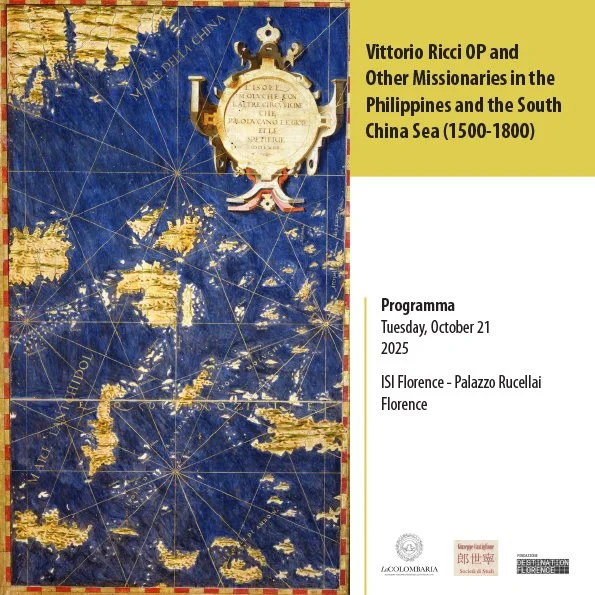
Program for the conference on Vittorio Ricci OP and other Missionaries in the Philippines and South China Sea (1500-1800)
Born in Fiesole (the village perched on a hill just north of Florence), Vittorio Ricci (1621–1685) distinguished himself as a Dominican missionary, scholar, and diplomat in the Philippines and southeast China. Once ordained, Ricci was sent by the renowned Dominican scholar Juan Bautista Morales—an expert on Chinese language and culture—to Rome, where he successfully advocated for the Dominican college in Manila to receive pontifical university status. Founded in 1611, that college eventually became the University of Santo Tomas.
In 1648, Ricci traveled from Mexico to the Philippines, where he learned Chinese. He then proceeded to the Dominican mission in Amoy (Xiamen). It was there that Ricci developed close ties with Koxinga (also known as Zheng Chenggong, 1624–1662), the founder of the short-lived dynastic maritime state in Taiwan commonly called the Kingdom of Tungning.
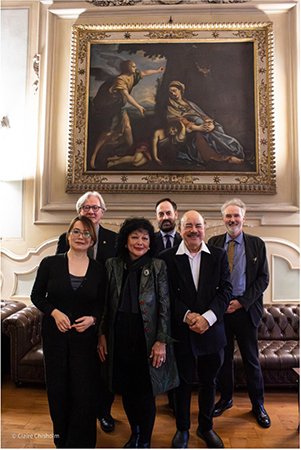
(From Back Left) Francesco Vossilla, Spyridon St. Kogkas, Stefano Baldassarri (Front from Left) Zhang Zheng Ying, Lolita Valderrama Savage, and Virgilio Reyes Jr. at Palazzo Rucellai, October 2025
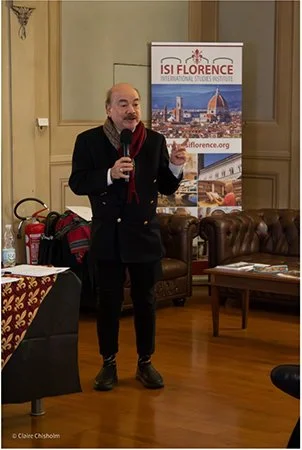
Virgilio Reyes Jr. speaking at the Vittorio Ricci O.P., and Other Missionaries from the Philippines and South China Sea (1500-1800) at Palazzo Rucellai, October 2025
In 1662, Ricci returned to Manila as an envoy on behalf of Koxinga, whose later attempt to invade the Philippines was repelled by Spanish troops and their Filipino allies. Ricci thus came to be viewed—using modern terminology—as a double agent, representing both Spain and China at different points in his career. Being both Italian and a missionary, he embodied the multi-faceted complexity of the 16th-century “clash of cultures.”
Speaking of Italians, it is worth remembering that a forerunner of Vittorio Ricci was Antonio Pigafetta (ca. 1485–1531). Pigafetta left his native Vicenza, in the Veneto, to accompany the Portuguese explorer Ferdinand Magellan to the Philippines in 1521. Because of this experience, Pigafetta produced what is universally regarded as the first detailed chronicle of the Filipinos and their initial encounter with Europeans. A century later, the Philippines had already begun to take on the political and cultural configuration that it largely retains today.
In a nutshell, here is a concise summary of the papers presented at the ISI Florence conference, following the order in which they were delivered:
Gabriele Capecchi traced Florence’s historical links to the Philippines through explorers and naturalists. In particular, he focused on Georg Kamel (1661–1706), the famous Jesuit after whom the camellia flower is named. As is well known, Kamel lived and worked in the Philippines, where he died in Manila on May 2, 1706.
Carlo Cinelli examined Vittorio Ricci’s role as a missionary, cultural mediator, and diplomatic envoy, providing precise and highly informative insights into his life.
Spyridon St. Kogkas explored how the Vatican’s missionary legacy can serve as both a historical reference point and a foundation for contemporary intercultural dialogue and global collaboration. In doing so, Prof. Kogkas highlighted how Filipino cofradías acted as a bridge between the Church and the local community. This helps explain why Filipino devotional festivals today are neither purely European nor purely indigenous, but hybrid expressions of global Catholicism.
Zhang Zheng Ying, a Taiwanese scholar, examined Vittorio Ricci and Angelo Cocchi’s connections with the Philippines, Taiwan, and Ming China.
Francesco Vossilla concluded the sequence with an analysis of Ricci’s diplomatic missions involving Koxinga and the Dutch East India Company.
As for me, in my introductory remarks I noted that the Philippines is today the largest Christian-majority nation in Southeast Asia. Its political and cultural background remains strongly connected to Western powers and their allies in the region. The Philippines is clearly implicated in whatever military and political developments unfold in Southeast Asia, standing face to face with the reinvigorated and emerging power of China and its autonomous neighbor Taiwan, itself an economic power.

Virgilio Reyes Jr. and Lolita Valderrama Savage discussing at the Vittorio Ricci Academic Conference, October 2025
The ISI Florence conference was spearheaded by Prof. Stefano Baldassari, PhD (Director, ISI Florence), with the support of renowned Filipino American artist Lolita Valderrama Savage, whose works have been exhibited in major international venues (including Florence) since the mid-1970s. As a graduate of the University of Santo Tomas, she coincidentally shares a historical connection with Dom Vittorio Ricci, who played a role in its founding some 400 years ago, as noted above.
It was also fitting that a Filipino, the Reverend Gerard Francisco Timoner III, now heads the Dominican Order; his message was read at the conference by another UST alumnus, Father Reynaldo Corsino, who currently serves as pastor to the Filipino community of St. Barnaba in Florence.
On a more personal note, I am happy to add that my visit coincided with two significant events in Florence: the outstanding Beato Angelico exhibit at Palazzo Strozzi and the Museo San Marco, which brought together paintings from diverse locations around the world, and the Florence Biennale, which featured (among others) five Filipino artists. I found it fitting that Fra Angelico’s masterpieces were on display at the same time Filipino religious iconography was being shown at the Fortezza da Basso, the venue of the Florence Biennale. Like Vittorio Ricci, Fra Angelico (1395–1455) was a Dominican; he also began his artistic career in Fiesole, where Ricci was born. This is why he is sometimes known as Giovanni da Fiesole, although his actual birthplace was a small village in the Mugello valley.
Regarding this remarkable exhibit, I was particularly struck by a recent painting at the Santa Maria Novella Perfume Factory by Los Angeles–based British artist David Hockney. In that work, Hockney reinterprets Fra Angelico’s famous Annunciation, using modern techniques to reimagine the fifteenth-century painting through a contemporary lens. From a Filipino perspective, our everyday exposure to retablos in churches and our centuries-old familiarity with Christian imagery make us feel at home with Fra Angelico, whom Pope John Paul II beatified in 1982. It was therefore not surprising to find religious imagery in the Filipino art displayed at the Florence Biennale.
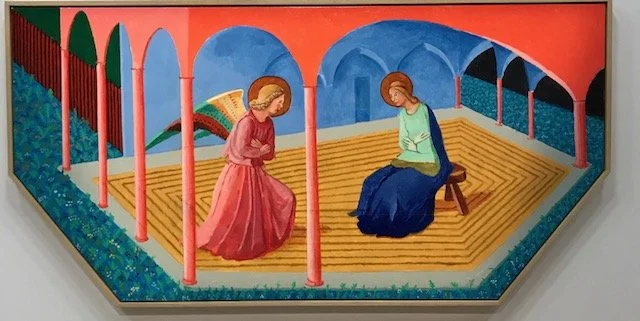
David Hockney’s Annunciation II, after Fra Angelico, 2017 (Source: The Paris Review)
Among the Filipino artists who participated were Noli Principe Manalang, Marco Polo “Marpolo” Coria Cabrera, and Marjowyn Vito. One particularly striking work by Principe Manalang depicted a playing card with female figures as Virgin and Prostitute, and male figures as Benevolent Christ and Tyrant.
I am also glad to report that during my stay in Florence, the local Filipino community (the Mindoreno Association) celebrated the tenth anniversary of its founding on October 18th. Among the participants were Pablo Alvarez, head of the Filipino Association of Florence, and Carlos Simbillo, current Head of the Knights of Rizal in Italy. Many of the Filipinos present at the gathering proudly recounted the professional success of their children, especially in fields such as medicine, graphic design, and computer programming. Their fluency in Italian and the education they have received in public schools have propelled them into these new roles and positions. Their parents have wisely invested in their future retirement through real estate and island resorts managed as Airbnb facilities in Mindoro or La Union. As with any Filipino gathering, food, fun, and song took center stage, with Mindoro Queens and Princesses crowned and honored. This reminded me of the cofradias in the Philippines, which are now embodied as a civic association in Florence by the Mindoro Association of Filipinos.
A visit to Italy – and, particularly, Florence – would not be complete without a foray into its famous cuisine. Among the many local culinary specialties are Florentine beefsteak, crostini, ribollita, and cantucci. Bistecca alla Fiorentina is a thick-cut, bone-in-porterhouse or T-bone steak, traditionally from Chianina cattle, grilled rare over high heat. The steak must be grilled until a seared crust is formed, while the inside remains red and juicy. Crostini originated from the Roman tradition of using bread to gather oils and sauces from communal plates on which food was served. A well-known example is bruschetta, that is, toasted bread with seasoned diced tomatoes on top. Ribollita is a hearty soup made from stale bread that is soaked in water to soften it. It is cooked twice to make it firmer (hence the name) instead of being a simple soup made of bread, legumes and vegetables. A Florentine note is the presence of black bread and beans in the soup; in Italy, Florentines are known for their love for beans. Finally, cantucci from Prato are twice-baked oblong cookies (which is why they are known as “biscuits” in the United States) made of flour, sugar, eggs, and whole almonds. They are normally taken with a sweet wine like Florentine vin santo or Sicilian Marsala. They are similar in shape (and, arguably, in taste) to Filipino lengua de gato.

Florence, Italy (Source: ISI Florence)
Florence would not be Florence were it not forward-looking and, paradoxically, futuristic as well. A trip to Bargino, outside Florence, to the Cantina Antinori nel Chianti Classico brings us close to the Florentine soul and spirit. Here, in the verdant Tuscan countryside, stands a magnificent complex owned by the Antinori family. The Cantina Antinori is at once a winery and a production facility, complete with extensive vineyards, a sports resort, a museum, and a restaurant for visitors.
Designed in 2004 by the architectural firm Archea, under the direction of renowned architect Marco Casamonti, the Bargino complex was completed in 2011. This monumental building, set in the Tuscan hills between Florence and Siena, brings together nature, science, and industry. Its architectural references to the DNA double helix, the rich historical past of the region and of the Antinori family (further underscored by sections of older structures transferred to the site), the cathedral-like passages connecting its various wings, and the dark cellars where wines mature all make the Bargino complex both innovative and evocative.
Because of this experience, Pigafetta produced what is universally regarded as the first detailed chronicle of the Filipinos and their initial encounter with Europeans.
The Antinori family, one of the oldest and most prominent aristocratic families in Florence, produces exquisite wines that delight the palate and accompany the finest Italian dishes to perfection. Under the leadership of Piero Antinori, the family is also known for its patronage of the arts. It is therefore unsurprising that part of the Antinori art collection is displayed within the Bargino complex for public enjoyment.
Finally, since I mentioned cantucci, I should note that during a visit to Bargino one can taste them with a glass of Antinori wine—an indulgence reminiscent of the famous madeleine episode in Proust’s Remembrance of Things Past.
The author (Philippines Ambassador to Italy in 2011-2014) was invited to speak at the International Studies Institute conference in Palazzo Rucellai titled Vittorio Ricci, OP, and Other Missionaries in the Philippines and the South China Sea (1500-1800) on October 21, 2025.

A career diplomat of 35 years, Ambassador Virgilio A. Reyes, Jr. served as Philippine Ambassador to South Africa (2003-2009) and Italy (2011-2014), his last posting before he retired. He is now engaged in writing, traveling and is dedicated to cultural heritage projects.
More articles from Virgilio A. Reyes, Jr.
